

On this page
Astronomer Jill Tarter spent decades looking for a needle in a cosmic haystack. As the former director of the Center for SETI Research, she led the effort to find evidence of extraterrestrial intelligence by scanning the skies for artificial radio signals (Wikipedia).
Her work laid the foundation for how we define and search for "technosignatures" — measurable signs of technology beyond Earth. By pioneering new ways to listen to the universe, she changed how humanity views its place in the cosmos.
What was Project Phoenix?
Between 1995 and 2004, Tarter directed Project Phoenix, the most comprehensive search for extraterrestrial intelligence of its time. Run by the independently funded SETI Institute, the project did not just sweep the entire sky randomly. Instead, it focused on about 800 nearby, Sun-like stars within a 200-light-year range (Project Phoenix)).
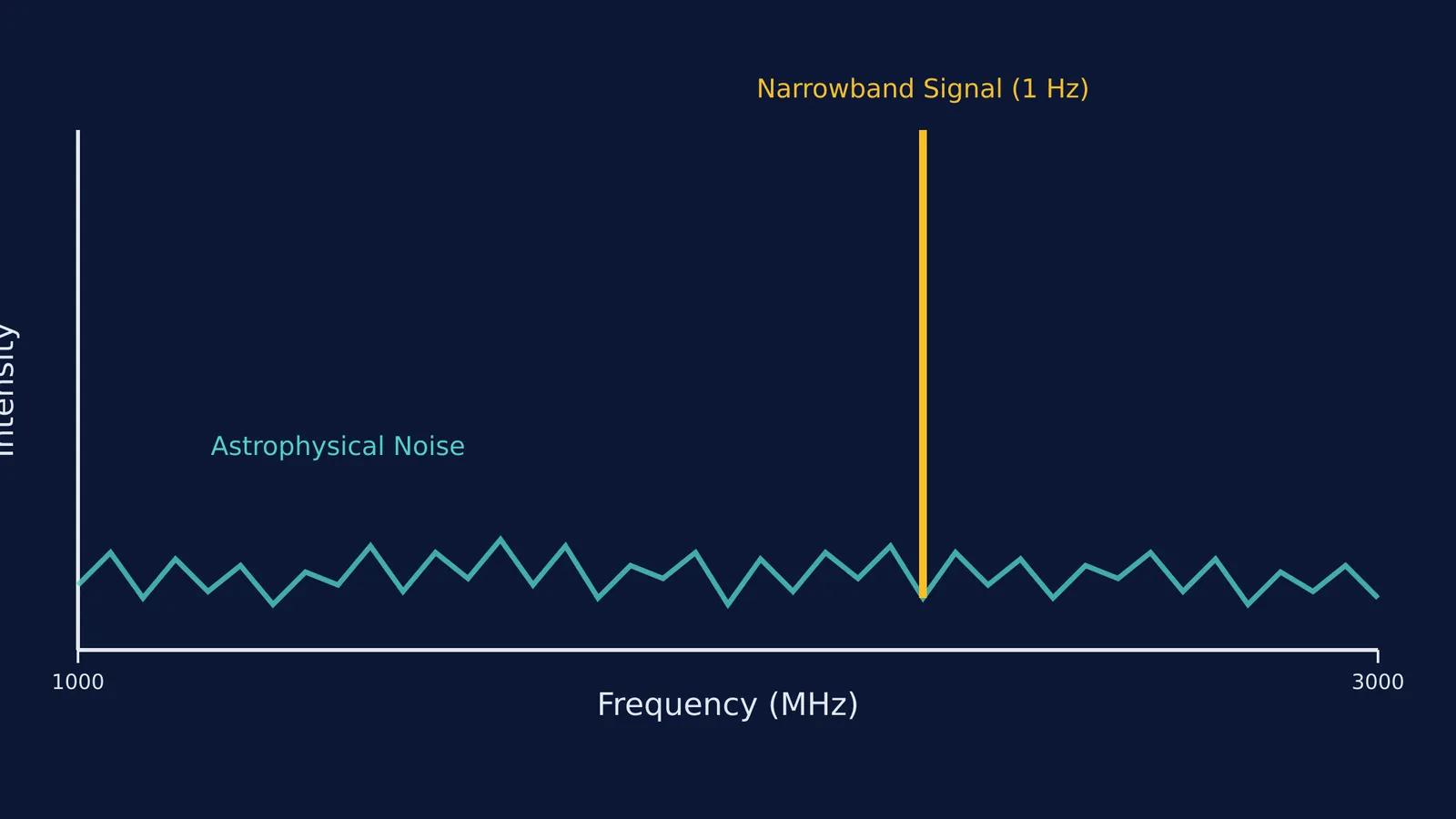
Using major radio telescopes, including the Parkes telescope in Australia and the 140-foot Green Bank telescope in West Virginia, Project Phoenix looked for narrowband radio signals between 1,000 and 3,000 MHz. Natural astrophysical sources like pulsars or quasars produce wideband radio noise, which means their energy is spread out over many frequencies. A signal occupying a very narrow frequency range — as small as 1 Hz — would not happen naturally and would be a strong indicator of an engineered transmitter.
In 2004, after checking all 800 stars on the list, the project concluded without finding an extraterrestrial signal. Project leader Peter Backus remarked that they were forced to conclude that we live in a quiet neighborhood.
How did she shape the search for radio signals?
Tarter's approach to science required immense patience and rigorous data filtering. Early in her career as a graduate student at the University of California, Berkeley, she programmed outdated PDP-8/S computers to process radio data for the SERENDIP project. She also coined the term "brown dwarf" during her 1975 PhD dissertation to describe small-mass objects that fail to stably fuse hydrogen (Wikipedia).
Her systematic methods ensured that false positives, such as human-made satellites or natural radio bursts, were quickly identified and discarded. Because the search space is so large — incorporating different frequencies, locations, and signal types — Tarter and her colleagues had to design automated systems to sift through terabytes of data.
If you want to think like a SETI scientist when tackling a hard physics or maths problem, follow this checklist:
Filter the noise: Identify which information in the question is relevant (the narrow signal) and what is a distraction (the wideband noise).
Rule out false positives: Check your assumptions before leaping to a conclusion. Could this answer just be a unit mismatch or calculation error?
Be patient with null results: If your first method does not yield an answer, it does not mean the problem is impossible. It just means you have successfully ruled out one approach, bringing you closer to the right one.
When you study waves, frequencies and signal processing in physics, the underlying concepts can be difficult to picture. If you are brushing up on displacement and pressure waves in sound, Fermi's AI tutor can work out what you already know and build a plan for your session. It holds a line of reasoning, checking your understanding of wave mechanics as it goes. For step-by-step guidance on calculating things like the number of photons emitted per second by a source, you can use the Fermi Problem Library.
Why does the SETI search matter?
Even without a definitive detection, the methods developed by Tarter's teams drove advances in radio astronomy and signal processing. Her work tracking and archiving previous searches ensures that future astronomers do not duplicate efforts.
Her persistence in the face of null results is a powerful example of the scientific method. As Tarter has often pointed out, the universe is vast, and searching the stars forces us to take a broader perspective on what it means to be human on a fragile planet.


