

On this page
French entomologist Jean-Henri Fabre did not learn about nature by sitting in a library. Instead, he spent decades in his garden, watching wasps, beetles and caterpillars go about their lives. He wrote up his findings in a lively series of books called *Souvenirs Entomologiques*, earning praise from Charles Darwin, who called him an "inimitable observer" (Wikipedia).
Fabre's approach to science was deeply hands-on. By actively observing rather than passively reading, he made discoveries that the textbooks of his time could not offer. For today's students preparing for competitive exams, his method holds a powerful lesson about how we really learn.
Who was Jean-Henri Fabre?
Born in France in 1823, Fabre was largely self-taught. He worked as a teacher but is best remembered as a pioneer in entomology—the study of insects. Rather than writing in the dry, clinical style typical of 19th-century academics, he preferred a biographical approach. He wanted his work to be read "without fatigue", combining a passion for scientific truth with engaging stories of insect behaviour (Wikipedia).
His greatest work, *Souvenirs Entomologiques*, spans thousands of pages of detailed field research. He refused to jump to grand theories, relying instead on what he could see and test himself in the natural world. This dedication to direct observation made his writings not only scientifically rigorous but also highly accessible to the general public.
What did Fabre learn from pine processionary caterpillars?
One of his most famous experiments involved pine processionary caterpillars. These insects instinctively follow the silken trail left by the caterpillar directly in front of them. To test the limits of this instinct, Fabre arranged a group of them in a closed circle around the edge of a pot.
Without a leader to break the loop, the caterpillars simply followed each other in a continuous circle for seven days. It was a vivid demonstration of blind instinct versus active problem-solving. He also noticed that changes in their behaviour could forecast low atmospheric pressure events (Wikipedia).
Why does active learning work better than reading?
Many students fall into the same trap as those caterpillars: they follow a familiar, passive path. They reread textbooks or watch hours of video lectures without stopping to test themselves. But learning science requires you to step off the continuous loop and actively grapple with the material. To see how to apply this to your studies, read How to read a science textbook actively, not just reread it.
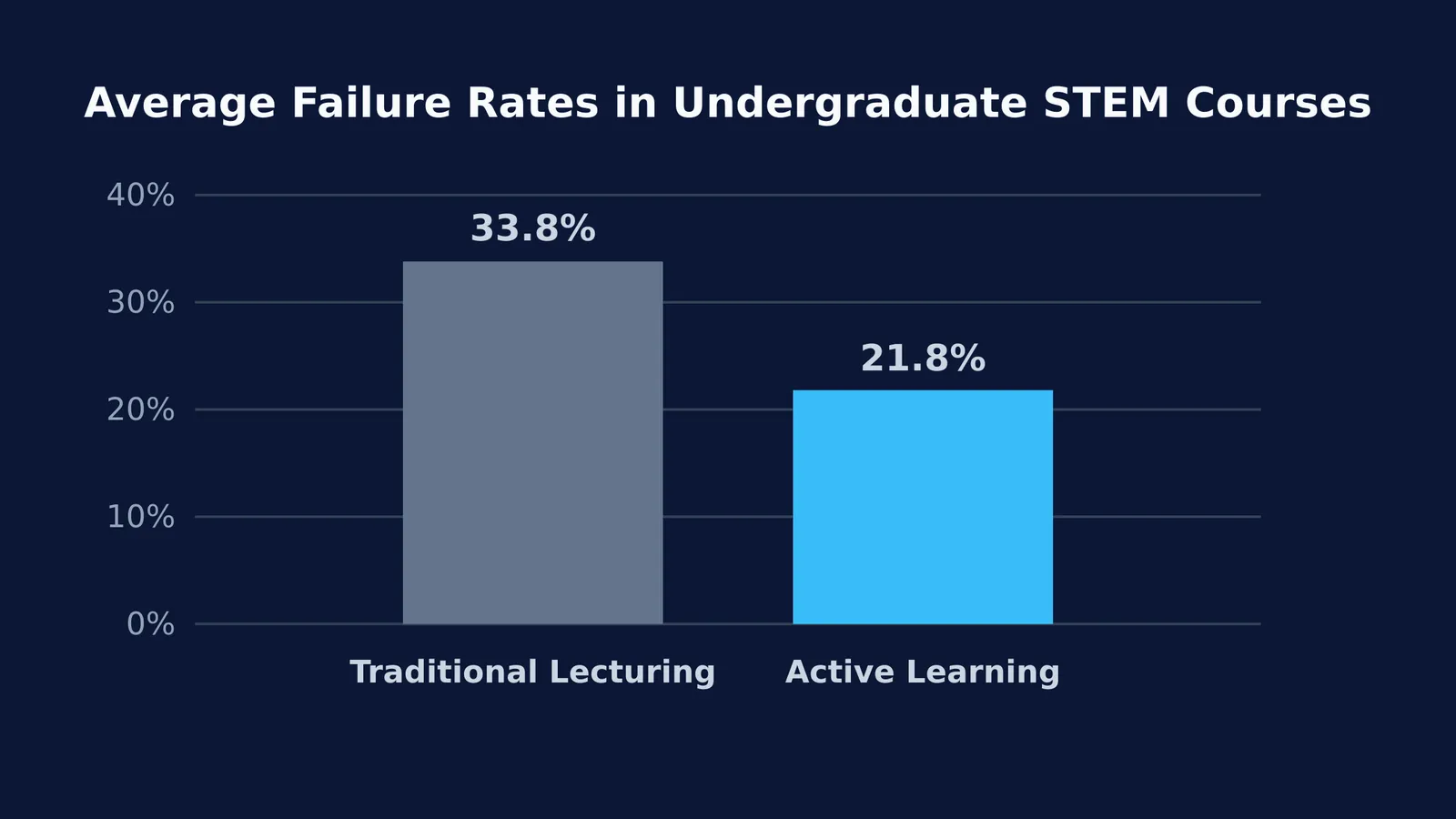
The evidence for active learning is clear. A major 2014 study of undergraduate science, engineering and mathematics courses found that active learning leads to increases in examination performance that would raise average grades by half a letter. The same study found that failure rates under traditional lecturing increase by 55% over the rates observed under active learning (Freeman et al., 2014).
You can dive into the details of this research in What the 2014 Freeman active learning meta-analysis found.
How can you build active study habits?
If you are preparing for exams like JEE or NEET, you cannot afford to be passive. Here is how to apply an active approach to your daily routine:
Test yourself early: Do not wait until you have finished a chapter to try problems. Attempt questions as you go.
Draw it out: Whether it is a free-body diagram in mechanics or a food web in biology, sketching the idea forces your brain to work. Practising NCERT biology diagrams for NEET: draw from memory, then label is a great way to start.
Explain why you are stuck: When you hit a wall, do not just look up the final answer. Fermi's AI tutor teaches rather than answers: it holds a line of reasoning across a session, notices where a student is stuck, and decides whether to explain, ask or show.
Reflect on mistakes: Reviewing where a method went wrong is more valuable than doing ten more identical problems blindly. If you are struggling with physics concepts that are hard to picture, the Fermi Simulation Lab provides interactive simulations for the ideas that are easier to see than to read.
By choosing to be an active observer of your own learning, just as Fabre was of his insects, you build a deeper, more resilient understanding of science. Instead of merely consuming information, you construct knowledge that lasts long after the exam is over.


