

On this page
When the Electronic Numerical Integrator and Computer (ENIAC) was completed in 1945, it was a 30-ton behemoth containing 18,000 vacuum tubes (Source). It was the world's first general-purpose electronic digital computer. But the hardware was only half the battle. To make it run, six women had to figure out how to program it (Source).
Jean Bartik and her five colleagues—Kay McNulty, Betty Holberton, Marlyn Wescoff, Frances Spence, and Ruth Lichterman—became the "Sensational Six" who brought the machine to life. Before the ENIAC, human "computers"—mostly women—calculated artillery firing tables by hand using mechanical desk calculators. A single ballistics trajectory took about 40 hours of painstaking work to complete, a task the ENIAC would later do in 20 seconds (Source). The military needed these tables urgently for World War II, and the ENIAC was designed to automate this exact process. Yet, their greatest achievement was not just running the ENIAC, but figuring out *how* to do it when no one else knew the answer.
How do you program a machine with no manual?
When Bartik and her team were hired, programming languages and operating systems did not exist. Because the project was initially classified, the women were not even allowed to see the hardware right away. They were simply handed a stack of wiring blueprints.
They were given no instruction manuals or handbooks, because none had been written yet (Source). To write a program, they had to understand the machine's internal logic entirely from schematic diagrams, tracing how electrical pulses would flow through the accumulators and multipliers.
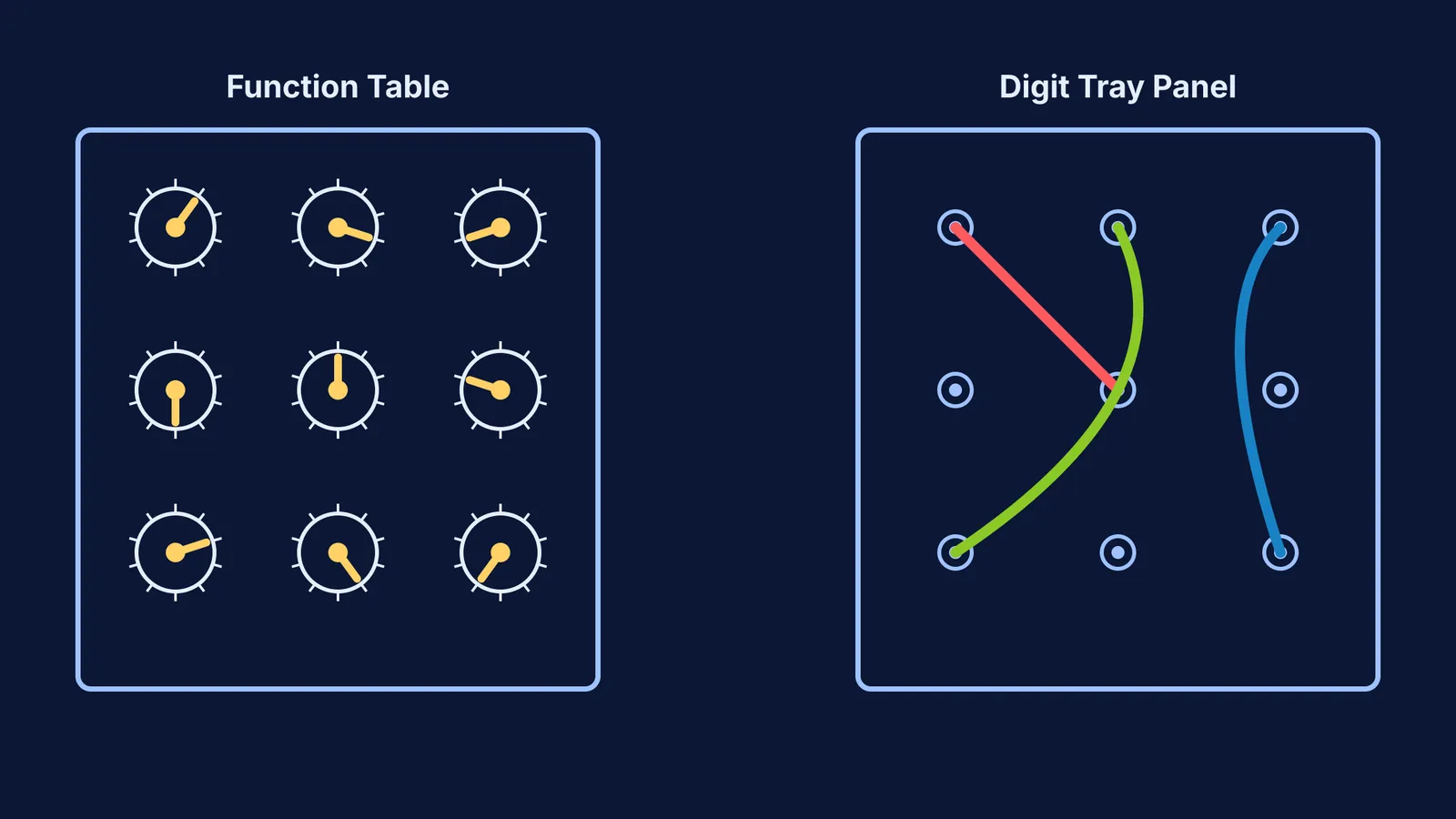
Programming the ENIAC was grueling, physical work. It involved manually setting 3,600 ten-position rotary switches on the function tables to input constants, and plugging heavy black communication cables into digit trays to route data between units (Source). If a calculation failed, debugging meant physically crawling into the machine to trace a wire or find a burnt-out tube.
What can students learn from the ENIAC programmers?
Today, when you hit a wall while studying, the urge is to look for the answer. You might flip to the back of the book or search for the solution. But the ENIAC programmers had no back of the book.
Their method is a perfect example of active learning. Instead of memorising steps, they broke complex differential equations down into the smallest logical components. When you learn the Node potential method: solving circuits by assigning voltages, you are doing something similar: mapping out the physical reality of the circuit before you calculate the numbers.
If you get stuck on a difficult numerical, do what Bartik did. Instead of asking for the final answer, trace the logic from the ground up. This is how Fermi's AI tutor teaches rather than answers: it holds a line of reasoning across a session, notices where you are stuck, and decides whether to explain, ask or show.
Why is the struggle the key to learning?
Because they had to fight to understand the ENIAC's wiring, Bartik and her team developed a deeper mastery of computing than anyone else at the time. They codified foundational concepts like subroutines and nesting. Bartik herself later led the team that converted the ENIAC into a stored-program computer. They didn't just operate the machine; their struggle to learn it laid the groundwork for software engineering.
Much like Margaret Dayhoff and the first protein sequence database, the ENIAC programmers proved that the hardest problems often hide the biggest leaps in understanding.
The next time you face a concept that feels like it has no manual, try taking it apart:
Map it out: Draw the diagram or write the known variables before attempting the math.
Test a piece: Solve one small part of the equation to see if the logic holds.
Debug your steps: If the answer is wrong, do not immediately look up the solution. Walk backward through your working to find the exact line where the logic broke.
When you find the answer yourself, the knowledge stays with you long after the test is over. If you need a structured space to practice this kind of step-by-step thinking, the Fermi Problem Library has a step-by-step solver that explains the reasoning.


