

On this page
In January 2001, Indian astrophysicist Jayant Narlikar led an experiment that tested the upper limits of Earth's biosphere. Collaborating with the Indian Space Research Organisation (ISRO) and the Tata Institute of Fundamental Research (TIFR), Narlikar launched a high-altitude balloon from Hyderabad to collect air 41 km above the ground (Narlikar et al., 2003). The mission aimed to determine whether microscopic life could survive in the freezing, ultraviolet-bathed middle stratosphere.
Why search for life 41 km above the ground?
Atmospheric scientists long assumed viable biology ended at the tropopause, roughly 16 km above tropical latitudes, where temperature stops falling and vertical convection halts. Just as Fabry and Buisson's measurement of the ozone layer showed that ozone absorbs solar ultraviolet light between 20 and 30 km, the stratosphere was considered sterile. With pressure below 3 hPa, temperatures near −70 °C at the tropopause, and intense ultraviolet flux, life seemed impossible. Yet earlier research, following Victor Hess and the balloon flights that found cosmic rays, proved balloons could turn the upper atmosphere into a laboratory. As reported by Narlikar et al. in Astrophysics and Space Science, the team sought to test whether viable microbes existed at 41 km.
How did the balloon gather uncontaminated air at 41 km?
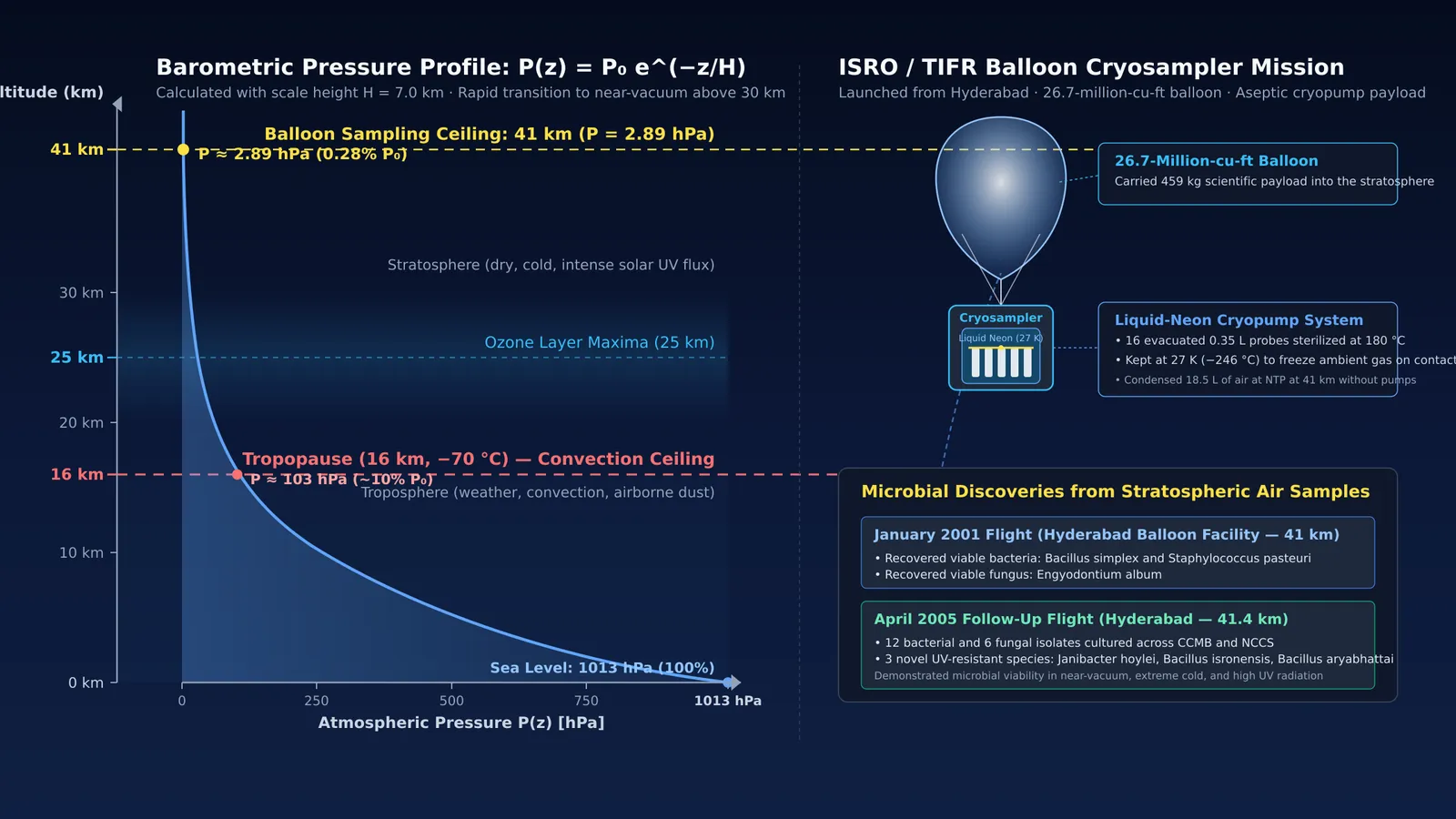
Capturing air at 41 km requires preventing contamination from ground dust or the balloon. The team built a 459 kg payload around an aseptic cryosampler, launched on 21 January 2001 with a 26.7-million-cubic-foot balloon from Hyderabad (Narlikar et al., 2003). The instrument held 16 stainless steel tubes, each with a volume of 0.35 litres. Before launch, tubes were baked at 180 °C, evacuated to ultra-high vacuum, and sealed.
Submerged in liquid neon at 27 K (−246 °C), the probes acted as cryopumps: opening valves between 20 km and 41.06 km froze ambient gases instantly onto the inner walls. At 41 km, one canister condensed 18.5 litres of air at normal temperature and pressure (Wainwright et al., 2003). The motorized valves were resealed before descent, preventing contamination during parachute recovery.
What microbes did the stratospheric samples reveal?
In cleanroom laboratories at Sheffield, Cardiff, and the Centre for Cellular and Molecular Biology (CCMB) in Hyderabad, researchers applied membrane potential-sensitive dyes to detect living cells (Wainwright et al., 2003). The team cultured three organisms from 41 km: two bacteria (*Bacillus simplex* and *Staphylococcus pasteuri*) and a fungus (*Engyodontium album*).
A second flight on 20 April 2005 from Hyderabad isolated 12 bacterial and 6 fungal isolates. As reported by Shivaji et al. in the International Journal of Systematic and Evolutionary Microbiology, three bacteria were novel species showing extraordinary ultraviolet resistance:
*Janibacter hoylei*, named after cosmologist Sir Fred Hoyle
*Bacillus isronensis*, named in honour of ISRO
*Bacillus aryabhattai*, named after the ancient astronomer Aryabhata
Why did the discovery fuel the panspermia debate?
Finding living cells 25 km above the tropopause ignited debate (Narlikar et al., 2003). Narlikar, Hoyle, and Chandra Wickramasinghe argued that because the tropopause blocks vertical mixing, these microbes could represent cometary panspermia—extraterrestrial biology entering Earth from space. Other scientists favoured terrestrial origins, linking the debate to Alexander Oparin and the primordial soup theory. They suggested violent storms or volcanic plumes could occasionally loft hardy spores into the stratosphere.
Worked physics: how much did air pressure fall at 41 km?
Why use liquid neon instead of a mechanical pump? In their analysis of stratospheric conditions (Narlikar et al., 2003), the team had to account for how atmospheric pressure P falls exponentially with altitude z: P(z) = P₀ × e^(−z / H)
Using sea-level pressure P₀ = 1013 hPa and scale height H ≈ 7.0 km:
Altitude ratio: z / H = 41 km / 7.0 km ≈ 5.86.
Exponential factor: e^(−5.86) ≈ 0.00285.
Stratospheric pressure: P(41 km) ≈ 1013 hPa × 0.00285 ≈ 2.89 hPa.
At 2.89 hPa, air pressure is under 0.3% of sea level (Narlikar et al., 2003). Mechanical pumps stall in such low density and risk oil contamination. Liquid-neon cryopumping froze thin air directly into solid condensates at 27 K without moving parts.
How can students explore atmospheric physics and biology?
Connecting atmospheric pressure decay with cellular biology requires linking fluid mechanics, thermodynamics, and microbiology. When revising these topics, the Fermi Concept Library maps every concept in physics, chemistry, biology, mathematics and computing, letting you see how gas laws link to atmospheric structure.
To picture how air density drops and temperature inverts, the Fermi Simulation Lab provides interactive simulations for ideas that are easier to see than to read. When working through exponential decay numericals, Fermi's AI tutor can work out what you already know and build a plan for the session, guiding your reasoning step by step.


