

On this page
Every modern smartphone, laptop, and hearing aid relies on a tiny, inexpensive component to capture sound. Before 1962, capturing high-quality audio required bulky equipment and heavy power supplies. That changed when a pair of scientists figured out how to trap a permanent electrical charge inside a thin piece of plastic.
Who invented the electret microphone?
James E. West, born in Virginia in 1931, developed a fascination with electricity early in his childhood. Despite the limited opportunities for Black scientists at the time, he pursued a degree in physics at Temple University. In 1957, he joined Bell Laboratories as an acoustical scientist (Johns Hopkins University).
At Bell Labs, West teamed up with his colleague Gerhard Sessler to solve a problem with standard condenser microphones. Traditional microphones used two metal plates acting as a capacitor to convert sound waves into an electrical signal. However, they required a high-voltage direct current (DC) power supply to keep the plates charged, making them large and expensive.
In 1962, West and Sessler invented the foil electret microphone. They replaced the heavy power supply with a thin polymer film—an "electret"—that carried a permanent electrostatic charge.
The invention was a massive success because of its high fidelity, durability, and low cost. Today, approximately 90% of the 2 billion microphones manufactured annually are based on the electret design (National Inventors Hall of Fame). Beyond his technical achievements, West spent his 40-year career at Bell Labs advocating for diversity in STEM and creating summer research programs for minority students.
How does a foil electret microphone work?
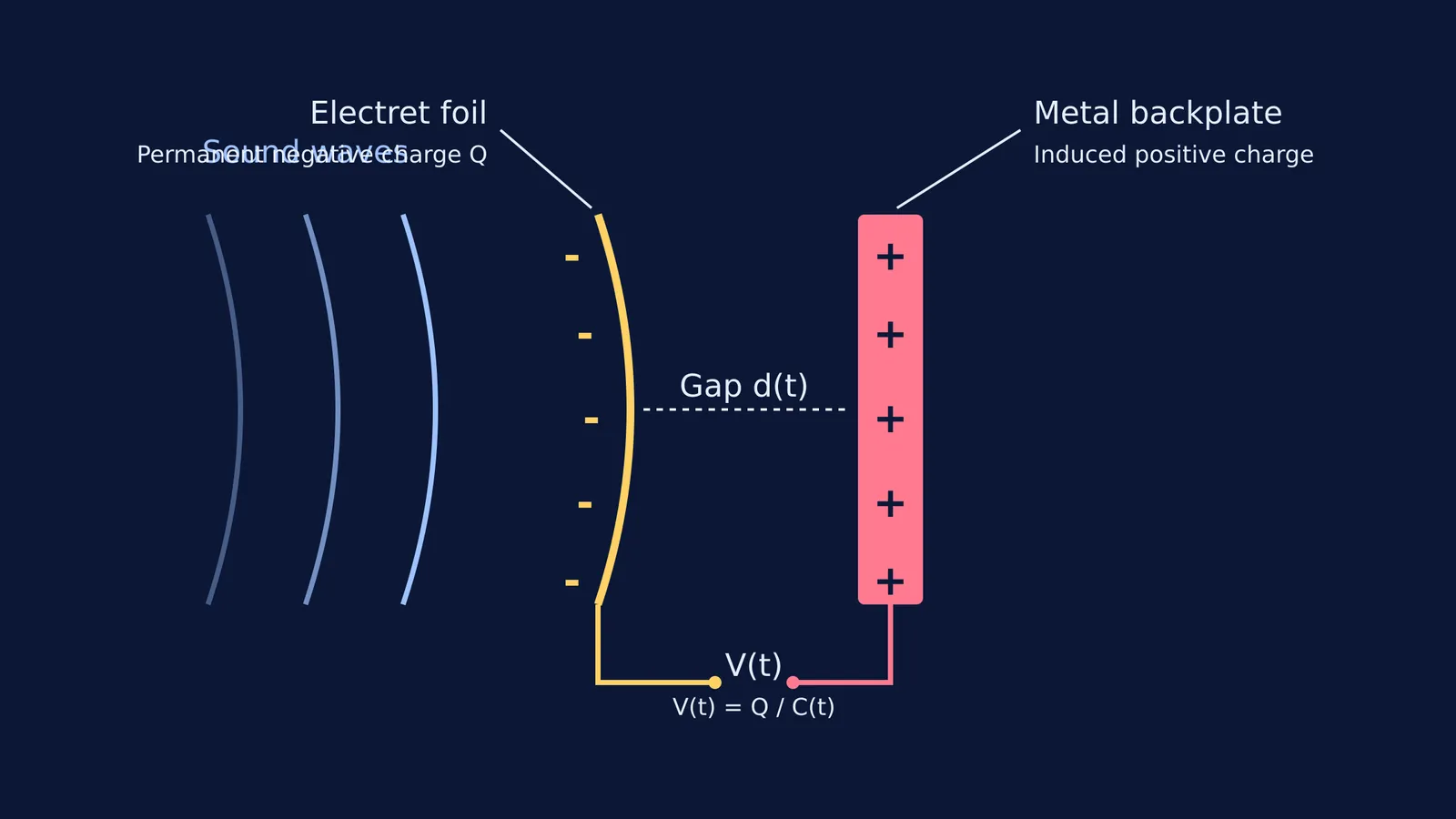
The electret microphone is a brilliant application of variable capacitance. It consists of two main parts separated by a tiny air gap:
The diaphragm: A thin, permanently charged electret foil that vibrates when sound hits it.
The backplate: A stationary metal plate.
Together, these form a parallel-plate capacitor. The capacitance C of a parallel-plate capacitor is given by the formula C = εA / d, where ε is the permittivity of the air gap, A is the area of the plates, and d is the distance between them.
When you speak, the sound waves create pressure fluctuations that push and pull the thin foil diaphragm. This causes the distance d to change rapidly in time with the sound.
Because the electret material holds a constant charge Q, any change in the capacitance C must result in a change in the voltage V across the plates, following the fundamental equation Q = CV.
For example, if a sound wave pushes the diaphragm inward, halving the distance d, the capacitance C doubles. Since the charge Q is trapped in the foil and cannot change, the equation V = Q / C tells us the voltage V must halve. As the diaphragm vibrates back and forth, the fluctuating voltage creates an exact electrical copy of the original sound wave.
Because the signal produced has an extremely high impedance (high voltage but almost zero current), a small junction field-effect transistor (JFET) is built into the microphone to lower the impedance so the signal can travel through wires without degrading.
How can you learn physics from everyday devices?
The electret microphone is a perfect example of how abstract physics equations translate into everyday technology. If you are studying electrostatics, you can use the Fermi Concept Library to explore every concept in physics and see its place in the map.
Once you understand the parallel-plate model, you can step up to deriving the capacitance of spherical and cylindrical capacitors or calculating the energy density in an electric field. If you get stuck on the mathematics, Fermi's AI tutor can work out what you already know, build a plan for the session, and teach through the problem by writing on a board and checking your understanding as it goes.


