

On this page
The water wheel was the engine of the early industrial revolution. But by the 1840s, textile mills needed more power from the same rivers. In Lowell, Massachusetts, an engineer named James B. Francis applied rigorous scientific testing to the problem. Working as the head engineer for the Proprietors of Locks and Canals on the Merrimack River, he spent years moving turbine engineering from rule-of-thumb guesswork to a strict mathematical discipline. In 1848, he developed an inward-flow reaction turbine that captured both the pressure and the velocity of the water.
How did James Francis invent the turbine?
Before Francis, turbines were often built by trial and error. Francis built upon earlier outward-flow and inward-flow designs by adding careful mathematical and graphical calculations to match a turbine to its specific water flow and pressure head.
To prove his designs, he conducted what became known as the Lowell hydraulic experiments. He used a Prony brake to measure the exact mechanical power output on the turbine's shaft, and he refined the use of weirs to calculate the volume of water flowing through the system.
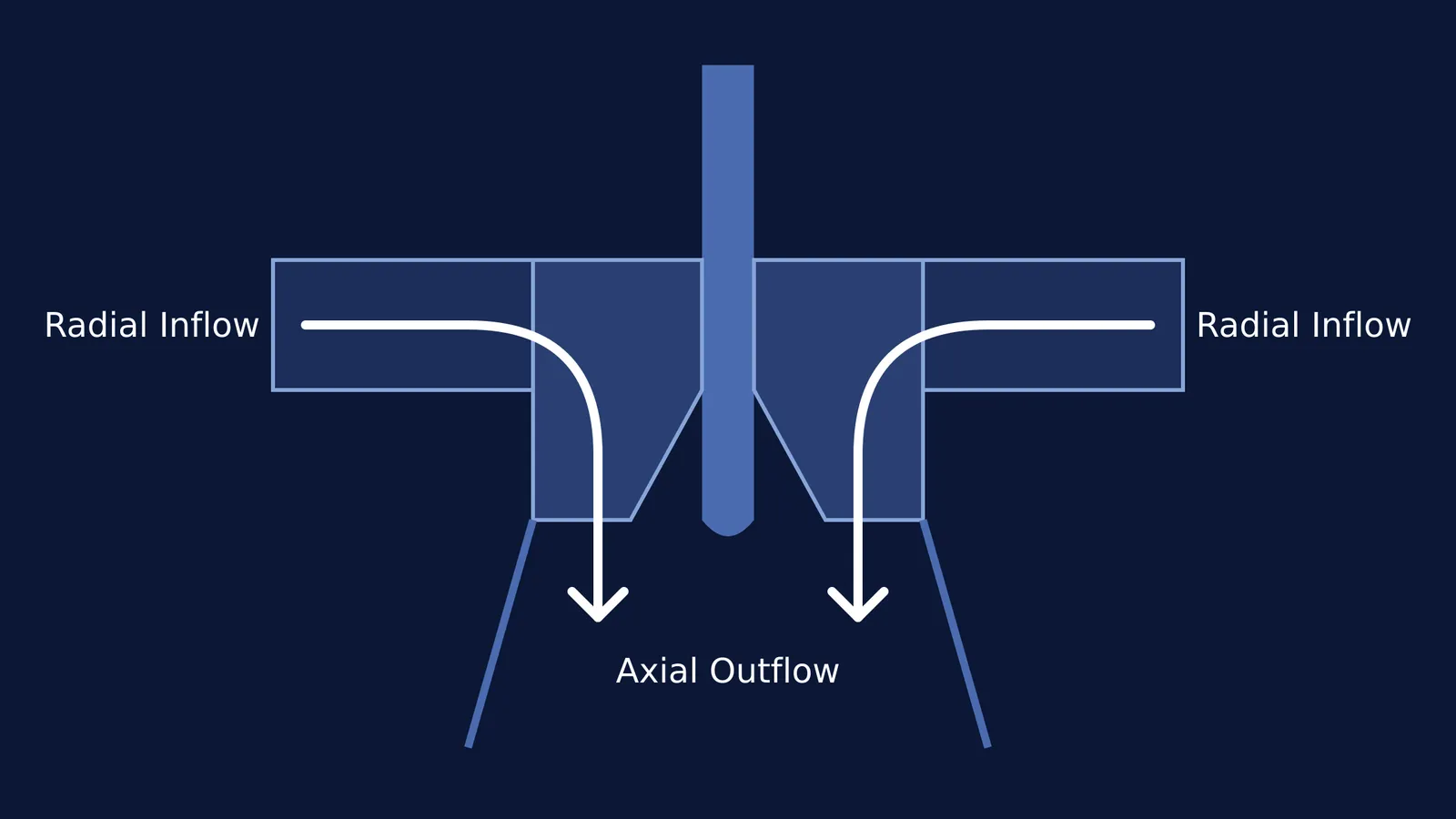
His resulting design, which became known as the Francis turbine, achieved an unprecedented efficiency of over 90%, with some modern units reaching 99%. Instead of water just falling onto flat paddles, the water in a Francis turbine enters radially from the outside, pushes against curved blades, and exits axially down the centre.
Understanding the mathematics of fluid flow and pressure changes inside a machine can be tricky. The Fermi Concept Library contains step-by-step lessons on every concept in physics, making it easier to grasp the forces that drive these turbines.
How does a Francis turbine work?
The Francis turbine is a reaction turbine. This means it generates power from the combined forces of pressure and moving water, unlike a simple impulse turbine that relies purely on a jet of water striking a bucket.
Water enters through a spiral casing, which acts like a snail shell to distribute the water evenly. It then passes through adjustable guide vanes that direct the water onto the runner at the perfect angle. The runner's curved blades extract the energy, and a draft tube at the exit recovers pressure.
If you are solving a fluid mechanics problem about turbines, use this checklist to set up your equations:
Identify the turbine type: Is it an impulse turbine (using only velocity) or a reaction turbine (using both pressure and velocity)?
Check the flow path: For a Francis turbine, remember that water enters radially and exits axially.
Account for the draft tube: Do not forget the pressure recovery at the exit when calculating the net work done.
Why are Francis turbines so common in India?
Today, the Francis turbine is the most widely used water turbine globally, typically operating at a head range of 40 to 600 meters. This makes it perfectly suited for the large dams built across India's major rivers.
At the Bhakra Dam, two powerhouses use ten massive Francis turbines to deliver a combined capacity of 1,325 MW. Similarly, the underground River Bed Power House at the Sardar Sarovar Dam relies on six 200 MW Francis pump-turbines to generate power while also offering energy storage.
The principles behind these massive machines show up across the physics syllabus. To see how fluids amplify force, read about Pascal's law in hydraulic machines, or explore how that power reaches your home with Edith Clarke and the calculator for power transmission lines.


