

On this page
Your immune system constantly patrols your body to identify and destroy foreign invaders and abnormal cells. The foot soldiers of this system are the T cells. However, this destructive power must be carefully controlled so that T cells do not attack your own healthy tissues. To prevent this, the immune system has built-in checkpoints that act as brakes.
For decades, scientists tried to treat cancer by pressing the accelerator—attempting to stimulate the immune system to attack tumours. James P. Allison took the opposite approach: he decided to cut the brakes.
What is the CTLA-4 brake on T cells?
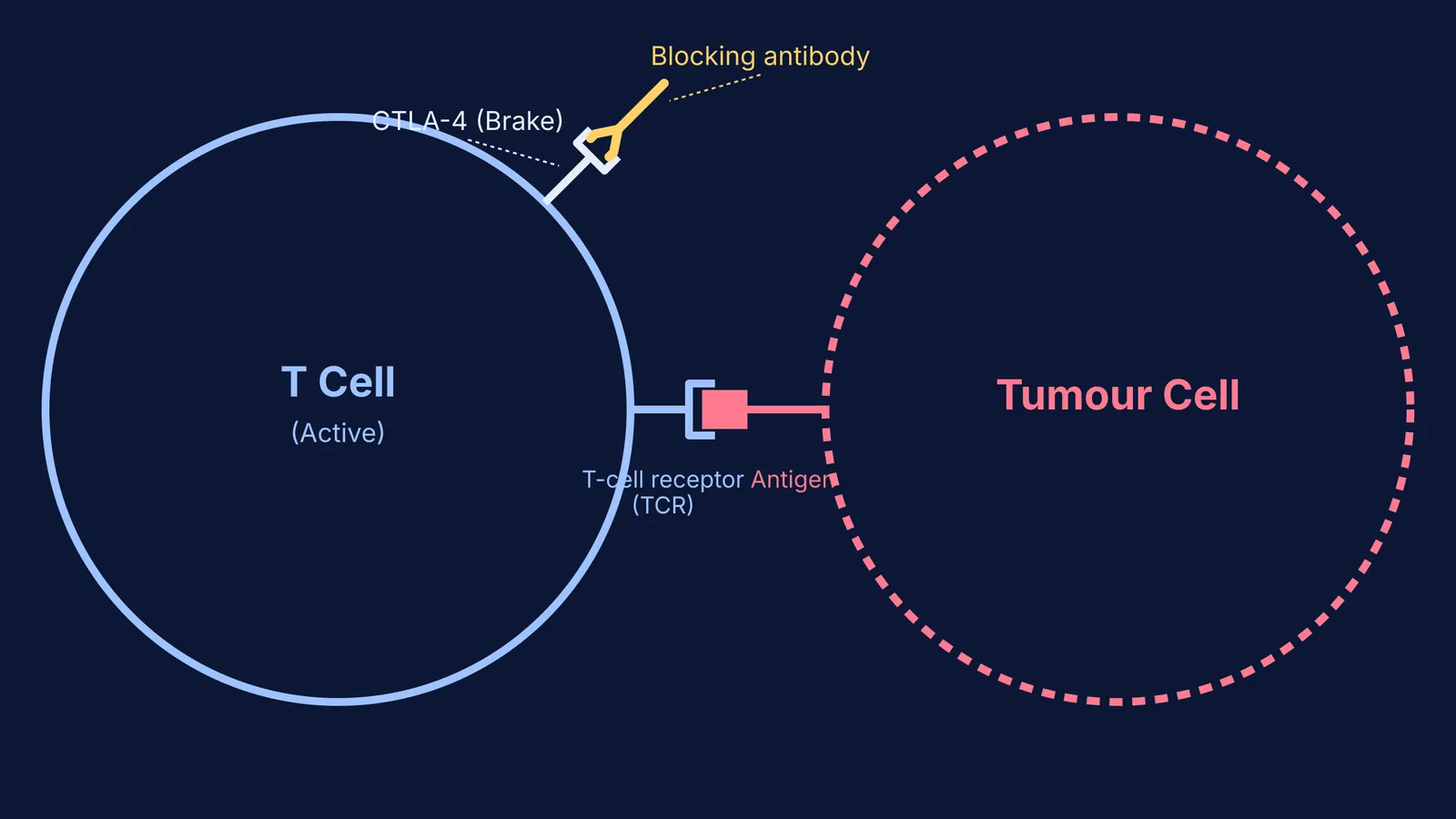
T cells require a two-step verification process to launch an attack. First, the T-cell receptor (TCR) must recognise a specific antigen on a target cell. Second, a costimulatory signal confirms that the target is indeed a threat.
But there is a catch. T cells also produce a protein called CTLA-4 (cytotoxic T-lymphocyte-associated protein 4). CTLA-4 acts as an "off" switch. When it binds to certain molecules on other cells, it shuts down the T cell's activity. This is essential for preventing autoimmune diseases, but cancer cells often exploit this mechanism. By keeping the CTLA-4 brake engaged, tumours can quietly evade the immune system and continue to grow.
You can read more about how T cells mature and learn to distinguish friend from foe in our article on Jacques Miller and the role of the thymus in immunity.
How did James Allison free the immune system against cancer?
While working at the University of California, Berkeley, Allison suspected that blocking CTLA-4 might free the immune system to destroy cancer cells.
In a paper published in the journal *Science* in March 1996, Allison and his colleagues Dana R. Leach and Matthew F. Krummel tested this idea. They administered antibodies that physically blocked the CTLA-4 receptor in mice. The paper reported that this blockade resulted in the rejection of pre-established tumours in the mice. Furthermore, the mice developed immunity to secondary exposures of the tumour cells.
Instead of targeting the cancer directly with radiation or toxic chemicals, Allison targeted the immune system itself. This approach is known as immune checkpoint therapy.
What is immune checkpoint blockade?
Immune checkpoint blockade has created a new approach to treating cancer. Following Allison's foundational research, a drug called ipilimumab was developed to block CTLA-4 in humans. In March 2011, the US Food and Drug Administration approved ipilimumab for the treatment of advanced melanoma, a skin cancer.
For his discovery of cancer therapy by inhibition of negative immune regulation, James Allison shared the 2018 Nobel Prize in Physiology or Medicine.
The behaviour of T cells is also central to understanding other diseases; for instance, you can explore How HIV replicates: reverse transcription and helper T cell loss. If you find the complex interactions of immune cells and receptors hard to picture, the Fermi Simulation Lab provides interactive simulations for the ideas that are easier to see than to read.
How do you study complex biological pathways?
When learning about systems like immune regulation, students often get lost in a sea of acronyms. To master these topics for your exams, use this three-step framework:
Identify the baseline state: Ask what the system does when nothing is wrong. For T cells, the baseline is a careful balance of activation and inhibition.
Trace the pathway: Map out the sequence of events. Draw a flow chart showing how the T-cell receptor recognizes an antigen, and how CTLA-4 steps in to apply the brake.
Introduce the disruption: What happens when a disease or a drug changes the system? In this case, the antibody blocks CTLA-4, preventing the brake from engaging.
Drawing out the pathway yourself forces you to connect the pieces. If you run into a concept gap while trying to map out a biological pathway, the Fermi Concept Library has every concept in physics, chemistry, biology, mathematics and computing, each with its own lesson and its place in the map. And if you are not sure where to start with a new topic, Fermi's AI tutor works out what you already know and builds a plan for the session.


