

On this page
The Persian polymath Avicenna (980–1037 CE), known in the Islamic world as Ibn Sina, was a master of medicine, philosophy, and mathematics. But when he looked out at the rugged landscapes around him, he asked a question that would not be formally answered in Europe for hundreds of years: how did these mountains get here?
His monumental scientific encyclopedia, *The Book of Healing* (1027), contains a detailed section on natural sciences, including mineralogy and meteorology. Within these pages, Ibn Sina outlined a framework for understanding the Earth that anticipated the core principles of modern geology. He did not just catalogue different types of rocks; he sought to explain the dynamic physical forces that shape the Earth over vast stretches of time, using fossils and rock strata as evidence.
How do mountains form?
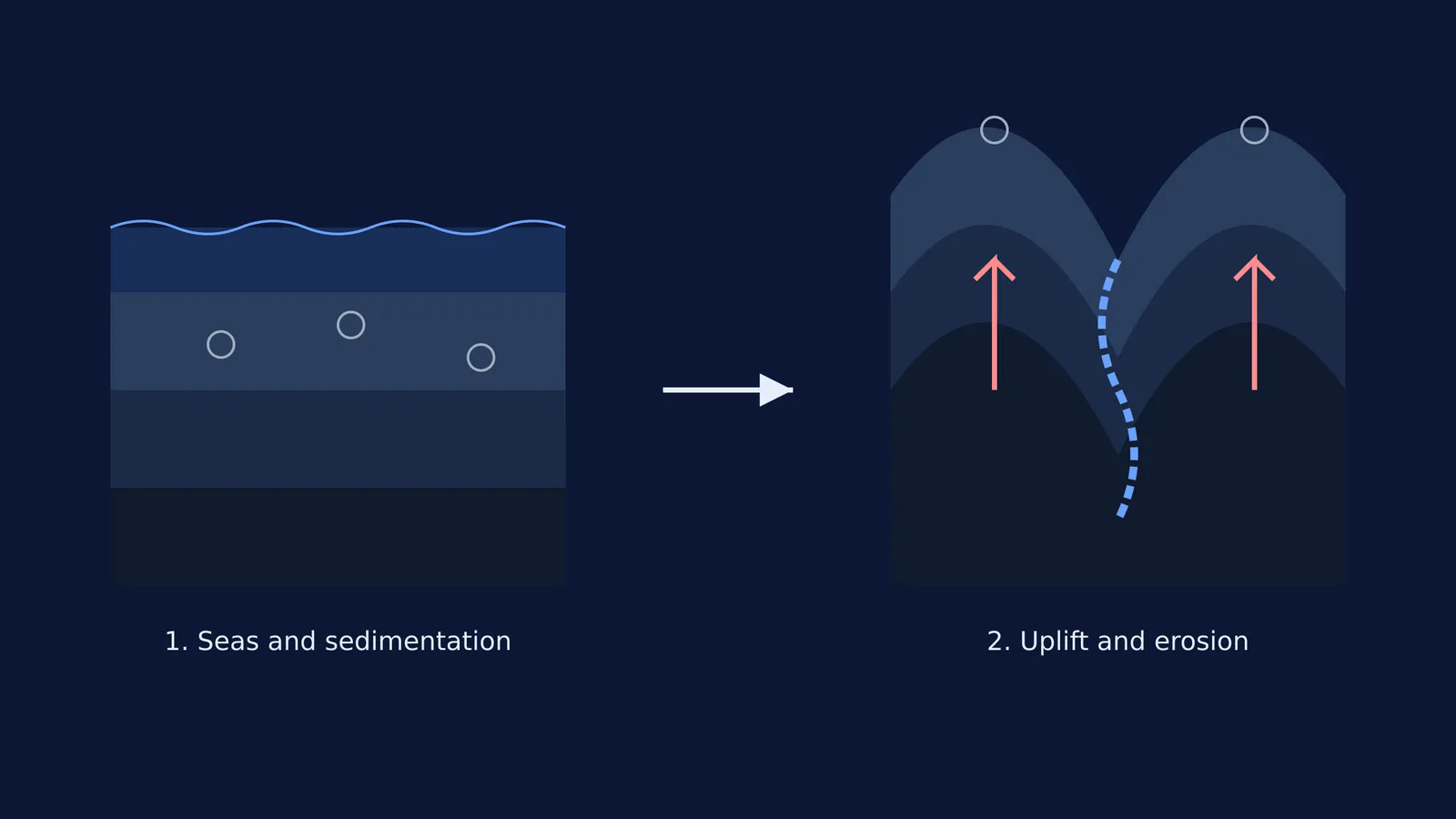
Ibn Sina rejected the idea that mountains were static, unchanging features of the world. Instead, he proposed that they are built and destroyed by continuous natural processes. He identified two primary causes for mountain formation:
Uplift: He suggested that mountains could be formed by upheavals of the Earth's crust, such as the violent forces released during earthquakes.
Erosion: He observed that running water cuts new routes through the land, eroding softer earth into valleys and leaving behind harder rock strata as standing peaks.
He understood that these processes were not instantaneous. He argued that the excavation of valleys and the raising of land took a very long time, pointing toward the modern geological concept of "deep time". (To understand the modern forces behind these crust upheavals, read about Arthur Holmes and the convection currents inside the Earth.)
For ideas that are easier to see than to read, such as tectonic shifts and the slow erosion of landscapes, you can run interactive models in the Fermi Simulation Lab.
What are fossils and how do they form?
When Ibn Sina looked at fossils, he faced a philosophical problem. Aristotle, whose work Ibn Sina deeply respected, had suggested that fossils grew within the rock due to vaporous exhalations. Other medieval scholars believed they were merely rocks that happened to look like animals, or the result of spontaneous generation.
Ibn Sina rejected these mystical ideas in favour of a chemical mechanism. When he examined high-altitude limestone, he found fossilised sea shells. From this, he correctly deduced that the peaks of these mountains must have once been submerged under ancient seas.
To explain how they turned to stone, he proposed the theory of petrifying fluids (*succus lapidificatus*). He theorised that when organic remains came into contact with a powerful mineralising virtue—often released during earthquakes or found in specific mineral-rich waters—they were converted into stone over time without losing their original shape. This observation of life leaving a permanent physical mark on the Earth is a key milestone in science, later echoed by thinkers like Vladimir Vernadsky and the biosphere.
How did he read rock strata?
Ibn Sina observed that the Earth's crust is often composed of different strata, or layers. Rather than seeing these layers as a single, uniform block of stone, he noticed that some strata were soft and others were hard.
He reasoned that running water cut through the softer layers to carve out valleys, while the harder rock remained standing as mountain peaks. By looking at a mountain face, he realised that the Earth itself kept a physical record of its history. He understood that these geological changes, from the upheaval of the crust to the slow carving of valleys, occurred over a long period of time.
How can you observe like Ibn Sina?
Ibn Sina’s discoveries came from active, systematic observation. You can apply his framework of questioning to your own science studies. When encountering a complex natural phenomenon or a difficult physics problem, use this checklist to break it down:
What is the current state? (e.g., "There are sea shells inside this mountain rock.")
What physical process could cause this? (e.g., "The rock must have once been underwater, and a mineral process turned the shells to stone.")
How much time would that take? (e.g., "The sea drying up and the land rising must have taken ages.")
Can I see this process happening now? (e.g., "Water is eroding the riverbank today, just as it eroded valleys in the past.")
By asking *how* and *why* instead of just memorising *what*, you can uncover the underlying rules of the natural world, just as Ibn Sina did a thousand years ago. His ability to connect small observations, like the shape of a fossil or the hardness of a rock layer, to the massive forces shaping the planet laid the groundwork for the Earth sciences. Today, we continue to build on this foundation by observing the world closely and questioning how it came to be.
When you are studying complex, interconnected systems like Earth's history, simply reading facts is rarely enough. Fermi's AI tutor works out what you already know, builds a plan for the session, and teaches through it — writing on a board, drawing the figure, running the simulation, and checking understanding as it goes.


