

On this page
In 11th-century Al-Andalus, the Arab Muslim botanist and agronomist Ibn Bassal created the *Hā’īṭ al-Sultān* botanical garden in Seville. Originally based in Toledo, he moved to Seville after Alfonso VI conquered Toledo in 1085. He travelled extensively on pilgrimage to the Hejaz, visiting Egypt, Sicily, Syria, and regions stretching from Yemen to India. He returned with a wealth of agronomic knowledge and seeds, including knowledge of cotton cultivation, which he cultivated and studied. Source
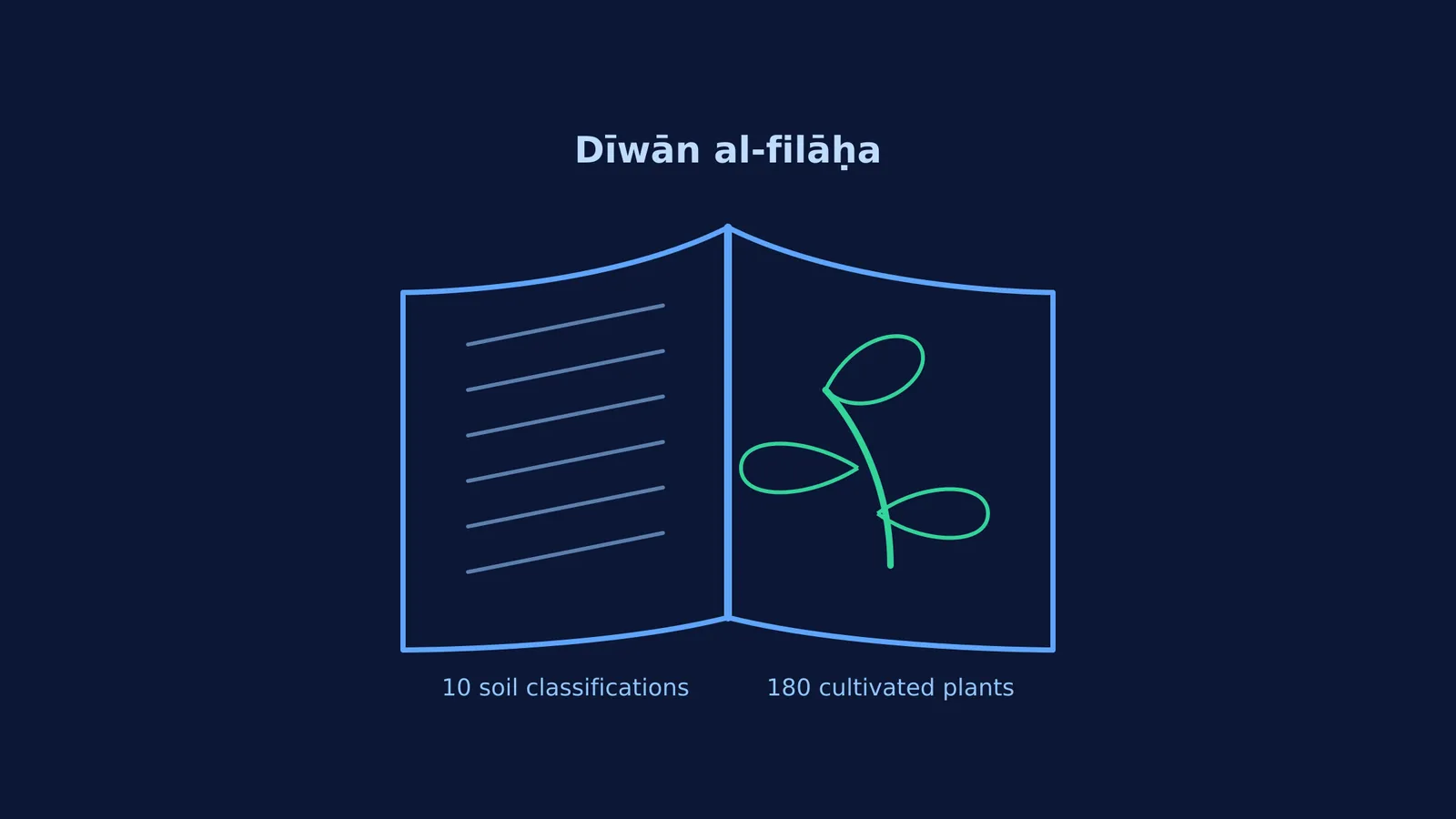
His life's work culminated in the *Dīwān al-filāḥa* (An Anthology of Husbandry). Originally dedicated to the botanical garden of Al-Ma'mūn at Toledo, it was a practical agriculture book that recorded his own systematic experiments rather than relying on previous texts. Source
What was in Ibn Bassal's agriculture book from Toledo?
The *Dīwān al-filāḥa* was a practical and systematic guide that transformed farming in the region. Ibn Bassal detailed the care and propagation of over 180 cultivated plants. He listed staples like chickpeas, rice, and sesame, alongside herbs and spices such as cumin and coriander. He also covered vegetables requiring plentiful watering, such as cucumbers, melons, pumpkins, and eggplant. Source
He extensively covered arboriculture, detailing how to propagate the palm, olive, pomegranate, quince, apple, fig, and orange, among dozens of other trees.
He also wrote a separate treatise called *The Classification of Soils*, which divided soil fertility into ten distinct classifications. Source This rigorous approach helped farmers match the right crops to the right ground, a crucial step in the Arab Agricultural Revolution.
To support these plants, his book provided precise recipes for manure and compost. He noted that the excessive heat and moist qualities of pigeon dung worked well for weaker plants in cold temperatures, while human waste was better for hot temperatures because it lacked heat. Pig dung, on the other hand, he warned would destroy pastures and poison plants. Source
Compost made without manure—using herbage, straw, oven ashes and water—was also catalogued but considered less desirable. Just as chemists centuries later would codify the law of the minimum for crops, Ibn Bassal's 11th-century classifications laid a scientific groundwork for managing soil chemistry.
How did Ibn Bassal improve irrigation?
The agricultural boom in the Islamic Golden Age relied heavily on advanced irrigation to extend the growing season and increase productivity. Source A key piece of this puzzle was the *noria*, a hydropowered scoop wheel that lifted water from a river into an aqueduct, and the animal-powered *saqiyah*. Source
Ibn Bassal made a critical mechanical breakthrough for these systems: he invented the flywheel mechanism to smooth out the delivery of power from a driving device to the driven machine. Source By pioneering the flywheel in the *noria* and *saqiyah*, he made water-lifting far more efficient, allowing cities and vast agricultural fields to receive a steady, reliable water supply.
These wheels operated on an immense scale. In the 10th century, a *noria* in Iraq was recorded as lifting 153,000 litres of water per hour. By the height of the era, the rice plantations of Valencia were said to have 8,000 *norias*, while Mallorca operated over 4,000 animal-driven *saqiyas*. Source This widespread mechanisation supplied water for cities as well as agriculture, supporting a boom in urbanisation and population growth.
What did the agricultural revolution teach about crop rotation?
Agronomists of the era, including Ibn Bassal and the 12th-century writer Ibn al-'Awwam, developed sophisticated techniques to keep the soil fertile year after year. They introduced the crop rotation of flax with wheat or barley, and practiced companion planting of grapes and olives. Source
This systematic approach turned agronomy into a scholarly science. The almanacs and manuals of the time catalysed real change, prompting farmers to seek out new crops—from citrus fruits to sugar cane—and carry out botanical experiments. If you are studying modern agriculture or biology, mastering concepts like arithmetic vs geometric growth in plants helps explain the yields these historical farmers were trying to maximise.
For students today looking to grasp the science behind such historical shifts—from the biology of roots to the physics of a flywheel—Fermi's AI tutor teaches by holding a line of reasoning across a session, noticing where you are stuck, and deciding whether to explain, ask, or show. If a mechanical concept like torque or power delivery is hard to picture, you can explore it interactively in the Simulation Lab.


