

On this page
In short Christiaan Huygens was the first to derive the centripetal force formula mv²/r in his 1659 treatise De Vi Centrifuga. He found it by comparing the distance an object on a circle falls away from its tangent line to the distance a body falls under gravity.
Who first found the centripetal force formula?
Before Isaac Newton published his universal laws of motion and gravitation, scientists were already trying to understand why objects moving in a curved path do not fly away. The Dutch physicist and astronomer Christiaan Huygens first derived the mathematical formula for this required force in 1659.
Huygens named this tendency *vis centrifuga*, or centrifugal force, focusing on the outward pull an object exerts on whatever is holding it in the circle. He worked out that to keep an object of mass m moving at a constant speed v in a circle of radius r, the restraining force required is exactly F = mv²/r. This has the same magnitude as the inward pull we now call centripetal force, a term Newton introduced later when he reframed the problem from the perspective of an inertial observer looking inward.
Huygens's discovery was foundational. It helped him understand pendulums and improve the accuracy of pendulum clocks by understanding exactly how the period of oscillation relates to the force of gravity. It also paved the way for Newton's later realization that gravity itself must follow an inverse-square law to keep planets in their orbits.
How did Huygens prove it geometrically?
Huygens did not have the modern tools of differential calculus or vectors. Instead, he used a brilliant geometric comparison with Galileo's law of falling bodies.
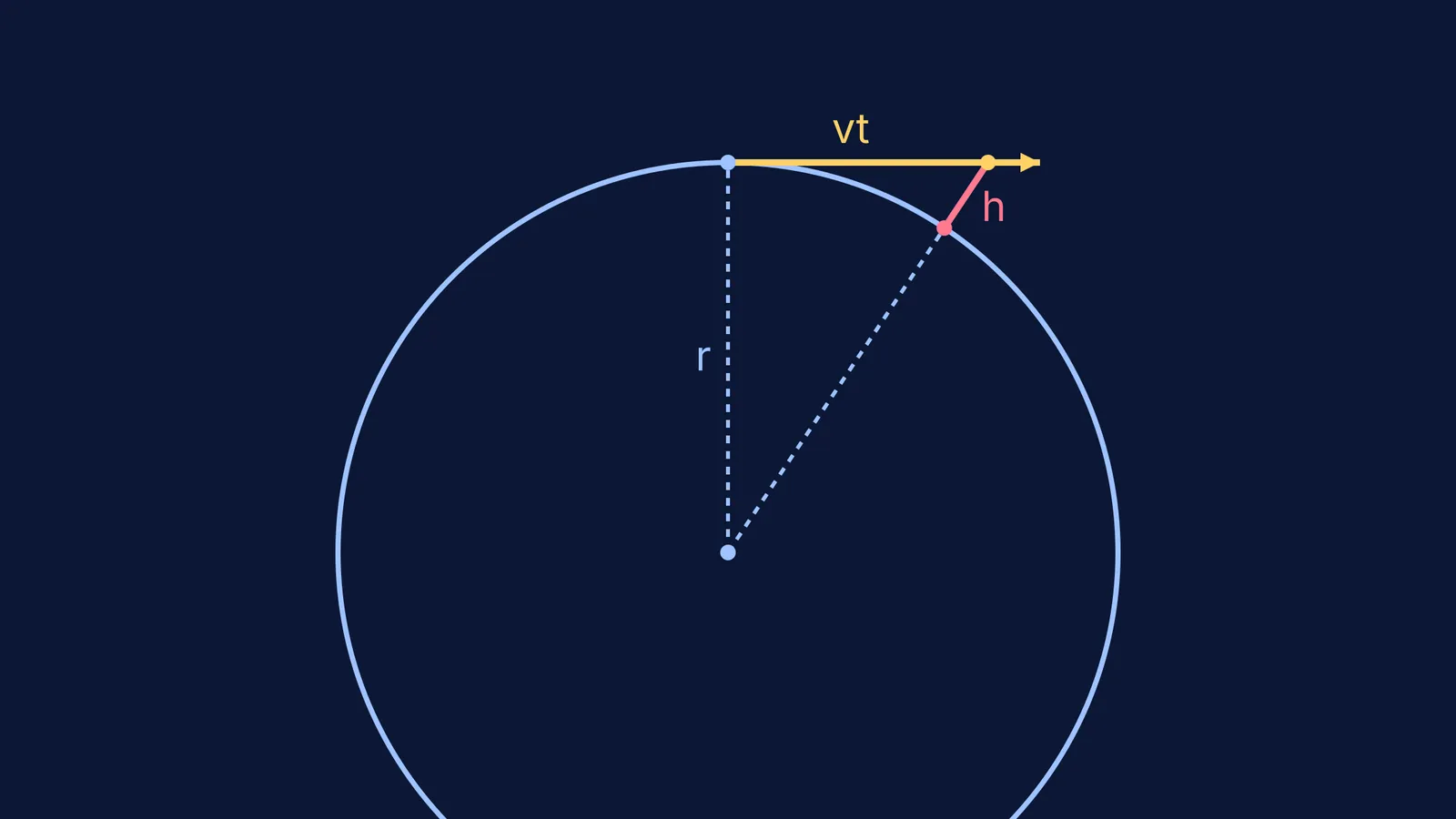
He imagined an object moving along a circular path. According to the principle of inertia, if the holding force suddenly vanished, the object would continue in a straight line along the tangent to the circle. Therefore, for a very short time interval t, the object would travel a straight distance vt along this tangent line. To stay on the circle, it must constantly "fall" back toward the center by a small distance h.
Using the Pythagorean theorem on the right triangle formed by the radius to the tangent, the tangent segment, and the radius to the new position, Huygens showed that for small angles, this fall distance is approximately h = (vt)² / (2r).
He then compared this to the distance a body falls under constant acceleration, which Galileo had established as h = (1/2)at². Setting the two distances equal gives:
(1/2)at² = v²t² / (2r)
Cancelling the time squared (t²) and the halves leaves the required acceleration: a = v²/r. Multiplying by the object's mass gives the total force. Huygens completed this work in 1659, though it was only published in full posthumously in 1703 as *De Vi Centrifuga*. He did, however, include the results without their proofs as an appendix to his 1673 masterpiece *Horologium Oscillatorium*.
Why do students struggle with centripetal force?
Today, every science student meets this formula. In 2024, more than 1.47 million unique candidates registered for the JEE Main, where rotational mechanics and circular motion form the backbone of the physics syllabus.
Despite its simple shape, F = mv²/r causes endless confusion in exams. The most common mistake is treating centripetal force as a brand new, separate force to be added to a free-body diagram alongside tension, gravity, and normal forces. It is not. Centripetal force is simply the required net force for circular motion. It must be provided by existing physical forces.
When you are stuck on a physics numerical, reading the textbook theory again rarely helps. Fermi's AI tutor works out what you already know and builds a plan for the session. If you keep drawing centrifugal force in the wrong direction, the tutor notices where you are stuck and teaches through it — writing on a board, drawing the figure, and checking understanding as it goes.
How do you visualise centripetal acceleration?
If you struggle to picture how velocity vectors change direction to create an inward acceleration, reading static diagrams can be frustrating. The Fermi Simulation Lab provides interactive simulations for the ideas that are easier to see than to read. You can change the speed or the radius of a moving object and watch the acceleration vector stretch and shrink in real time.
When you are ready to test your understanding, the Fermi Problem Library has worked problems with a step-by-step solver that explains the reasoning rather than printing an answer. It helps you set up the equations correctly before you plug in the numbers, ensuring you understand which forces are providing the centripetal pull.
How do you apply centripetal force in problems?
The best way to master circular motion is to see how mv²/r appears in different physical situations. Here are three classic cases you can work through to solidify your understanding:
Simple pendulum string tension at any angle: Tension must balance the outward component of gravity and also provide the required inward centripetal force.
A car over a hump: Gravity provides the centripetal force, meaning the normal force from the road drops as the car's speed increases.
Pendulum in an electric field: When an electric force is added to the bob, the effective gravity changes, but the fundamental requirement for circular motion remains exactly the same.


