

On this page
In organic chemistry, some names appear so often that they become shorthand for a whole class of reactions. Hugo Schiff is one of them. If you are studying for JEE Main or NEET-UG, you will meet his name twice: once for a family of compounds called Schiff bases, and again for a bright pink dye test used to spot aldehydes.
Who was Hugo Schiff?
Hugo Schiff (1834–1915) was a German-Italian chemist who left a massive mark on analytical and organic chemistry. Born in Frankfurt, he studied under Friedrich Wöhler, the chemist famous for synthesising urea. Schiff later moved to Italy, where he spent most of his career and founded the Chemical Institute at the University of Florence.
His legacy is tied to two major discoveries: a class of compounds called imines (which became known as Schiff bases) and a chemical test that turns magenta in the presence of an aldehyde.
What is a Schiff base?
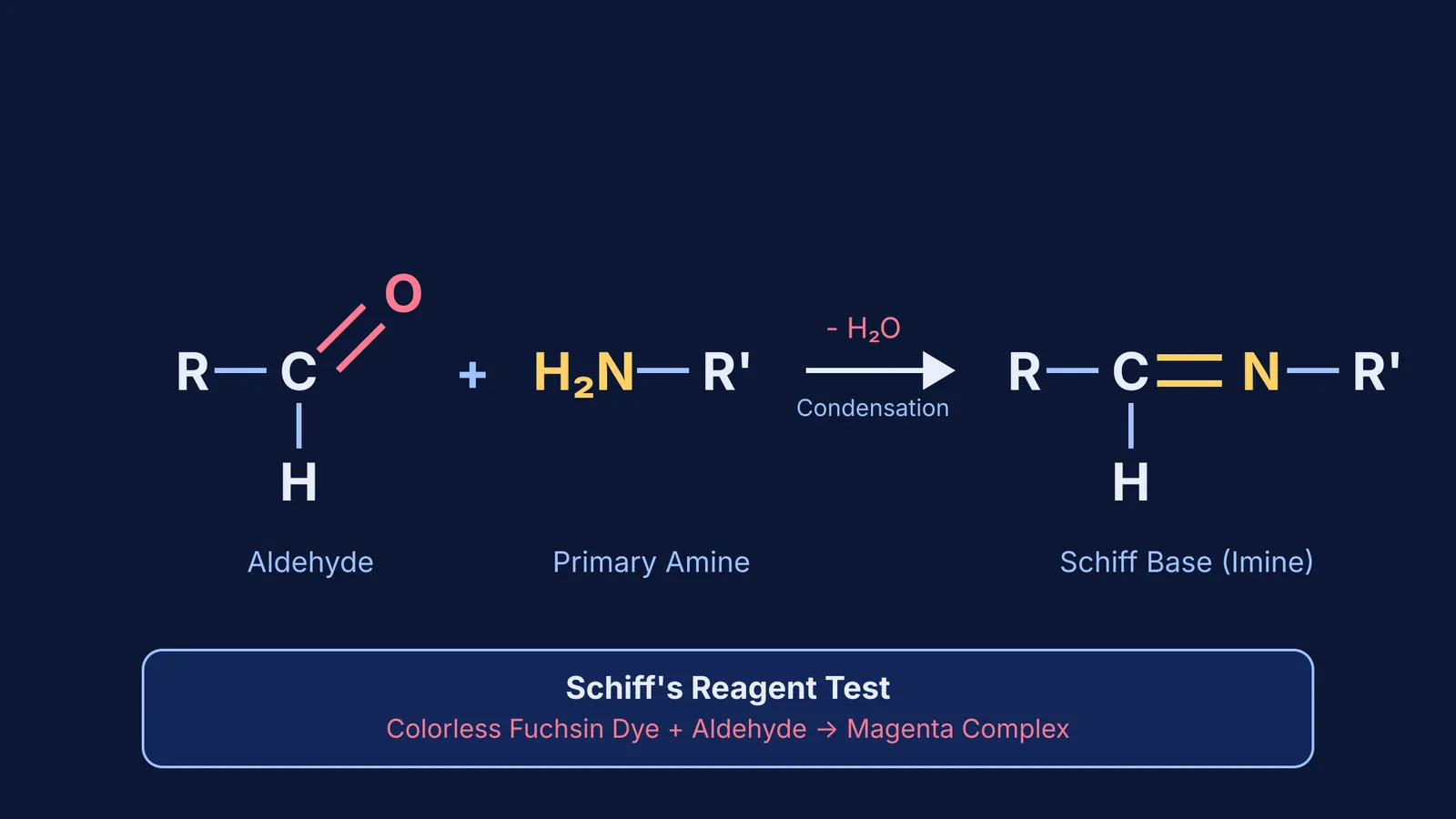
A Schiff base, also known as an azomethine, is a compound with a carbon-nitrogen double bond, written generally as R₂C=NR'.
It forms when a primary amine (R'-NH₂) reacts with a carbonyl compound (an aldehyde or a ketone) in a condensation reaction. The two molecules join together, and a molecule of water (H₂O) is eliminated.
Because the nitrogen atom has a lone pair of electrons, Schiff bases are excellent ligands. They bind tightly to metal ions, making them incredibly useful as catalysts in industrial chemistry and as active ingredients in antibacterial drugs.
If you find yourself stuck trying to remember the mechanism for imine formation, Fermi's AI tutor can work out what you already know and build a plan for the session, showing you exactly how the nitrogen attacks the carbonyl carbon.
What is Schiff's reagent?
Schiff's reagent is a chemical solution used specifically to detect aldehydes.
It is made from a dye called fuchsin (or pararosaniline), which is normally a deep pink colour. To make the reagent, sulfur dioxide (SO₂) is bubbled through the dye until it is completely decolorised.
When you add a few drops of an unknown organic liquid to this clear solution:
If it turns bright magenta/pink: The liquid is an aldehyde.
If it stays colourless: The liquid is a ketone (or another non-aldehyde compound).
This happens because the aldehyde reacts with the decolorised dye to form a new, highly coloured complex. Ketones, which are less reactive due to steric hindrance and the lack of a hydrogen atom on the carbonyl carbon, generally do not trigger this colour change.
How do you test for aldehydes?
In your Class 12 chemistry studies and competitive exams, you will often be asked to distinguish between two different organic compounds. Schiff's test is a standard tool for this, sitting alongside Tollens' and Fehling's tests.
Here is a quick checklist for spotting aldehydes:
Tollens' test: Gives a silver mirror with all aldehydes (both aliphatic and aromatic).
Fehling's test: Gives a red precipitate with aliphatic aldehydes only.
Schiff's test: Turns pink/magenta with all aldehydes.
If an exam asks you to distinguish between propanal (an aldehyde) and propanone (a ketone), you can cite Schiff's reagent. Propanal will turn the reagent pink, while propanone will not. If a question gives you a product that undergoes the Cannizzaro reaction, you know it is an aldehyde without an alpha-hydrogen, and it will still give a positive Schiff's test.
When you are reviewing carbonyls with ammonia derivatives and keep mixing up the specific reagents, the Fermi Concept Library groups these reactions logically so you can see the patterns rather than just memorising the exceptions.


