

On this page
In the late 19th century, cleaning large public venues and residences was an exhausting chore. Early mechanical sweepers relied on compressed air. At London's Empire Music Hall in 1901, an American inventor demonstrated a machine that blew high-pressure air into theater chairs to dislodge dust.
British engineer Hubert Cecil Booth watched with skepticism. While the blast loosened dirt, it scattered the particles into the room, where they billowed before settling back onto the furniture. Booth asked why the apparatus did not suck the dust in instead. The inventor dismissed the suggestion, claiming suction cleaning was mechanically impossible.
How did Hubert Cecil Booth test his suction idea?
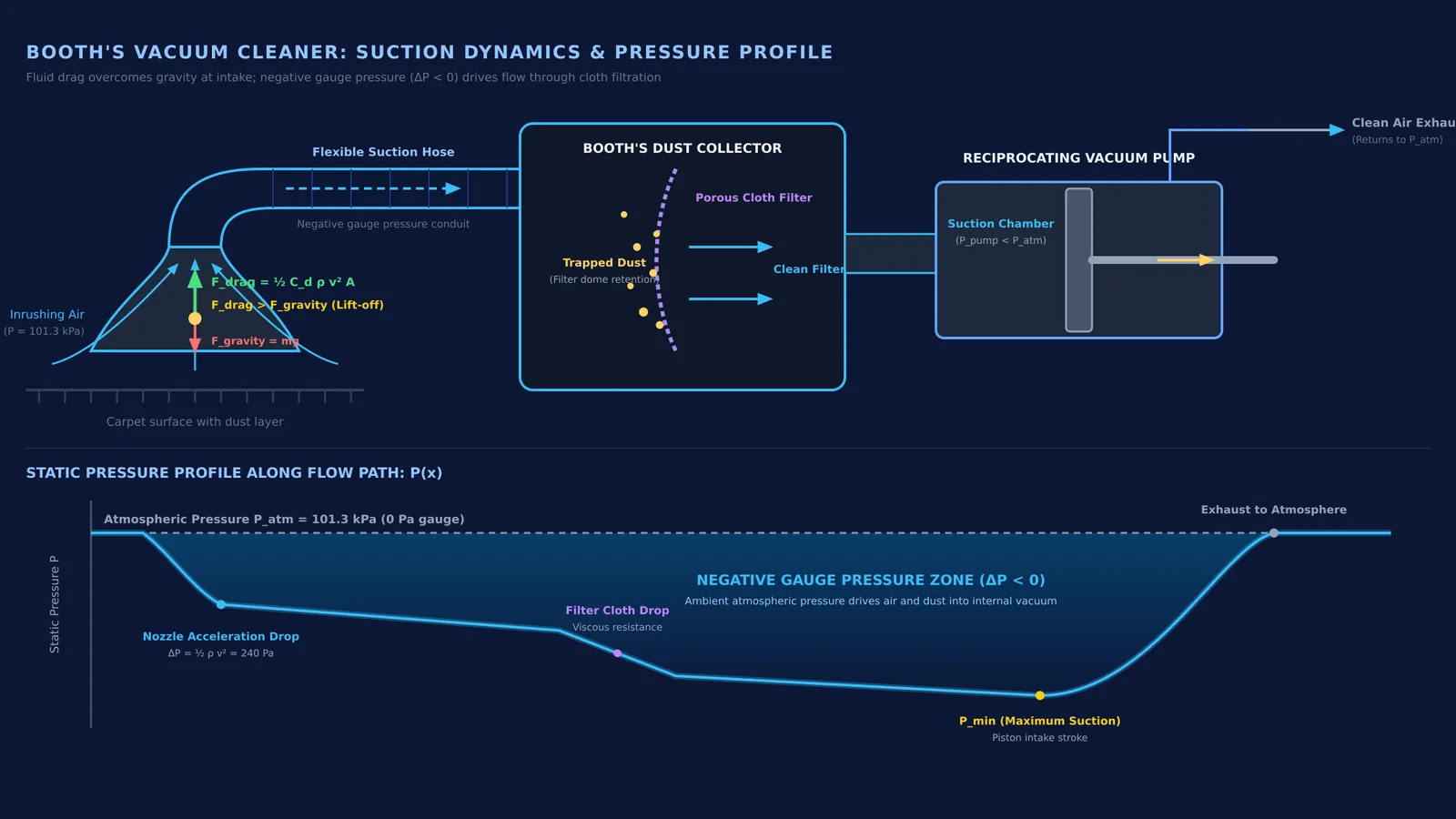
Booth was unconvinced. A civil and mechanical engineer trained at London's Central Technical College, Booth understood that fluids move along pressure gradients. If a pump created a zone of negative gauge pressure, atmospheric pressure would push the surrounding air—and loose particles—into an enclosed chamber.
Shortly after, Booth tested his idea at a London restaurant. He placed a silk handkerchief across a velvet chair, pressed his lips to the cloth, and inhaled sharply. When he pulled the handkerchief away, a dark ring of dust coated its underside. The porous fabric trapped particulate matter while letting air pass.
Booth quickly drafted a machine combining a vacuum pump and an airtight filter. On August 30, 1901, he filed for British Patent No. 17,433 (Google Patents), titled "Improvements relating to the Extraction of Dust from Carpets and other Materials." His patent detailed a suction tool connected via flexible tubing to a dust collector with a cotton filter dome.
How does atmospheric pressure lift dust into a vacuum?
Booth's mechanism relies on fluid drag created by a pressure difference between ambient room air and the cleaner's internal intake. As documented in aerodynamic flow relations by the NASA Glenn Research Center, standard ambient atmospheric pressure sits at roughly 101.3 kPa. When a vacuum pump extracts air from an enclosed chamber, internal static pressure drops below ambient levels, creating a negative gauge pressure (ΔP < 0) that drives fluid flow.
As explored in Daniel Bernoulli and Hydrodynamica, accelerating air into a narrow nozzle lowers static pressure. Consider the forces lifting a dust particle off a surface:
Gravity: A mineral dust grain with radius 25 μm and density 2000 kg/m³ has a mass of roughly 1.3 × 10⁻¹⁰ kg, giving a downward gravitational force of 1.3 × 10⁻⁹ N.
Aerodynamic drag: Incoming air exerts upward drag: F_drag = (1/2) C_d ρ_air v² A. For air density 1.2 kg/m³ and drag coefficient C_d ≈ 1.5, an air speed of just 1 m/s generates enough lift to exceed gravity.
Pressure differential: To overcome surface adhesion and draw air through the nozzle at 20 m/s, the pump must create a pressure drop ΔP = (1/2) ρ_air v² ≈ 240 Pa.
To overcome friction along long hoses and porous cloth filters, Booth's industrial pump generated several thousand Pascals of suction. To explore interactive simulations for ideas that are easier to see than to read, students can examine fluid flow in the Fermi Simulation Lab. When practicing fluid dynamics and pressure calculations, the Fermi Problem Library provides worked problems with a step-by-step solver that explains the reasoning rather than printing an answer.
What was Booth's horse-drawn "Puffing Billy"?
Early powered engines were too heavy for portable household appliances. Booth founded the British Vacuum Cleaner Company to operate commercial suction services, deploying large horse-drawn mobile rigs parked outside buildings while operators fed long hoses through windows, as chronicled by the Science Museum Group.
Nicknamed "Puffing Billy" for its rhythmic piston chug, the wagon remained in the street while operators cleaned interior spaces. Because negative pressure pulled air inward, dirt traveled straight through the hose into the wagon's filter bin, leaving interior rooms clean. London socialites even held vacuum parties, sipping tea while watching dirt flow past a glass inspection tube.
How did Booth's invention transform public sanitation?
Booth's invention quickly became a vital public health tool. Before King Edward VII's coronation in 1902, the blue carpets of Westminster Abbey were heavily soiled. Booth's machines extracted extensive grime without scattering dust into the historic air. The impressed monarch subsequently ordered vacuum installations for Buckingham Palace and Windsor Castle.
Suction cleaning also tackled disease. During an outbreak of spotted fever in naval barracks, Booth's machines sanitized bedding and dormitories. The British Vacuum Cleaner and Engineering Company soon supplied trolley cleaners to naval facilities, including the Royal Naval College at Osborne House around 1905, documented in the Science Museum Group Collection.
Later, the company introduced smaller home models under the Goblin brand, such as the 1930 Goblin "Wizard" preserved in the Science Museum Group Collection.
By inverting a machine that blew dust into one that drew it inward, Booth demonstrated the power of first-principles thinking. To see how pressure governs fluid behavior, explore Fluid mechanics: pressure, buoyancy and Bernoulli mistakes to avoid and Blaise Pascal: pressure, a mountain barometer and probability.


