

On this page
In the 1960s, one of the world's most brilliant pure mathematicians packed his bags and left his office in Beijing to visit factories, tea farms and coal mines across China (MacTutor History of Mathematics). Hua Luogeng (1910–1985), known globally for his work in number theory alongside G. H. Hardy at Cambridge, believed that advanced mathematics belonged on the shop floor as much as it did in academic journals.
Despite having no formal university degree, Hua had risen from working in his father's grocery store to becoming the director of the Institute of Mathematics at the Chinese Academy of Sciences. He spent the latter part of his career popularising two techniques—the 0.618 method and the overall planning method—that transformed how ordinary workers approached efficiency.
What is the 0.618 method?
Imagine you need to find the ideal temperature to roast tea leaves. Trying every single degree takes too long, and guessing randomly is unreliable. You need an optimal point, but you want to find it using the fewest possible experiments.
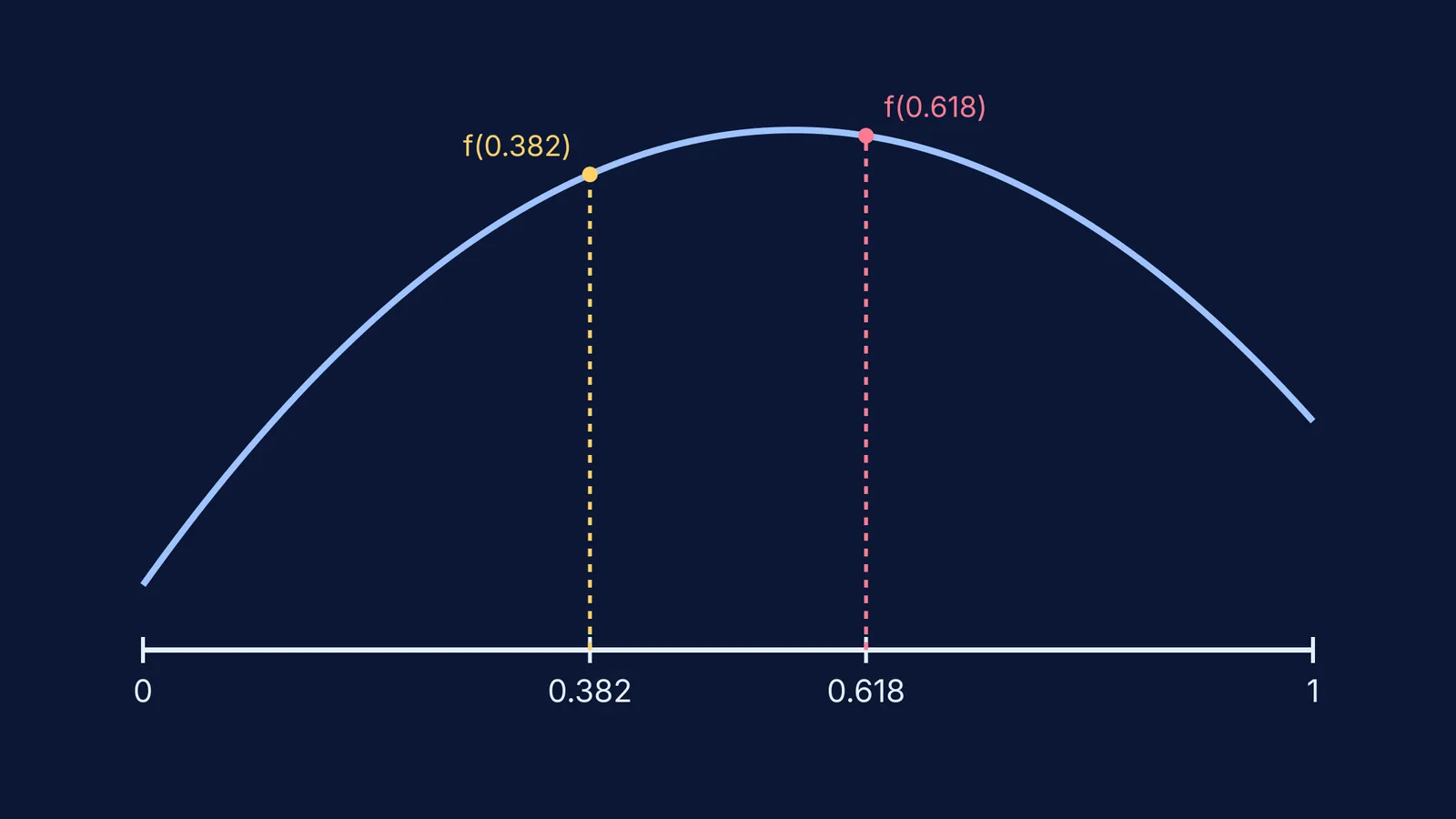
Hua taught workers the "Optimum Selection Method", which is a practical application of the golden section search. It relies on the golden ratio (approximately 0.618). If you have a range of possible temperatures, you do not test the middle. Instead, you run your first two tests at exactly 38.2% and 61.8% of the way through that range (MacTutor History of Mathematics).
You then compare the two results. If the tea roasted at the 61.8% mark tastes better, you know the true optimum lies somewhere in the upper section of your temperature range. You discard the lower section entirely.
The mathematical beauty of the 0.618 ratio is that when you look at your new, smaller range, your previous 61.8% test point sits exactly at the 38.2% mark of the new interval. You only need to run one new experiment for each subsequent step. This mathematical guarantee allowed factories to find the perfect chemical concentrations and roasting temperatures in just a few attempts, without workers needing a degree in calculus.
What is the teapot analogy for overall planning?
While the 0.618 method tackled quality, the "Overall Planning Method" tackled time. This was Hua's adaptation of the Critical Path Method (CPM) and PERT, complex tools typically used in Western project management.
To explain these concepts to people with no formal education, Hua wrote widely distributed pamphlets containing a famous analogy: making tea.
The slow way: Wash the kettle, put water on to boil, stand and wait. Once boiled, wash the cups, prepare the tea leaves, and brew.
The slightly better way: Wash the kettle and put water on to boil. While waiting, wash the cups and prepare the leaves.
The overall planning way: Wash the kettle and start the water boiling immediately. Because boiling is the longest unbroken task (the critical path), you must start it first. While the water heats, you execute all other secondary tasks in parallel.
By running tasks in parallel alongside the critical path, you eliminate idle time entirely. The tea is ready the exact moment the water boils.
Just as Hua Luogeng used overall planning to find the most efficient sequence of steps, Fermi's AI tutor works out what you already know and builds a plan for the session. Rather than leaving you to guess what to tackle next, it holds a line of reasoning across a whole session and decides whether to explain, ask, or show.
How can you use overall planning in your studies?
You can apply Hua's teapot logic to your own exam preparation to cut out wasted hours.
Identify your critical path: Which subject or chapter takes the most unbroken time to digest? (For example, mastering The wavy curve method for rational inequalities in JEE maths requires deep, uninterrupted focus).
Start the long task first: Begin your study session with the heavy conceptual lifting. Do not waste your highest-energy hours on administrative tasks like sorting your notes.
Slot in parallel tasks: While you take a break from active problem-solving, or while you wait for a teacher to reply to a query, complete shorter tasks. Review your flashcards or check a formula sheet.
A legacy beyond number theory
Hua Luogeng passed away in 1985 from a heart attack, immediately after delivering a mathematics lecture at the University of Tokyo. Today, he is remembered not just for his contributions to prime number theory, but as the mathematician who proved that rigorous logic could solve everyday problems.
Whether you are roasting tea leaves, managing a factory, or structuring a revision timetable, working mathematically means working smarter.
Read more:


