

On this page
In October 1935, twenty-five-year-old Indian physicist Homi Jehangir Bhabha submitted a paper from Gonville and Caius College, Cambridge, that solved an urgent puzzle in quantum mechanics. Three years after Carl Anderson detected the positron, physicists still lacked a relativistic equation for collisions between electrons and positrons. Bhabha showed that their interaction flows through two competing quantum channels that interfere with each other.
Published in the *Proceedings of the Royal Society of London*, Bhabha's paper, The scattering of positrons by electrons with exchange on Dirac's theory of the positron, provided the complete relativistic cross section. Today, particle colliders across the globe rely on Bhabha scattering to calibrate their beam luminosity.
What is Bhabha scattering?
Bhabha scattering is the quantum electrodynamic process where a relativistic electron and a positron collide and scatter: e⁻ + e⁺ → e⁻ + e⁺.
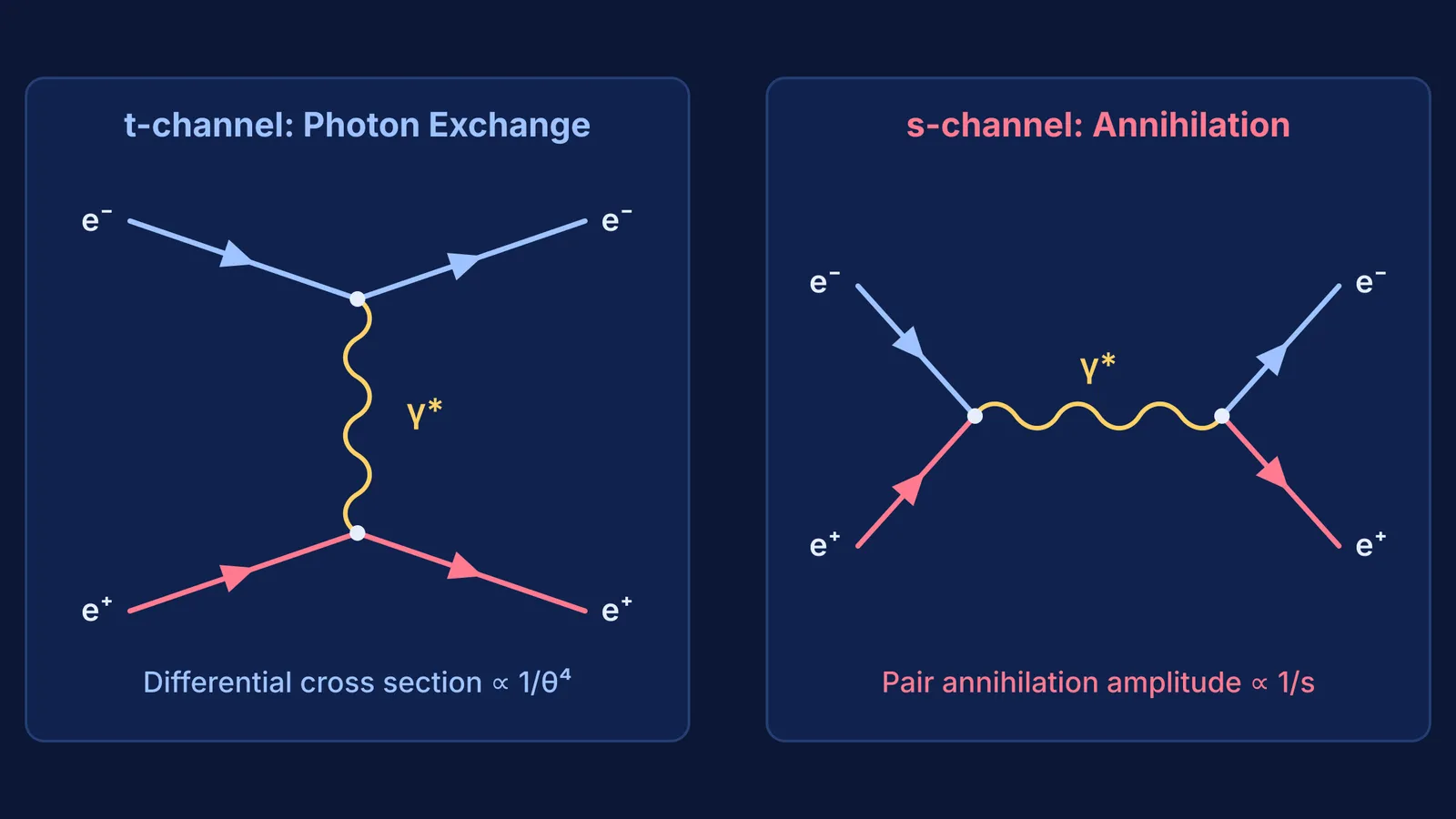
As detailed in William Penney's Royal Society biographical memoir, Homi Jehangir Bhabha, 1909–1966, Bhabha realised that Paul Dirac's relativistic equation that predicted antimatter required two distinct physical mechanisms whenever an electron meets a positron:
Scattering channel (t-channel): The incoming electron and positron exchange a virtual photon across space, altering trajectories while keeping their identities.
Annihilation channel (s-channel): The electron and positron momentarily annihilate into a virtual photon carrying the total collision energy, which creates an electron-positron pair in the final state.
Because quantum mechanics adds probability amplitudes before squaring, the total amplitude is M = M_t + M_s. The resulting cross section contains an interference term that alters the observed deflection rate.
Why is electron-positron scattering different from electron-electron scattering?
In electron-electron scattering (Møller scattering), two identical negative electrons collide. Quantum mechanics demands an exchange effect between identical fermions, but two electrons can never annihilate.
Electrons and positrons carry opposite charges and opposite quantum numbers, allowing virtual annihilation. Accounting for electron spin, discovered when Uhlenbeck and Goudsmit showed electrons have intrinsic spin, Bhabha derived the high-energy differential cross section in his 1936 Royal Society paper:
dσ/dΩ = (α² / 4s) × [ (s² + u²) / t² + (t² + u²) / s² + 2u² / (s t) ]
Here, α is the fine-structure constant (about 1/137), and s, t, and u are kinematic Mandelstam variables:
(s² + u²) / t² represents t-channel photon exchange, which diverges sharply at small deflection angles θ where t = −s sin²(θ/2) approaches zero.
(t² + u²) / s² represents s-channel virtual annihilation, varying smoothly over all angles.
2u² / (s t) represents quantum interference. Because t is negative, this term produces destructive interference, suppressing scattering at intermediate angles.
How do particle colliders use Bhabha scattering to calibrate luminosity?
Particle colliders measure beam luminosity (L), the concentration of collisions per second per unit area. In any reaction, the detected event count N relates to the physical cross section σ by N = L × σ. To measure unknown particles, physicists must know L accurately.
Colliders calibrate luminosity with a reference process whose theoretical rate is known precisely. At forward angles between 25 and 58 milliradians, t-channel photon exchange dominates over annihilation, scaling as dσ/dθ ∝ 1/θ³. This generates millions of clean events with negligible background.
Achieving an experimental systematic uncertainty of 3.4 × 10⁻⁴ (0.034%), CERN's OPAL Collaboration demonstrated that counting small-angle Bhabha events in silicon-tungsten calorimeters calibrates collider luminosity to sub-per-mille accuracy.
How can you calculate collider luminosity from Bhabha events?
High-energy experimentalists extract luminosity by integrating the Bhabha cross section over a forward calorimeter's acceptance, as detailed in LEP luminosity instrumentation:
Identify detector geometry: Suppose a monitor detects scattered electrons from θ_min = 30 milliradians to θ_max = 60 milliradians.
Integrate the forward cross section: In the small-angle limit, integrating the 1/θ³ dependence yields:
σ ≈ (16 π α² / s) × [ 1/θ_min² − 1/θ_max² ]
Calculate numerical cross section: At center-of-mass energy √s = 91.2 GeV, setting α ≈ 1/137 gives an effective cross section of σ ≈ 104.4 nanobarns (nb), or 104,400 picobarns (pb).
Compute luminosity: If the luminometer records N = 1,044,000 Bhabha events, the integrated luminosity is:
L = N / σ = 1,044,000 / 104.4 nb = 10,000 nb⁻¹ = 10 pb⁻¹
When working through collision kinematics or momentum transfer problems, the Fermi Problem Library provides worked problems with a step-by-step solver that explains the reasoning rather than printing an answer.
How did Bhabha scattering settle a modern neutrino puzzle?
Small theoretical refinements in Bhabha scattering can resolve major particle physics questions. Following measurements at LEP, the observed Z-boson decay width implied 2.9840 ± 0.0082 light neutrino species, two standard deviations below the Standard Model prediction of 3.
In 2020, Patrick Janot and Stanisław Jadach published an improved Bhabha scattering cross section calculation. Their higher-order corrections reduced the calculated cross section by 0.048% (increasing inferred luminosity accordingly), revising the measured light neutrino count to 2.9963 ± 0.0074. The discrepancy disappeared, confirming the Standard Model's three-family structure.
For students exploring how relativistic fields govern subatomic collisions, the Fermi Simulation Lab provides interactive simulations for ideas that are easier to see than to read, alongside structured lessons in the Fermi Concept Library.


