

On this page
When a massive earthquake hits, the news often reports its size on the "Richter scale". But for major quakes, this is almost always wrong. Seismologists today use the moment magnitude scale (Mw), developed in the 1970s by Hiroo Kanamori and Thomas C. Hanks.
The Richter scale, published in 1935, falls short for the most powerful tremors on Earth. Kanamori’s work connected an earthquake's magnitude directly to the physical work it performs as tectonic plates slide. This gave seismologists a measurement scale that never maxes out, no matter how catastrophic the event.
Why did the Richter scale need replacing?
The original local magnitude scale (ML) was developed by Charles F. Richter in 1935. It was based on the maximum amplitude of seismic waves recorded by a specific type of Wood-Anderson seismograph in California. It worked beautifully for the moderate, shallow earthquakes common in that region.
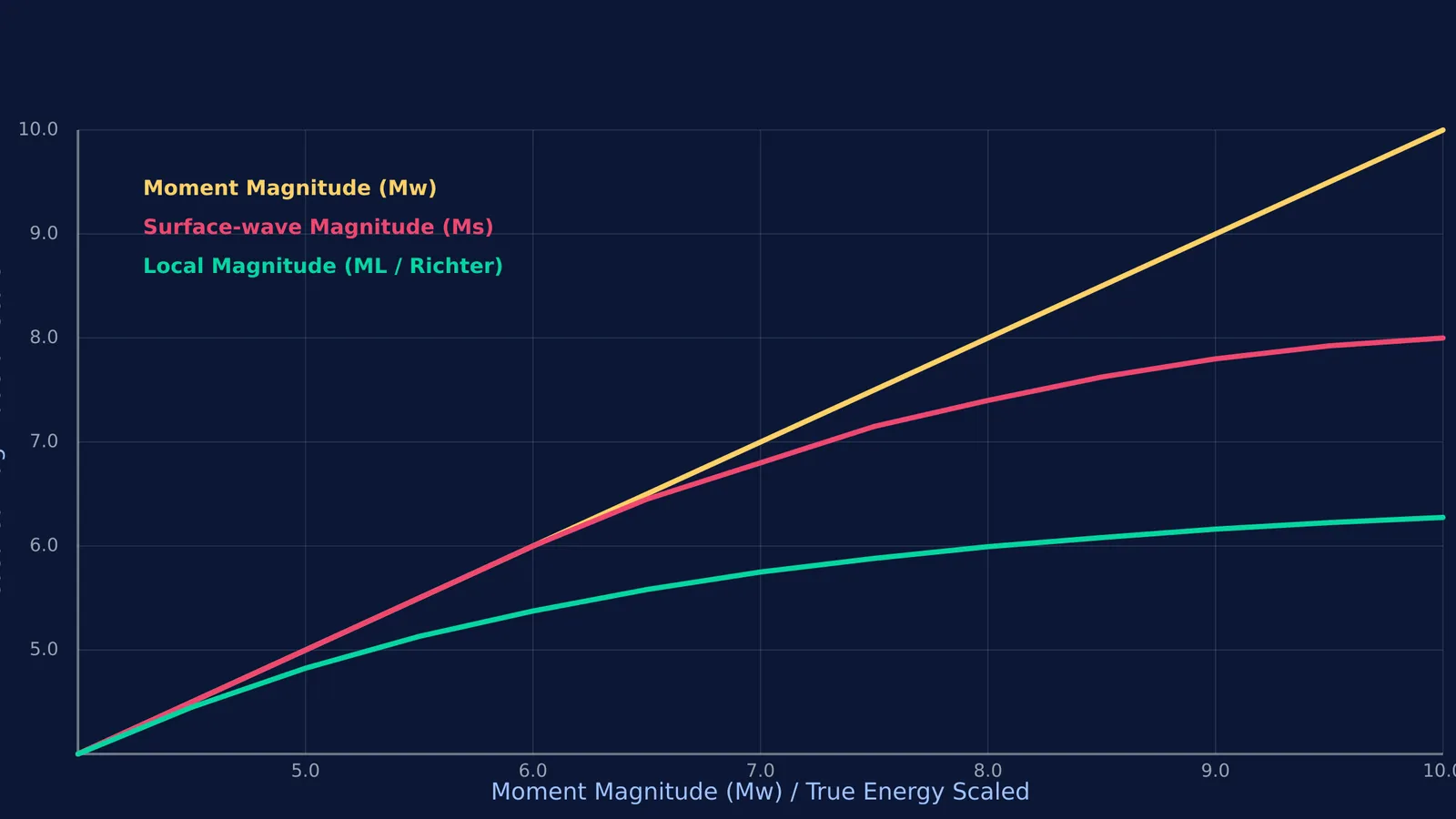
However, as seismologists deployed instruments worldwide and recorded larger events, they hit a mathematical wall called saturation. An earthquake generates a wide spectrum of waves, but the older instruments only measured specific high frequencies. As earthquakes get larger, they release more of their energy at very low frequencies (longer wavelengths). A seismograph's needle can only swing so far, and the high-frequency waves the Richter scale measured do not grow endlessly.
For earthquakes above a magnitude of 6.5, the local magnitude scale starts to flatten out, severely underestimating the event's size. A later surface-wave scale (Ms) was introduced to handle larger quakes, but it suffered the same saturation problem around a magnitude of 8.0.
For example, the 1960 Chilean earthquake—the largest earthquake ever recorded by modern instruments—was initially measured at an Ms of 8.5. It was actually vastly more powerful, but the older scales simply could not capture its true energy release, making it appear similar in size to quakes that were only a fraction of its strength.
What is seismic moment?
To fix this, Kanamori looked to the physical source of the earthquake rather than just the waves radiating away from it. The key was seismic moment (M₀), a concept introduced by Keiiti Aki in 1966.
Seismic moment is a fundamental mechanical measure of the work done by the earthquake. Instead of looking at a wave's amplitude, it looks at the fault itself. It depends on three physical variables:
The rigidity or shear modulus of the rock (μ), which is its resistance to being deformed.
The surface area of the fault that slipped (A).
The average distance the fault slipped (D).
M₀ = μ × A × D
Because it measures the actual fault movement, seismic moment never saturates. A longer fault, a deeper rupture, or a larger slip always yields a mathematically larger seismic moment. (This direct mechanical measurement is conceptually similar to how early seismometers physically tracked shifts in the earth; see John Milne and the horizontal pendulum seismograph.)
How do you calculate moment magnitude?
While seismic moment is precise, its numbers are enormous and difficult to communicate (often measured in trillions of dyne-centimetres or Newton-metres). Seismologists needed a way to translate this physical measurement back into the familiar 1-to-10 magnitude format the public understood.
In a 1979 paper, Thomas C. Hanks and Hiroo Kanamori defined the moment magnitude scale. It was carefully calibrated to match the old Richter numbers for small quakes but extend cleanly to the largest ones without saturating.
The formula for the moment magnitude scale (Mw) is:
Mw = (2/3) log₁₀(M₀) − 10.7
(where M₀ is the seismic moment measured in dyne-centimetres).
By this scale, the 1960 Chilean earthquake is now recognised as having an Mw of 9.4 to 9.6. The moment magnitude scale has become the standard for seismological authorities like the United States Geological Survey when reporting large earthquakes (typically those above magnitude 4.0).
How much more energy does a larger earthquake release?
Logarithmic scales can be highly unintuitive because small numerical changes hide massive physical differences (astronomers face a similar hurdle when measuring starlight; see Norman Pogson and the 2.512 rule for star brightness).
If you are preparing for a physics or earth science exam, you must know how to calculate the energy difference between two magnitude numbers. An increase of one full step on the logarithmic scale corresponds to a 10^1.5 (which is approximately 31.6, commonly rounded to 32) times increase in energy release.
Let's walk through a comparison between a 7.0 and a 9.0 earthquake:
First, find the difference in magnitude: 9.0 − 7.0 = 2.0.
The energy multiplier is 10^(1.5 × difference).
Plug in the difference: 10^(1.5 × 2.0) = 10³.
10³ = 1000.
Therefore, a 9.0 earthquake releases exactly 1,000 times more energy than a 7.0 event. Even though a 9.0 might only sound a bit worse than a 7.0, it is the equivalent of setting off a thousand 7.0 earthquakes at once.
When working through logarithmic formulas in physics, Fermi's AI tutor can check your steps and explain the maths behind the rules, rather than just printing the final answer. Understanding how the Mw formula handles logarithms is excellent practice, as the exact same mathematical patterns show up in sound intensity (decibels) and chemistry (pH) calculations.


