

On this page
For generations, fish farmers across India faced a stubborn biological barrier. Prized Indian major carps—rohu (*Labeo rohita*), mrigal (*Cirrhinus mrigala*), and catla (*Catla catla*)—grew well in freshwater ponds and developed healthy gonads, yet they refused to spawn in confined still water.
Why did Indian carps refuse to breed in ponds?
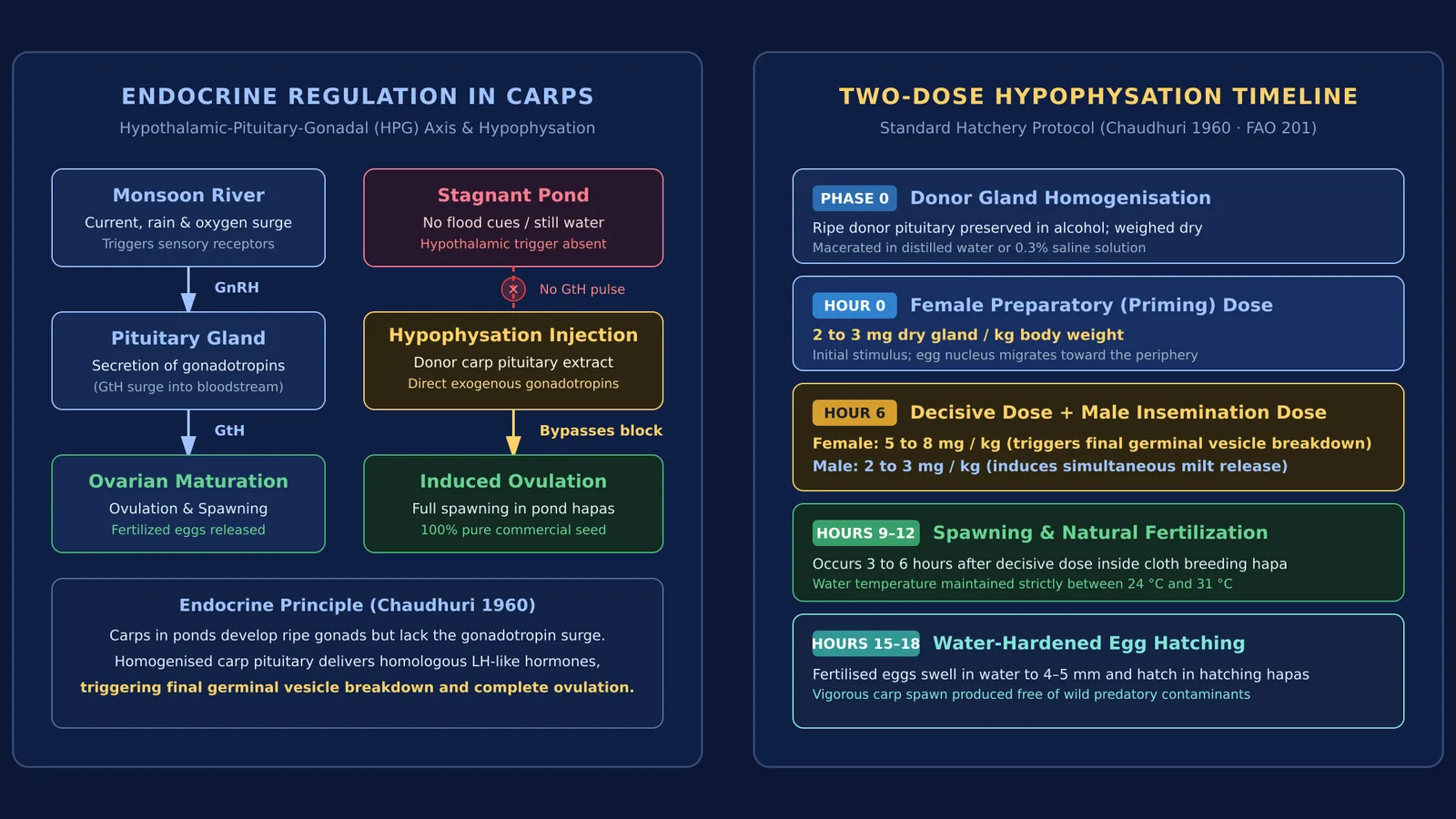
The bottleneck was environmental. In nature, Indian major carps breed exclusively during the monsoon in swollen, fast-flowing rivers. Rushing flood currents, rising oxygen levels, and temperature drops stimulate sensory receptors in the fish. These cues prompt the hypothalamus to release gonadotropin-releasing hormone, which triggers the pituitary gland to secrete gonadotropins into the blood.
In stagnant ponds, female carps reach the final preparatory stage of egg development, called vitellogenesis, but the process halts. Without the environmental triggers of a flowing monsoon river, the pituitary never releases its gonadotropin pulse. The unspawned eggs are eventually resorbed by the fish.
To stock ponds, farmers had to scoop wild hatchlings from riverbanks. This riverine collection was erratic and contaminated with predatory fry that devoured carp hatchlings, resulting in high mortality.
How did Hiralal Chaudhuri achieve the 1957 breakthrough?
The barrier was broken by Indian fisheries biologist Dr. Hiralal Chaudhuri (1921–2014) alongside Dr. K. H. Alikunhi at the Central Inland Fisheries Research Sub-station at Cuttack and Angul in Odisha. Chaudhuri asked a straightforward question: if stagnant pond water prevents the carp's brain from signalling its pituitary, could an injection of pituitary extract supply the missing gonadotropins directly?
Earlier trials with mammalian hormones on Indian carps had failed. Chaudhuri realized that carps require fish gonadotropins matching their specific receptor biology, an endocrine insight later reviewed in his analysis of hormones in induced carp spawning.
After testing minor carps in 1955, Chaudhuri achieved his landmark result on 10 July 1957. He injected carp pituitary gland extract into the muscle of a mature female *Cirrhinus reba*. Placed inside a cloth tank called a hapa in a pond, the fish spawned within hours, as Chaudhuri and Alikunhi reported in Current Science. The fertilised eggs hatched into vigorous fry.
Chaudhuri extended the technique to rohu, mrigal, and catla, standardizing dosages in the Indian Journal of Fisheries. The Government of India declared 10 July National Fish Farmers Day in 2001, as noted by the Press Information Bureau.
What is the standardized two-dose hypophysation protocol?
Chaudhuri's method was codified into a dependable protocol for hatcheries, recorded in FAO Technical Paper 201. The process uses a split-dose injection to mature eggs before triggering ovulation:
Gland preparation: Pituitary glands from mature donor carps are preserved in absolute alcohol and homogenised in distilled water or 0.3% saline solution.
Female preparatory dose: The female receives an initial intramuscular injection of 2 to 3 mg of dry gland per kilogram of body weight.
Female decisive dose: Exactly 6 hours later, the female receives a second dose of 5 to 8 mg per kilogram.
Male single dose: The male receives 2 to 3 mg per kilogram at the same time as the female's second injection.
Spawning in hapas: Injected breeders are released into a cloth hapa with water temperatures kept between 24 °C and 31 °C; spawning occurs 3 to 6 hours after the second dose.
The low initial dose moves the egg nucleus to the periphery, while the second dose induces ovulation.
How did induced breeding transform Indian aquaculture?
Induced breeding ended dependence on wild river seed. Farmers could now produce pure seed of known species on demand. This enabled composite fish culture—stocking compatible surface, column, and bottom feeders in one pond—transforming India into one of the world's leading aquaculture producers.
The technique also enabled controlled fish hybridization. Breeders could cross distinct species, creating hybrids like catla-rohu that combined catla's fast growth with rohu's meat yield.
How can students connect this discovery to biology exam prep?
For students mastering chemical coordination and endocrine glands or learning how to study NCERT for NEET, Chaudhuri's work illustrates vertebrate endocrinology in action. It provides a real-world example of how hormones act through membrane receptors: protein gonadotropins bind extracellular receptors to activate intracellular second messengers.
When studying complex hormonal cascades, students often struggle to connect anatomical glands with physiological responses. The Fermi Concept Library organizes every topic across biology and the physical sciences into an interconnected map. To test your understanding, Fermi's AI tutor works out what you already know and builds a plan for the session, guiding your reasoning step by step rather than just giving away answers.


