

On this page
For over a thousand years, the dominant medical theory was that the liver continuously produced blood from food. This blood then ebbed and flowed through the body like a tide, being consumed by the tissues. In 1603, an anatomist named Hieronymus Fabricius published *De Venarum Ostiolis* ("On the Valves of the Veins"), describing small structures that seemed to challenge this ancient model (Wikipedia).
How did Fabricius discover valves in veins?
Fabricius was a pioneering anatomist at the University of Padua, where he had designed the first permanent anatomical theatre in 1594. By carefully dissecting human veins, he mapped out tiny, semilunar (half-moon shaped) "pockets" lining the inside of the vessels.
However, Fabricius did not break with the traditional ebb-and-flow theory. Instead, he forced his new observation to fit the old model. He concluded that these valves existed simply to slow down the blood as it rushed out to the limbs, ensuring the tissues had enough time to absorb nutrients.
How did William Harvey prove circulation?
William Harvey studied medicine at Padua under Fabricius from 1599 to 1602 (Wikipedia). He looked at his teacher's anatomical "clue" but applied a new, rigorous method to understand it.
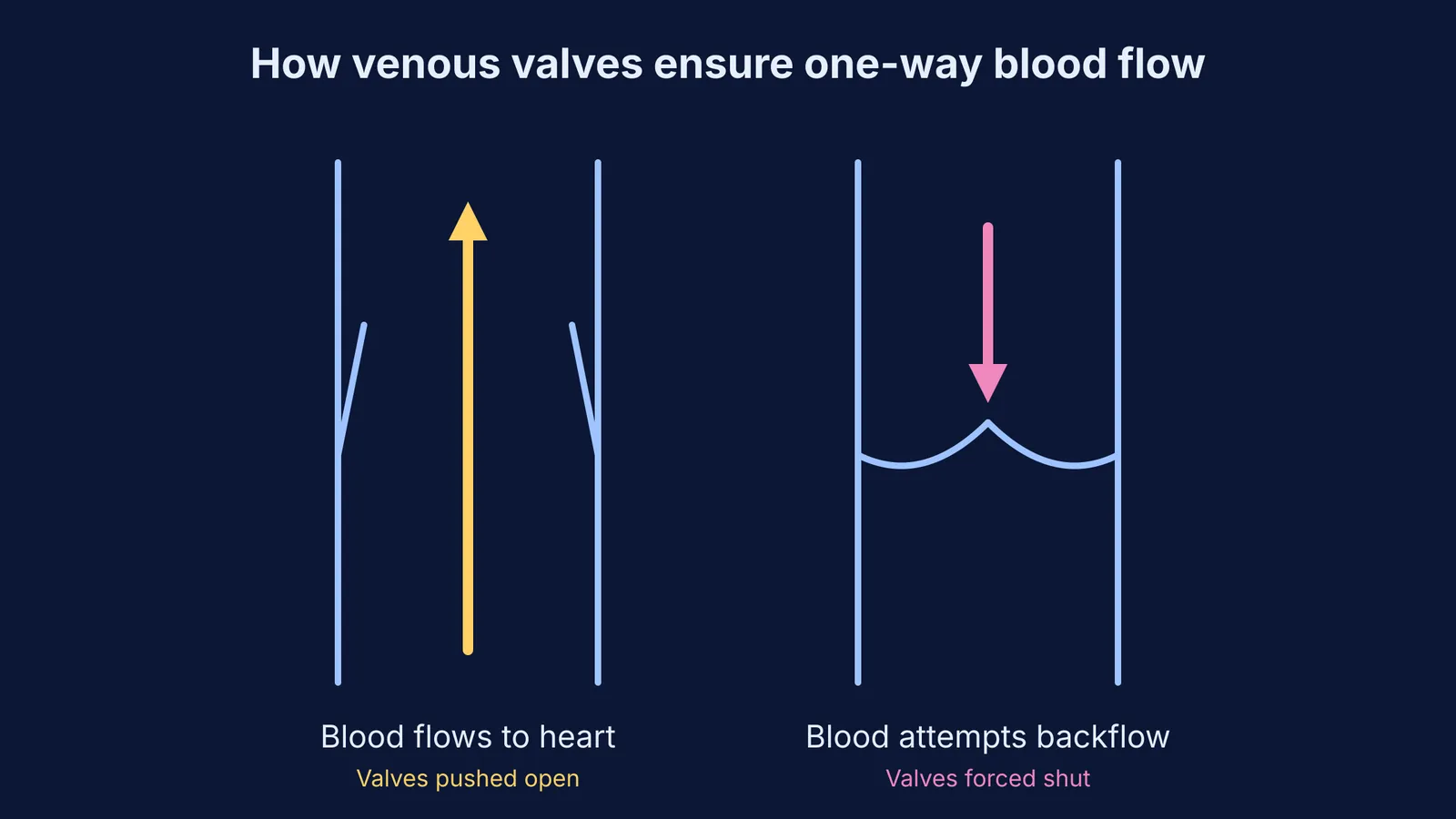
Harvey realised that the valves did not just slow blood down; they were one-way gates. He proved this with a simple but elegant experiment on the human arm. By tying a medium-tight bandage (a tourniquet) around an arm, he blocked the veins returning blood to the heart while leaving the deeper, higher-pressure arteries open. The veins below the bandage quickly swelled with blood.
When Harvey pressed a finger on a swollen vein and "milked" the blood along it towards the heart, that section of the vein stayed flat. Blood could not flow backwards to refill it because the pockets of the valves caught the reversed flow and sealed the vessel shut.
Why did Harvey calculate blood volume?
Harvey did not stop at observation. He calculated the volume of blood the heart pumped with every beat. He found that in just half an hour, the heart pumped far more blood than the entire body contained (Wikipedia). It was mathematically impossible for the liver to produce that much blood continuously.
In 1628, Harvey published *De Motu Cordis* (Anatomical Exercise on the Motion of the Heart and Blood in Animals). He proved that the heart acts as a pump, sending blood out through the arteries, and the veins—equipped with Fabricius's one-way valves—return that exact same blood to the heart in a continuous circuit.
What can students learn from this discovery?
Fabricius made a brilliant observation, but because he was committed to an old theory, he missed its true meaning. It was Harvey who asked the right questions, ran the experiment, and found the function behind the structure.
Students often fall into a similar trap today. It is easy to memorise the structure of a cell or the formula for a physical law without questioning how it works. But if you just memorise definitions, you will get stuck when an exam asks you to apply them to a new problem.
If you find yourself memorising facts without seeing how they fit together, Fermi's AI tutor can help. Most learning tools answer questions. Fermi teaches — it holds a line of reasoning across a whole session, notices where a student is stuck, and decides whether to explain, ask, or show. You can explore the physiology of the circulatory system in the Fermi Concept Library, which maps out every concept in biology.


