

On this page
In the mid-19th century, the pupil of the human eye was a dark, unyielding mystery. The problem was simple geometry: to see the back of the eye, you need to shine light into it. However, if you place a candle in front of a patient's eye, your own head gets in the way of the light. If you move your head to the side to let the light pass, you are no longer in the path of the light reflecting back out of the pupil.
How did Hermann von Helmholtz invent the ophthalmoscope in 1851?
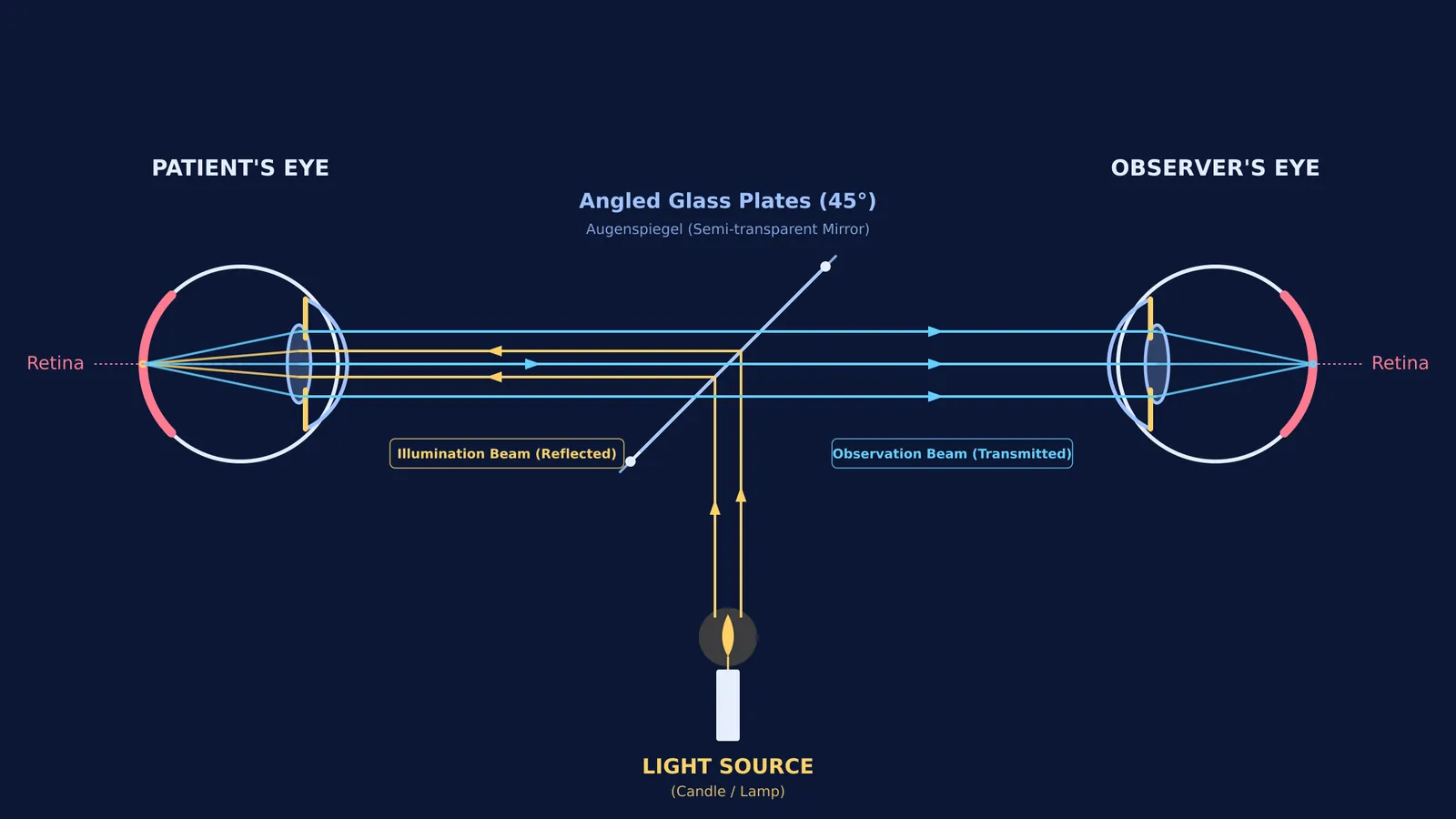
In 1851, German physiologist and physicist Hermann von Helmholtz solved this optical puzzle by inventing the ophthalmoscope Wikipedia. He originally built the device to demonstrate to his students why the pupil sometimes appeared black and sometimes light.
Helmholtz placed three angled microscope glass plates between himself and the patient. A candle at the side shone light onto the glass. The glass acted as a semi-transparent mirror, reflecting the light directly into the patient's pupil. When that light bounced off the retina and travelled back out, it passed straight through the glass plates into Helmholtz's eye. For the first time, an observer could clearly see the optic disc and retinal blood vessels in a living patient.
A year later, in 1852, his machinist Egbert Rekoss improved the device by adding two rotatable discs containing various lenses. This Rekoss disc allowed the examiner to quickly switch lenses to correct for refractive errors and focus the image.
Did Charles Babbage invent the ophthalmoscope first?
Surprisingly, yes. In 1847, four years before Helmholtz, the English mathematician Charles Babbage built a working prototype Wikipedia. Babbage used a small mirror with the silvering scraped off in spots, intending to reflect light into the eye while looking through the clear openings.
However, when Babbage showed his prototype to an eminent eye surgeon, the doctor was unable to obtain a clear image, and Babbage abandoned the project. Helmholtz succeeded because he solved both the illumination geometry and the optical focusing requirements, combining a reflection surface with corrective lenses.
How to use this practical framework for solving ray optics problems?
Helmholtz’s breakthrough came from breaking a complex system down into fundamental rays. When you are studying for physics exams, questions combining mirrors and lenses often look just as confusing as seeing the living retina once did. If you get stuck on optical instrument problems, use this three-step framework:
Isolate the first interaction. Ignore the final image. Draw the rays from the object to the very first optical element, whether finding concave mirror images for all six object positions, Class 10 or refracting through a lens, and calculate the position of the intermediate image.
Make the image the new object. The image formed by the first component becomes the object for the second. For instance, in a lens and mirror set apart: tracing the image through both, the output of the lens is the input for the mirror. If the intermediate image forms *behind* the second component, treat it as a virtual object.
Trace the chief rays. Do not draw a random scatter of lines. Track a ray passing through the optical centre and a ray parallel to the principal axis. This is the same fundamental skill tested in tracing a ray through a glass slab: the Class 10 practical.
When a multi-step optics problem leaves you staring at a blank page, the Fermi Problem Library provides worked problems with a step-by-step solver that explains the reasoning rather than printing an answer. If you find the geometry of lenses and mirrors hard to picture from a static textbook diagram, you can explore them in the Fermi Simulation Lab, which offers interactive simulations for the ideas that are easier to see than to read.


