

On this page
Herman Boerhaave did not believe that medicine could be learned from a book. In the early 18th century, he turned the University of Leiden into the medical capital of Europe simply by demanding that his students look at the patient.
Who was Herman Boerhaave?
Born in the Netherlands in 1668, Boerhaave was a physician, botanist, and chemist. Before his time, medical education was largely theoretical, with students memorizing classical texts in the Hippocratic tradition. Medical students rarely saw a patient before they graduated, and treatments were often based on superstition or outdated theories of bodily humors. Boerhaave saw that reading texts without seeing the disease in reality left young doctors completely unprepared to diagnose or cure anybody.
To fix this, he introduced a systematic, active-learning approach to the human body in both health and disease. He integrated chemistry and botany into the medical curriculum, arguing that you cannot understand how an organ works if you do not understand the chemical processes driving it. His methods were so renowned that students from all over the world flocked to his classes.
How did Boerhaave change medical teaching?
Boerhaave moved his lectures out of the academic hall and into the hospital. Boerhaave used exactly 12 beds—six for men and six for women—at the Caecilia Hospital to train his medical students (Britannica). Despite this small number of patients, these beds became the epicentre of eighteenth-century medical training.
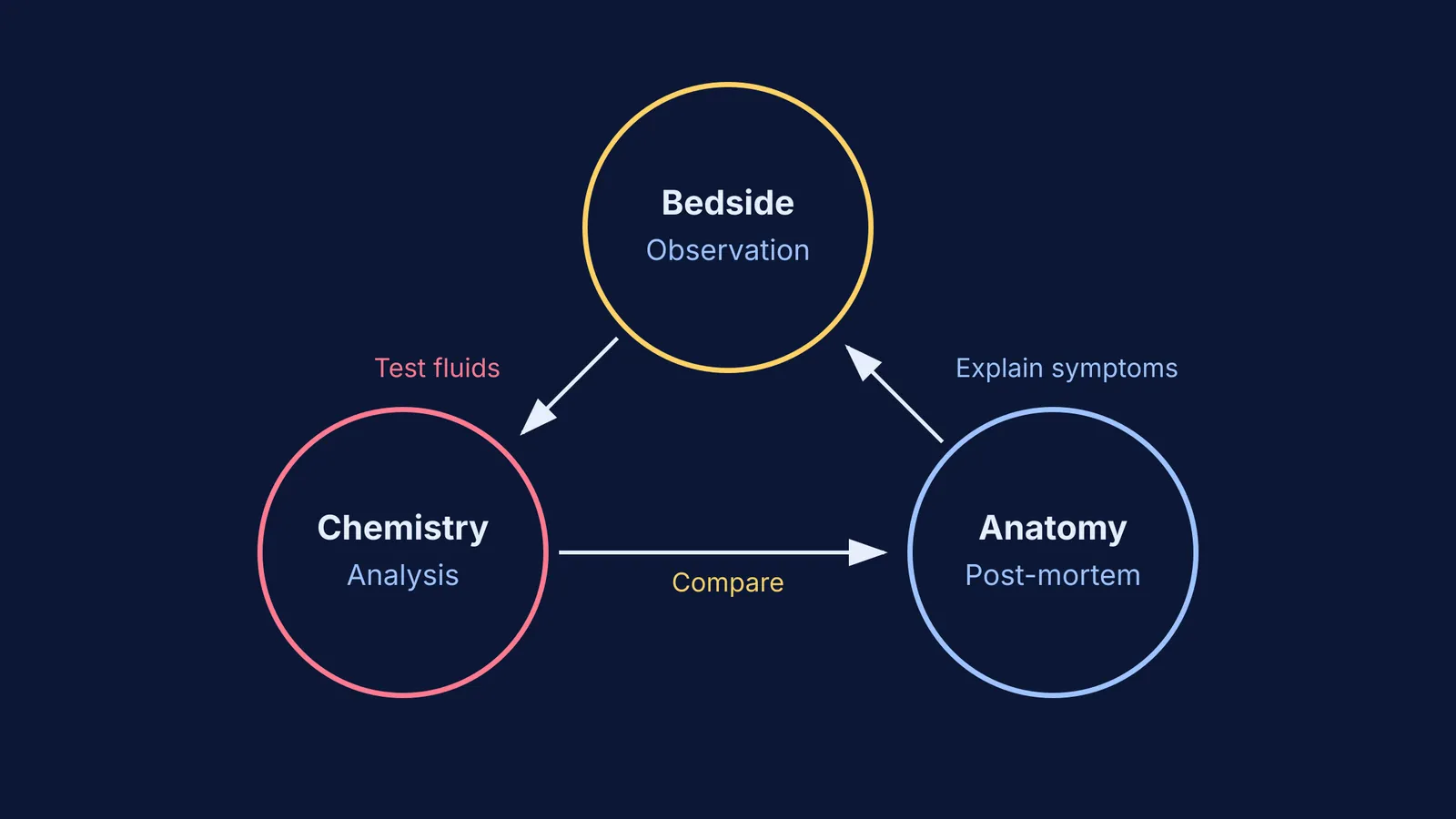
By bringing students directly to the bedside, he formalized what we now call the clinical method. He taught them to track a patient's temperature using an early version of the thermometer, record symptoms meticulously day by day, and test bodily fluids for chemical changes. He insisted that evidence, not theory, must guide the physician. Furthermore, when a patient died, Boerhaave systematically conducted post-mortem examinations. This allowed his students to correlate the physical breakdown of the internal organs with the exact symptoms they had seen at the bedside while the patient was alive. His students went on to found major medical schools in Edinburgh and Vienna, taking this rigorous clinical model with them.
To master a tough science concept today, that same active engagement is just as critical. Fermi's AI tutor teaches by holding a line of reasoning across a session, noticing where a student is stuck, and deciding whether to explain, ask, or show—writing on a board alongside the student to make the learning active.
Why did he write Elementa Chemiae?
Boerhaave's lectures on chemistry were so incredibly popular that his students began publishing unauthorized, error-filled versions of his notes. Frustrated by these pirated texts and the spread of misinformation, Boerhaave decided to write the definitive guide himself.
He was the first person to isolate urea from urine, publishing the method in his 1732 textbook *Elementa Chemiae* (Wikipedia). In doing so, he effectively laid the foundations for modern biochemistry. The book was split into two massive volumes: the first covered the theoretical foundations of chemistry and the tools of the trade, while the second focused entirely on practical chemical operations and experiments involving plants, animals, and minerals.
*Elementa Chemiae* replaced the cryptic, secretive traditions of alchemy with clear, systematic experiments on the physical properties of substances, much like Wilhelm Pfeffer and the first measurement of osmotic pressure later did for physical chemistry. It remained the most widely read and influential chemistry textbook of the entire century.
When studying chemical reactions or physics, reading a textbook is rarely enough. The Simulation Lab provides interactive simulations for the ideas that are easier to see than to read, bringing phenomena to life much like Boerhaave's live demonstrations.
A framework for clinical observation
Boerhaave's lasting genius was not just in what he knew, but in how he taught others to find the truth. He recognized that active, hands-on observation builds a much stronger mental model than passively reading a text. Whether you are observing a biological specimen under a microscope, or reading about Albert Szent-Gyorgyi and the isolation of vitamin C, you can apply Boerhaave's methodical approach to your own science studies.
Observe the raw data: Do not start with the formula. Look at the physical system, the chemical reaction, or the biological process (like Kikunae Ikeda and the discovery of umami taste) conceptually first.
Track the changes: Write down what happens as variables shift. In medicine, this means recording a fever; in chemistry, it means noting a colour change or a temperature drop.
Find the physical cause: Never memorize an effect without linking it to a cause. Tie the macroscopic symptom you observed back to the underlying anatomy or chemical mechanism.
Test your hypothesis: Once you think you understand the mechanism, predict what will happen if you change a variable. Then, run the experiment (or solve the practice problem) to see if reality matches your prediction.


