

On this page
Before the 1850s, steel was made in small batches and used mostly for tools. Rails and girders were made of wrought iron, which workers produced by stirring molten iron by hand. Henry Bessemer found a way to turn a large charge of molten iron into malleable metal in about twenty minutes, using only a blast of air. This post explains the chemistry, works through the numbers, and looks at how he dealt with a failure that nearly ended the idea.
Who was Henry Bessemer?
In his autobiography, Sir Henry Bessemer, F.R.S.: An Autobiography (1905), Bessemer writes that he was born at Charlton, Hertfordshire, on 19 January 1813. The book's closing chapter, written after his death, gives the date of death as 15 March 1898. Britannica's biography describes him as the son of an engineer and typefounder who made money from inventions such as a process for "gold" paint powder before turning to metallurgy. He was knighted in 1879.
What problem was Bessemer trying to solve?
Britannica explains the materials of the time. Cast iron from the blast furnace contains a lot of carbon, which makes it strong in compression but brittle. Wrought iron, needed for rails and spans, was made by "puddling": stirring molten iron to burn off carbon, then hammering out lumps of 100 to 200 pounds full of slag. It was slow, hot, skilled work.
Bessemer noticed, while working on a furnace, that pieces of pig iron left in a stream of hot air had turned into thin shells of decarburised iron. In the autobiography he describes the next step: about 10 lb of molten grey pig iron in a crucible, blown with air for thirty minutes, became soft malleable iron. But the crucible sat in a hot furnace the whole time. The real question, he wrote, was whether the air alone could make enough heat to keep the metal liquid.
What happened in the first converter?
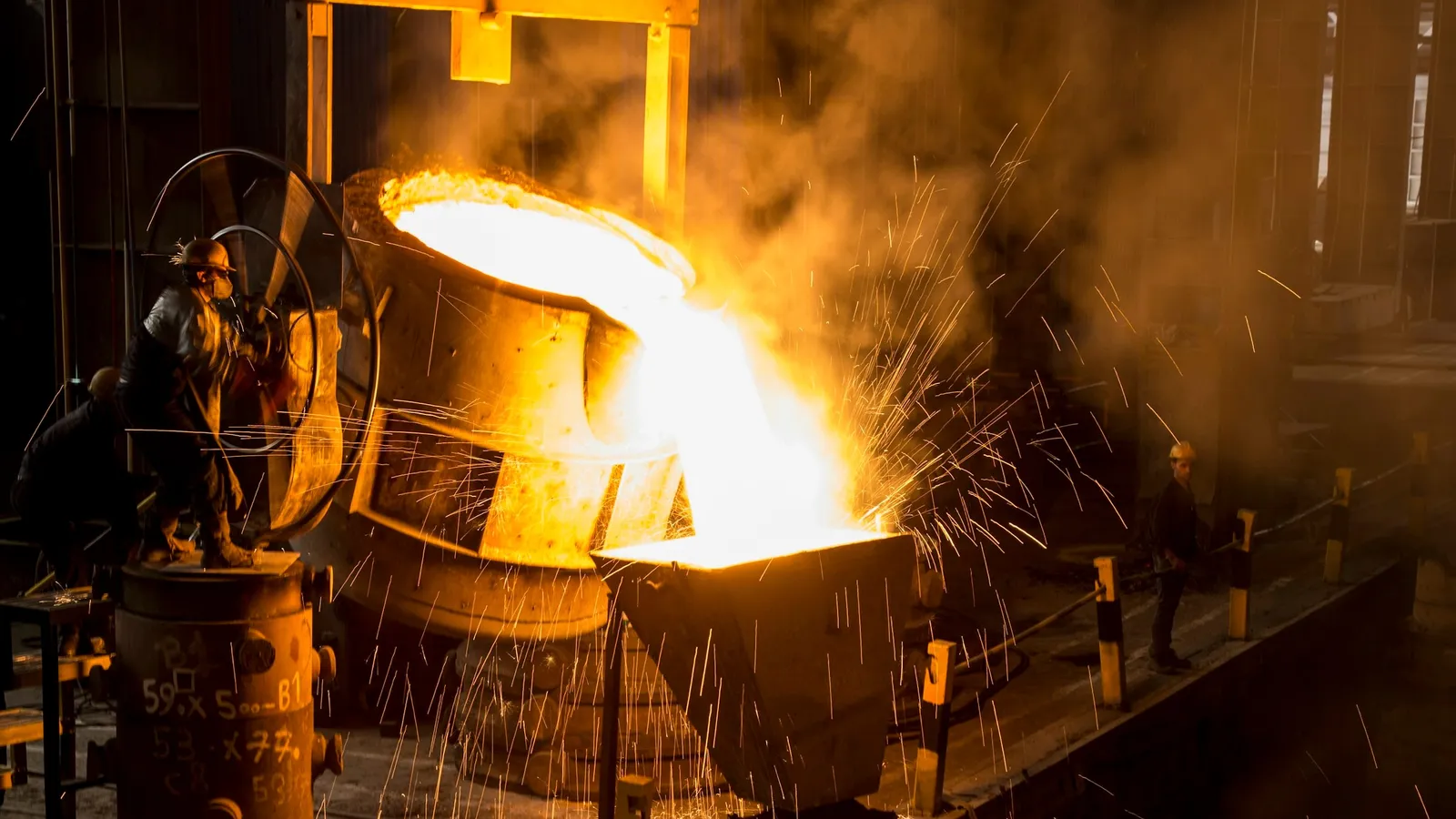
He built a cylindrical vessel about 4 feet tall with six air pipes, called tuyeres, near the bottom, and ran in about 7 cwt of molten pig iron under a blast of 10 to 15 lb pressure. For about ten minutes only sparks rose. Then, in his words, "the silicon had been quietly consumed, and the oxygen, next uniting with the carbon, sent up an ever-increasing stream of sparks and a voluminous white flame". Slag and metal erupted from the top. Ten minutes later it was over, and the metal was "wholly decarburised malleable iron". No fire had heated the vessel inside or out.
The chemistry is oxidation:
Si + O₂ → SiO₂, which goes into the slag.
2C + O₂ → 2CO, which burns at the mouth as the white flame.
Both reactions are exothermic. The heat they release is what keeps the iron molten.
Worked example: how much air does the carbon need?
Bessemer gives the charge (7 cwt) but not its carbon content, so the 4% carbon below is a sample figure for illustration. Use 1 cwt = 50.8 kg, C = 12.0 g/mol, air = 21% oxygen by volume, and 22.4 L/mol at STP.
Mass of charge: 7 × 50.8 = 355.6 kg.
Mass of carbon at 4%: 0.04 × 355.6 = 14.2 kg = 14,200 g.
Moles of carbon: 14,200 ÷ 12.0 ≈ 1,184 mol.
For 2C + O₂ → 2CO, moles of O₂ = 1,184 ÷ 2 = 592 mol.
Moles of air = 592 ÷ 0.21 ≈ 2,820 mol.
Volume at STP = 2,820 × 22.4 L ≈ 63,200 L, or about 63 m³.
A common slip is to use C + O₂ → CO₂ without checking the product. That doubles the oxygen. In the converter most carbon leaves as CO, which is why a flame burns at the mouth.
Why did the process fail for others, and what did he do?
After he read his paper at the British Association meeting in Cheltenham in August 1856, ironmasters took licences. The autobiography describes what followed: trials at several works were "most disastrous", because their pig iron contained so much phosphorus that the process could not make good iron from it. Bessemer had been testing with grey Blaenavon pig iron, which happened to be low in phosphorus. The press called his invention a meteor that had burned out.
He did not argue in the newspapers. He wrote that "action was necessary, and not words", and set about making the process work commercially himself, using phosphorus-free iron. Britannica's article on the Bessemer process notes that William Kelly in the United States had worked on a similar air-blast idea from 1847, that Robert Mushet's iron-manganese alloy helped remove excess oxygen, and that phosphoric ores could only be used after Sidney Gilchrist Thomas developed a new lining around 1877. Cheap steel then replaced iron in rails and buildings.
What can a student take from Bessemer's way of working?
Notice the odd result. A shell of pure iron in a furnace was a clue, not a nuisance.
Separate the variables. His crucible test proved decarburisation; the converter tested heat alone.
When a result fails elsewhere, look for what was different. Here it was phosphorus in the iron.
If mole calculations like the one above still feel shaky, the Fermi Problem Library has worked problems with a step-by-step solver that explains the reasoning rather than printing an answer. Steel rails soon carried trains like those in our post on George Stephenson and the early railways.
Try it now: redo the air calculation assuming all the carbon burns to CO₂, and explain why the answer is different.


