

On this page
Before the invention of modern electronics, scientists had to rely on the physical properties of water and air to measure how fast things were moving. In 1732, a simple glass tube changed the way we understand fluid mechanics.
Who invented the Pitot tube?
Henri Pitot (1695–1771), a French hydraulic engineer, invented the device that bears his name in 1732. At the time, he was working on measuring the flow velocity of the River Seine in Paris.
Before Pitot's work, many scientists incorrectly believed that the velocity of flowing water increased as you went deeper below the surface. Pitot's careful measurements proved the opposite: the water actually flows more slowly near the riverbed because of friction against the bottom.
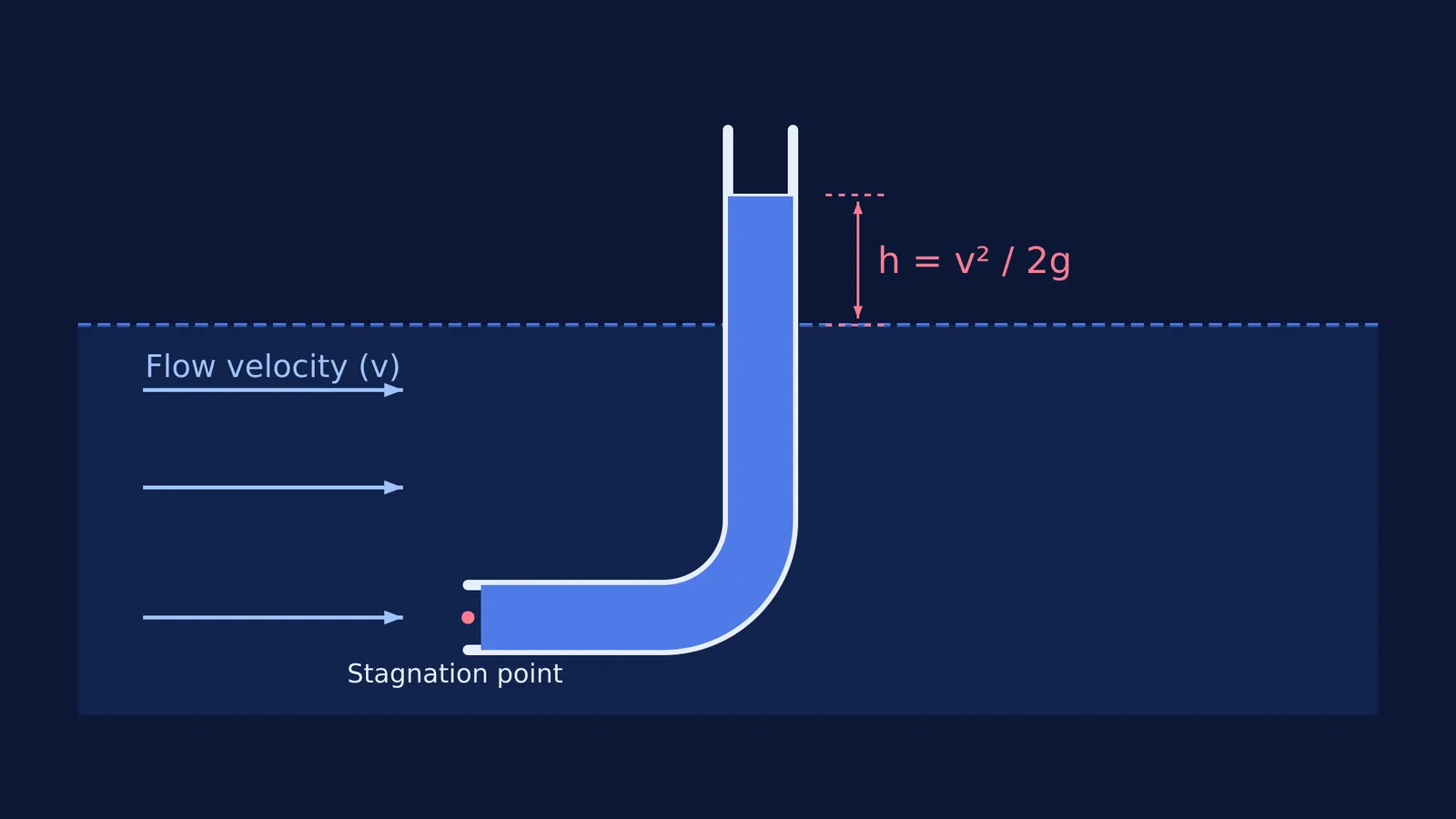
He achieved this breakthrough using an instrument that was remarkably simple in its design. Pitot used an L-shaped glass tube, open at both ends. He placed the short end in the river, pointing directly upstream into the flow of the water.
How does a Pitot tube work?
When a stream of fluid hits the open end of the tube, the fluid at that exact point stops moving. This spot is known as the stagnation point. Because the kinetic energy of the moving fluid is converted into pressure, the water inside the vertical part of the tube is pushed upward, rising above the free surface of the river.
Pitot discovered that the height the fluid rises, h, is proportional to the square of the fluid's velocity, v. The relationship is given by the equation v = √(2gh), where g is the acceleration due to gravity. This physical relationship forms the basis for how we still measure fluid flow today, relying on the same principles of pressure seen when two immiscible liquids in a manometer balance each other out.
If you are studying fluid dynamics and find pressure differences hard to picture, the Fermi Simulation Lab has interactive simulations for the ideas that are easier to see than to read.
Calculating fluid speed: a worked example
Imagine you are standing on a bridge, holding a basic Pitot tube in a stream of water. You notice that the water level inside the vertical part of the tube rises 0.2 metres above the flat surface of the stream.
You can calculate the exact speed of the current using the formula Pitot discovered:
Note the height h of the fluid column above the surface: h = 0.2 m.
Use the standard acceleration due to gravity on Earth: g = 9.8 m/s².
Multiply the values inside the square root: 2 × 9.8 × 0.2 = 3.92.
Take the square root of 3.92 to find the velocity v.
The velocity of the stream is √3.92, which is approximately 1.98 metres per second. This simple calculation—using only the height of a column of water—is the same principle that allows modern jets to know they are travelling safely through the sky.
How do aircraft measure airspeed?
While Pitot's original tube was brilliant for open rivers, it was difficult to use in closed pipes or fast-moving vehicles. In 1858, another French engineer named Henry Darcy modified the design into what we now call a Pitot-static tube.
Darcy added a second set of holes that measure the static pressure of the fluid without being affected by its forward motion. By comparing the total stagnation pressure from the front of the tube with the static pressure from the side, an instrument can calculate the exact speed of the fluid.
Today, nearly every commercial and military aircraft relies on a pitot-static system to measure its airspeed. It is usually seen as a small, sharp, heated probe sticking out from the nose or the wing of the aeroplane. The careful study of how air flows around these probes and wings is a vast field of physics, explored further by later scientists such as Roddam Narasimha and his work on turbulence in fluid flow.
What else did Henri Pitot discover?
Beyond fluid mechanics, Henri Pitot was a versatile scientist and engineer. In geometry, he proved Pitot's theorem in 1725, which states that for any tangential quadrilateral inscribed in a circle, the sums of the lengths of its opposite sides are equal.
He also served as the chief engineer for the Languedoc region of France. There, he directed the construction of the Saint-Clément Aqueduct in Montpellier and oversaw the repair of the famous Roman bridge, the Pont du Gard.
If you are working on a physics problem about fluid velocity or pressure and do not know where to start, the Fermi Problem Library provides worked problems with a step-by-step solver that explains the reasoning rather than printing an answer.


