

On this page
In classical physics, a vacuum is a space devoid of all matter and energy. But in quantum field theory, "empty" space is never truly empty. It is constantly buzzing with virtual particles that pop in and out of existence. This zero-point energy is usually invisible, but in 1948, the Dutch physicist Hendrik Casimir realised it could exert a physical push.
Casimir predicted that two uncharged, perfectly conducting metal plates placed very close together in a vacuum would attract each other. Today, the Casimir effect is a proven phenomenon that engineers must account for when building nanoscale machines.
What is the Casimir effect vacuum force?
The Casimir effect is a tiny, attractive force that acts between two parallel conducting plates in a vacuum (Casimir, 1948). Unlike gravity or electrostatic attraction, it does not depend on the plates having mass or electrical charge. For example, a typical capacitor in a DC circuit at steady state consists of two parallel plates, but if you removed all charge from them and placed them in a perfect vacuum, a mysterious inward pressure would remain.
This pressure comes entirely from the surrounding space. It is a macroscopic, measurable consequence of quantum vacuum fluctuations.
How do quantum fluctuations push plates?
According to quantum mechanics, the vacuum is filled with electromagnetic waves of all possible wavelengths constantly appearing and disappearing. These virtual photons have their own photon energy and momentum.
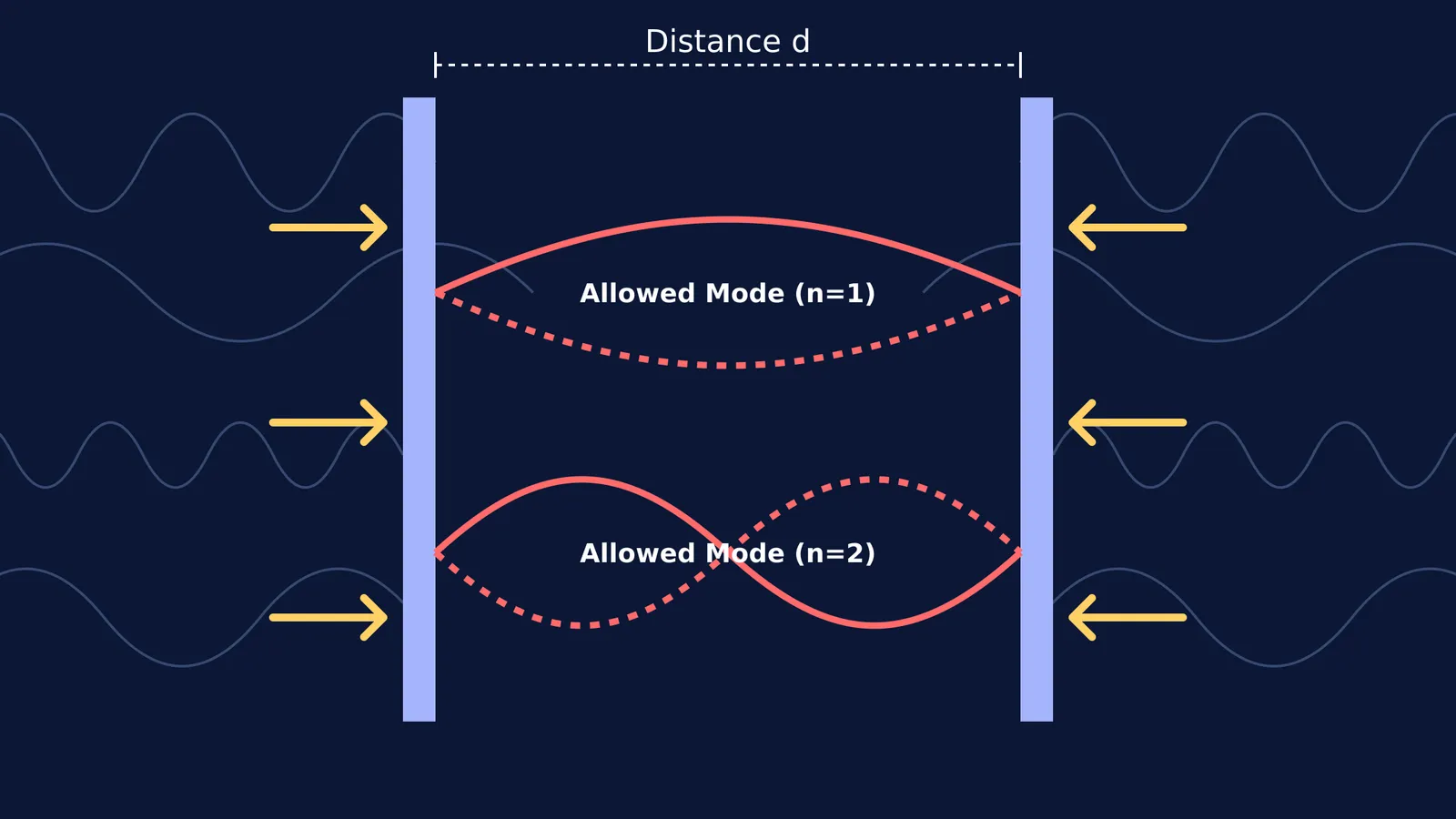
When you place two conducting plates close to each other, they act like mirrors for these virtual waves. The gap between the plates imposes a boundary condition: only waves with a wavelength that fits exactly into the gap (like standing waves on a guitar string) can exist there.
Outside the plates, there are no such restrictions, so a full, infinite spectrum of virtual photons exists. Because there are more virtual photons bouncing off the outside of the plates than on the inside, there is a higher radiation pressure on the outside. This difference in pressure pushes the plates together.
How to calculate the Casimir pressure?
Casimir's original paper, *On the attraction between two perfectly conducting plates*, showed that the pressure depends only on fundamental constants and the distance between the plates. The formula for the Casimir pressure P is:
P = π²ℏc / (240 d⁴)
Here, ℏ is the reduced Planck constant, c is the speed of light, and d is the distance between the plates.
Because the force scales with the inverse fourth power of the distance, it is negligible at everyday scales. However, it grows rapidly at microscopic distances. At a separation of 10 nanometers, the theoretical pressure reaches approximately 1 atmosphere (Wikipedia).
Has the Casimir effect been proven?
Yes. While Casimir published his theory in 1948, it took decades for technology to catch up to the challenge of measuring such a weak force between two perfectly parallel plates. In 1997, Steven Lamoreaux conducted the definitive experiment by using a spherical lens and a flat quartz plate (both coated in copper and gold).
By avoiding the impossible task of keeping two flat plates perfectly parallel, Lamoreaux measured the force using a torsion pendulum at distances between 0.6 and 6.0 micrometers. His results matched Casimir's theoretical predictions to within 5% (Lamoreaux, 1997).
Today, the Casimir effect is a practical problem in Microelectromechanical Systems (MEMS). In microscopic sensors and actuators, components can get so close that the Casimir force clamps them together, a failure mode known as "stiction".
Understanding concepts like zero-point energy often requires seeing the invisible. The Fermi Simulation Lab has interactive simulations for the ideas that are easier to see than to read, letting you adjust parameters like plate separation to watch how quantum forces shift in real time.


