

On this page
In 1942 a Hollywood film star and an avant-garde composer were granted a patent for a radio system that hops from one frequency to another to stay out of an enemy's reach. The star was Hedy Lamarr. The composer was George Antheil. Their idea, frequency hopping, is still in use: the Bluetooth radio in your earphones does a version of it all the time.
How did Hedy Lamarr invent frequency hopping?
The patent is US 2,292,387, "Secret Communication System". It was filed on 10 June 1941 and granted on 11 August 1942. The inventors are listed as Hedy Kiesler Markey, Lamarr's married name at the time, and George Antheil.
The problem was guiding a torpedo by radio. If it listens on one fixed frequency, an enemy only has to blast noise there to cut it off. The patent describes "remote control of dirigible craft, such as torpedoes", and aims for a system that is "difficult to discover or decipher".
The answer was to keep changing the frequency, with the transmitter and the receiver in the torpedo changing at exactly the same moments. To do that they borrowed from music. The patent uses "records of the type used for many years in player pianos": long paper rolls with holes punched in rows. It notes that a player-piano roll can have 88 rows of holes, which "would permit the use of 88 different carrier frequencies". Both rolls would be kept in step by "accurately calibrated constant-speed spring motors", like those used in clocks.
They were not the first to suggest switching frequencies: this history of frequency-hopping spread spectrum traces the idea back to a 1903 patent by Nikola Tesla.
Where did an actor get the technical background? The National Inventors Hall of Fame, which inducted Lamarr in 2014, says she had once been married to a munitions manufacturer, which gave her a foundation in weapons systems, including torpedo control.
Why does frequency hopping stop jamming?
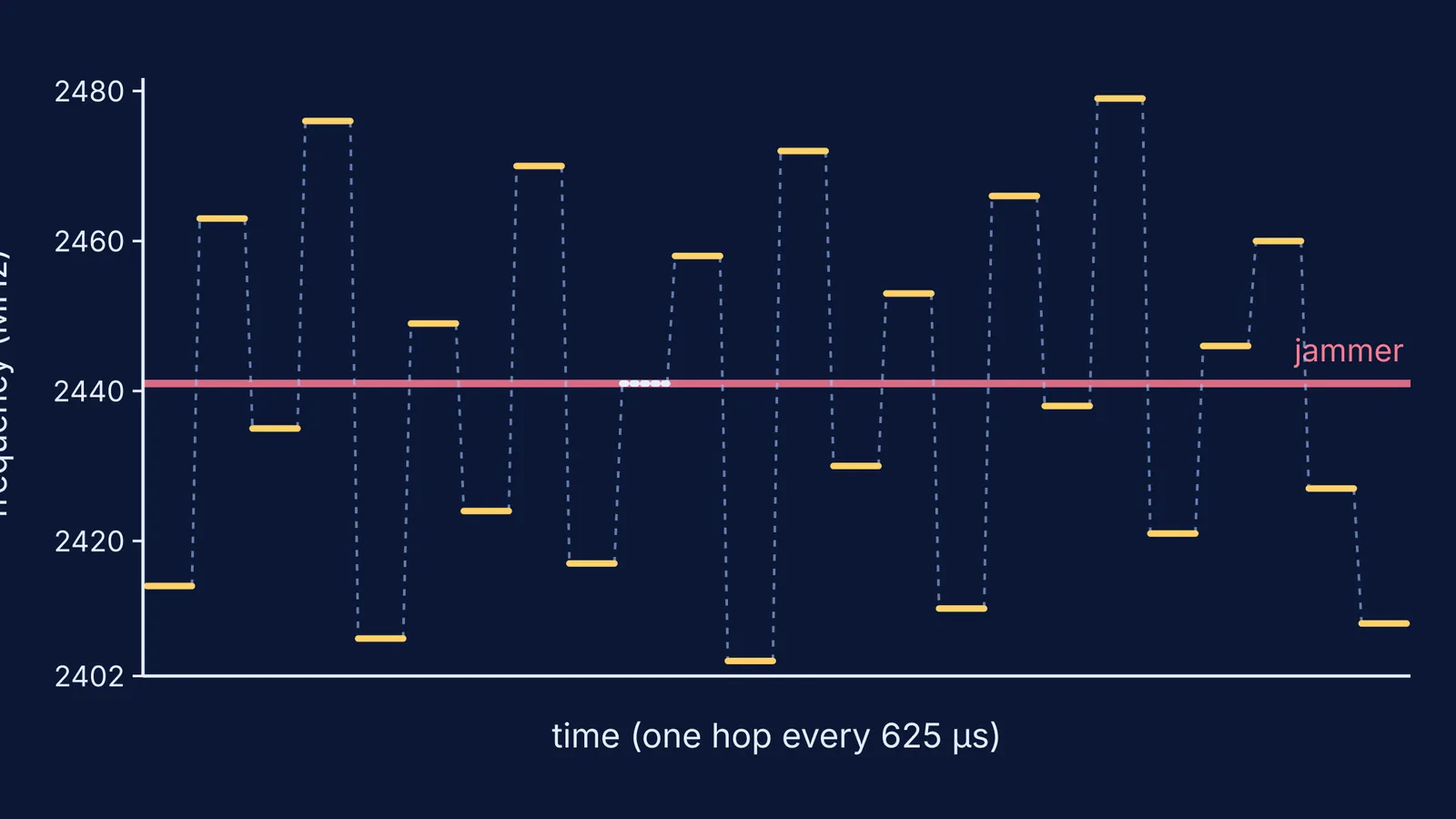
Frequency hopping means a transmitter and a receiver switch carrier frequency together, following a sequence that only they know. A jammer tuned to one frequency only catches the moments when the signal lands there.
Here is a worked example you can do on paper, using the 88 frequencies from the patent.
Fixed frequency: a jammer that finds your one channel blocks 100% of the time.
Hopping across 88 channels, each used equally often: the jammer's channel is in use only 1 time in 88, or about 1.1% of the time.
To block everything, the enemy now needs 88 jammers, or one jammer spread across 88 times the bandwidth, with its power spread thin.
If the sequence looks random, the enemy cannot predict the next hop and follow it.
Is Lamarr's idea really inside Wi-Fi and Bluetooth?
For Bluetooth, yes, quite directly. The Bluetooth SIG says both Bluetooth Classic and Bluetooth Low Energy use frequency-hopping spread spectrum in the 2.4 GHz band. Classic Bluetooth uses 79 channels spaced 1 MHz apart, and Bluetooth Low Energy uses 40 channels spaced 2 MHz apart.
An application note from Rohde & Schwarz gives the numbers for a Classic connection: up to 1600 hops per second, across channels at 2402 MHz plus 1 MHz times the channel number. One hop every 1/1600 of a second is 625 microseconds. Since version 1.2, Bluetooth also uses adaptive frequency hopping, which notices busy channels, such as one crowded by a Wi-Fi network, and leaves them out of the pattern.
Redo the worked example with Bluetooth's 79 channels: a jammer on one channel catches about 1 hop in 79, around 20 of the 1600 hops each second. Adaptive hopping can then mark that channel as bad and avoid it.
For Wi-Fi, the link is through the first standard. The IEEE 802.11 working group notes that the original 1997 standard offered two radio options in the 2.4 GHz band: a frequency-hopping spread spectrum radio and a direct-sequence spread spectrum radio, each at 1 Mbit/s with 2 Mbit/s also offered.
In 1997 the Electronic Frontier Foundation gave Lamarr and Antheil a special award for a technology that "has become a key component of wireless data systems".
What can students learn from Hedy Lamarr's invention?
Ideas cross fields. A torpedo problem was solved with a piano roll.
Do the numbers. The jamming argument is just probability: 1 in 88, then 1 in 79.
Connect it to what you study. A carrier frequency is the frequency of an electromagnetic wave, and hopping just means changing which one you use.
For more radio history, read about Edwin Armstrong's FM radio, built to beat static, Guglielmo Marconi's first radio signals across the Atlantic, and Claude Shannon's way of measuring information in bits.
If words like carrier frequency or bandwidth are still fuzzy, the Fermi Concept Library has a lesson for every concept in physics, each with its place in the map. The Fermi Simulation Lab has interactive simulations for ideas like these.


