

On this page
Ernst Weber and Gustav Fechner established that our perception of a stimulus changes logarithmically, not linearly. Their research showed that the "just noticeable difference" in a stimulus is a constant fraction of its starting intensity, meaning a stimulus must increase by a constant percentage, such as 5% for lifted weights (Wikipedia), for you to perceive a difference.
If you add one candle to a dark room, you notice it immediately. If you add that same candle to a brightly lit sunlit office, it makes no visible difference at all. This everyday experience forms the basis of psychophysics, the science of how physical stimuli translate into human sensation.
The relationship between what happens in the physical world and what our brains actually perceive was defined by two German researchers in the 19th century. Together, their findings explain why human senses can handle both a whisper and a jet engine without being overwhelmed.
What is the Weber-Fechner law?
The Weber-Fechner law is a combination of two connected principles that describe how sensation scales with stimulus intensity.
In 1834, Ernst Heinrich Weber published *De Tactu*, describing his experiments on weight and touch. He discovered the "just noticeable difference"—the smallest change in a stimulus that a person can detect. Crucially, Weber found that this difference is not an absolute amount, but a constant proportion of the original stimulus. If you are holding a heavy object, a small absolute increase will go unnoticed; the heavier the object, the more weight must be added for you to feel the difference.
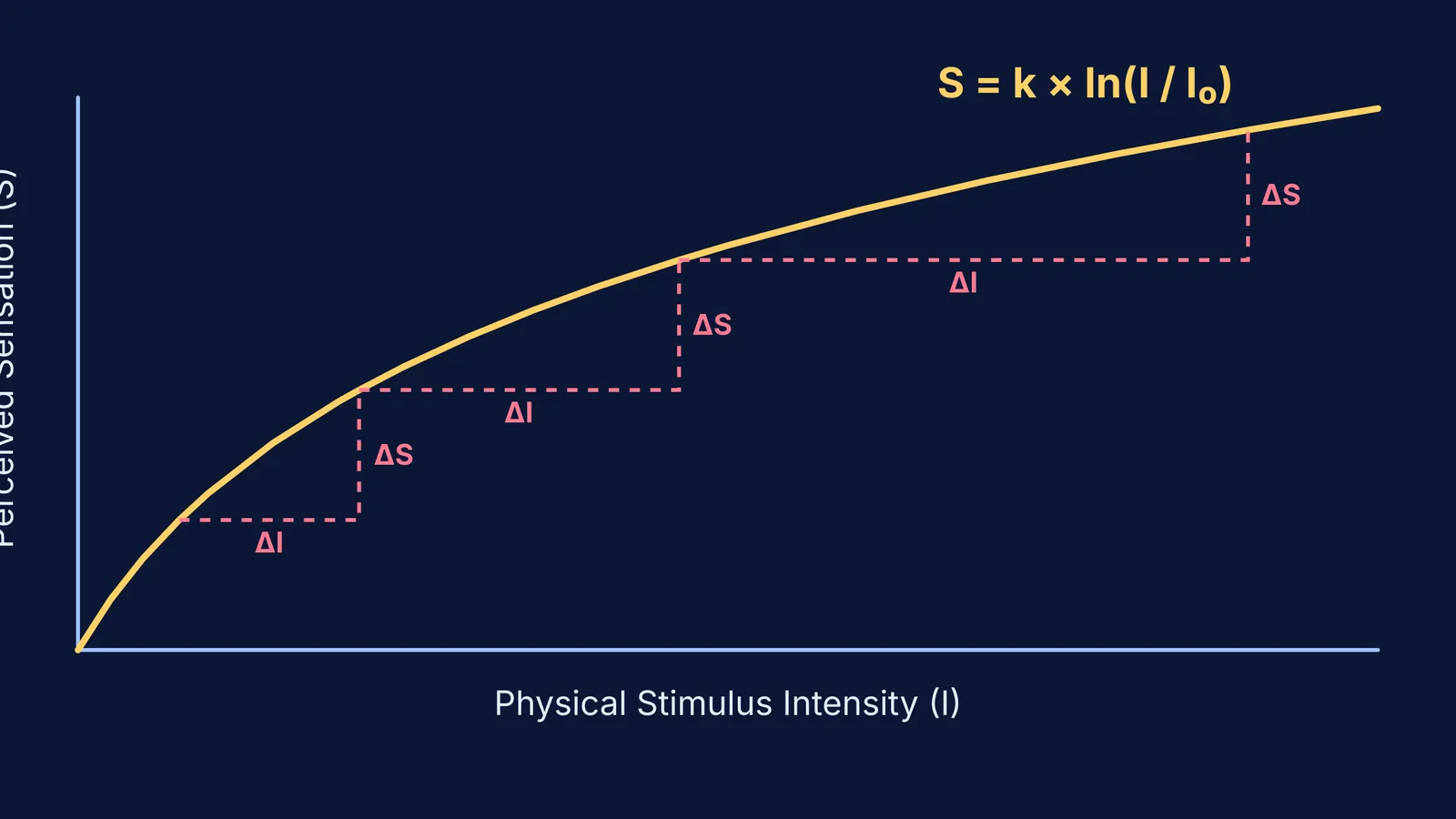
In 1860, Gustav Fechner expanded on Weber's empirical work in his landmark book *Elements of Psychophysics*. Fechner took Weber's proportional changes and integrated them mathematically to construct a formal relationship, proposing that perceived sensation increases as the logarithm of the physical stimulus intensity. This means that as a physical signal in the real world gets exponentially stronger, our subjective sensation of it only grows in linear, evenly spaced steps. This mathematical insight is why we measure sound volume in decibels or earthquake intensity on the Richter scale, both of which are logarithmic.
Students studying sensory biology or physics often find logarithmic scales hard to picture because they contradict our daily intuition. The Fermi Simulation Lab provides interactive simulations for the ideas that are easier to see than to read, allowing you to increase a virtual stimulus and watch the resulting non-linear response curve update in real time.
What is the Weber fraction for perception?
Because our senses are tuned differently, the constant proportion required to notice a change—known as the Weber fraction—depends on what you are measuring. A smaller fraction means the sense is more highly sensitive.
For example, experiments have shown that the typical Weber fraction for detecting a change in a lifted weight is about 5% (Wikipedia). This means if you are carrying a 10 kg backpack, you would need to add at least 0.5 kg (5%) to feel that it has become heavier. Understanding these proportional thresholds is essential for studying phenomena like displacement and pressure waves in sound or the dispersion of white light by a glass prism.
How do you calculate sensation with Fechner's formula?
Fechner's Law is expressed by a simple logarithmic equation that links the physical and mental worlds:
S = k × ln(I / I₀)
S is the perceived sensation.
I is the physical intensity of the stimulus.
I₀ is the threshold intensity (the lowest level you can perceive).
k is a constant specific to the sense being measured.
When solving equations involving logarithms, a common mistake is incorrectly isolating the variable inside the natural log function. If you are stuck calculating sensory thresholds or manipulating exponents, the Fermi Problem Library has worked problems with a step-by-step solver that explains the reasoning rather than printing an answer.
Understanding logarithmic perception gives you a better intuition for how the human body measures the world. The next time you turn up the volume, remember that your ears are actively compressing reality.


