

On this page
When a star is born, it does not just quietly light up. It announces its arrival with violent jets of gas that smash into the surrounding space.
For decades, astronomers saw mysterious glowing knots in the dark clouds where stars form, but they did not know what they were. It took two astronomers, looking at the same patches of sky from different observatories, to realise they were seeing the first breaths of newborn stars.
What are Herbig-Haro objects?
Herbig-Haro (HH) objects are small, bright patches of glowing gas found in active star-forming regions. They are transient phenomena that serve as visual signposts for newborn stars.
In 1951, the American astronomer George H. Herbig published a paper describing two peculiar, star-like nebulae with unusual spectra near a reflection nebula called NGC 1999 (Herbig, 1951). Working independently at the Tonantzintla Observatory in Mexico, Guillermo Haro found the same objects and published his own discovery the following year (Haro, 1952). Haro noticed these objects were invisible in infrared light, proving they were not simply stars hidden by dust, but a distinct class of glowing nebula.
The Soviet astronomer Viktor Ambartsumian later named them Herbig-Haro objects in honour of their discoverers. Ambartsumian suggested that these glowing knots represented the earliest stages of star formation, a hypothesis that ultimately proved correct.
How are Herbig-Haro objects formed?
The glow of a Herbig-Haro object is actually a massive cosmic collision.
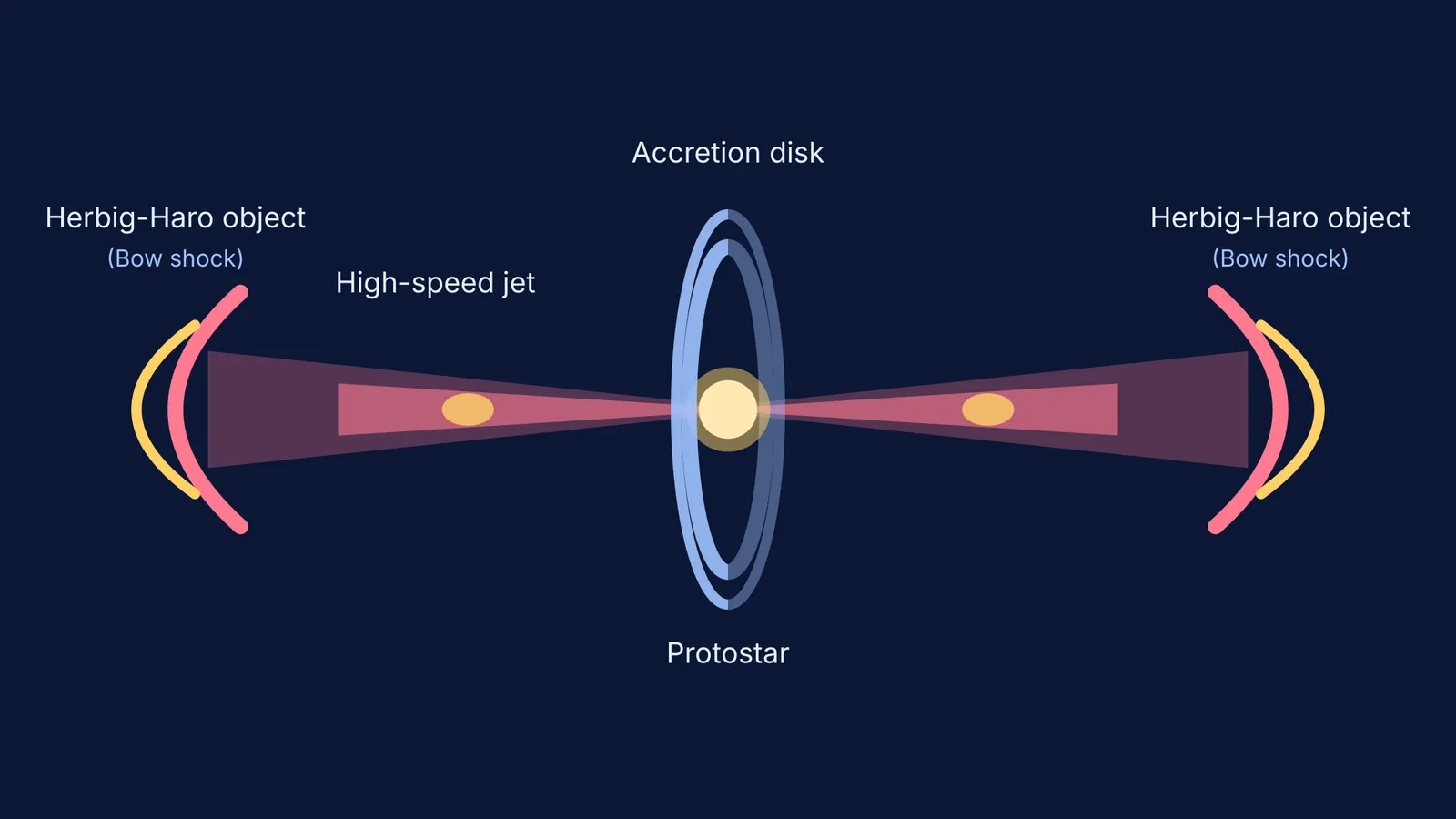
When a young protostar forms deep inside a molecular cloud, it pulls in material from a surrounding accretion disk. However, the rapidly spinning star cannot swallow all of this incoming matter. To shed excess angular momentum, the star ejects a fraction of this gas from its north and south poles in highly focused jets. These narrow jets shoot outward at extreme speeds, carving a path through the surrounding cloud.
When these high-speed jets slam into the cold, dense gas of the interstellar medium, they create powerful shock waves—much like the bow shock in front of a moving ship. The collision heats the gas intensely, ionizing it and causing it to glow brightly across the visible spectrum. If you find these concepts hard to picture, the Fermi Simulation Lab offers interactive simulations for the ideas that are easier to see than to read, such as how magnetic fields and rotation shape gas around a star.
Because a star has two poles, Herbig-Haro objects often appear in pairs. They are perfectly aligned on either side of a dark, dusty region where the parent protostar is completely hidden from view.
Who was Guillermo Haro?
Guillermo Haro was a towering figure in Mexican science who originally studied philosophy and law before turning his attention to the night sky. His journey into astronomy began while working as a reporter, where a visit to an observatory sparked a lifelong fascination with the cosmos.
Beyond Herbig-Haro objects, Haro discovered "flare stars" in the Orion Nebula—stars that undergo sudden, dramatic increases in brightness. He also identified a unique class of blue galaxies that undergo intense bursts of star formation, now known as Haro galaxies. He later served as the first president of the Mexican Academy of Sciences and founded the National Institute of Astrophysics, Optics and Electronics (INAOE), laying the groundwork for modern astronomy in Mexico.
His work on star formation connects deeply with the tools astronomers still use today. You can read more about how scientists read the signatures of distant stars in our guide to Meghnad Saha's ionisation equation, or explore the wider universe in our piece on Vesto Slipher and the first redshifts of galaxies.
A framework for reading astronomical discoveries
When astronomers like Haro and Herbig look through a telescope, they rarely see a clear picture of a star. Instead, they look at spectra—the fingerprint of light broken into its component colours. If you want to understand how astrophysics works, use this three-step framework for reading a spectrum:
Look for the continuous spectrum: A dense, hot object (like the core of a star) emits light at all wavelengths, creating a smooth rainbow.
Spot the absorption lines: If that light passes through a cooler gas (like a star's outer atmosphere), the gas absorbs specific wavelengths. These appear as dark lines and tell you what elements are in the cooler gas.
Identify the emission lines: If you see bright lines on a dark background, you are looking at a hot, glowing gas against the cold backdrop of space.
This third signature—strong emission lines of hydrogen, oxygen, and sulphur without a continuous background—is exactly what Herbig and Haro saw. It proved that the bright knots were not stars, but glowing shock waves of gas, giving us our first direct look at the violent birth of a star.


