

On this page
Gottlieb Haberlandt (1854–1945) was an Austrian botanist who saw the plant cell not just as a building block, but as an independent living unit. In 1902, he published a paper that changed how biologists thought about plant cells: *Culturversuche mit isolierten Pflanzenzellen* (Experiments on the Culture of Isolated Plant Cells).
With this work, Haberlandt became the first to attempt to culture isolated plant cells outside the parent plant. His goal was to prove a radical idea: that every living plant cell contains the genetic blueprint to regenerate into a complete, functioning plant. Today, this property is known as totipotency, the ability of a single cell to divide and produce all the differentiated cells in an organism (Wikipedia).
What was Gottlieb Haberlandt's experiment in 1902?
Haberlandt wanted to test his theory by keeping individual cells alive in an artificial environment. He isolated mesophyll cells—the photosynthetic cells found in leaves—from plants like *Lamium purpureum* (purple dead-nettle) and *Tradescantia*. He also experimented with epidermal hairs and other easily accessible tissues.
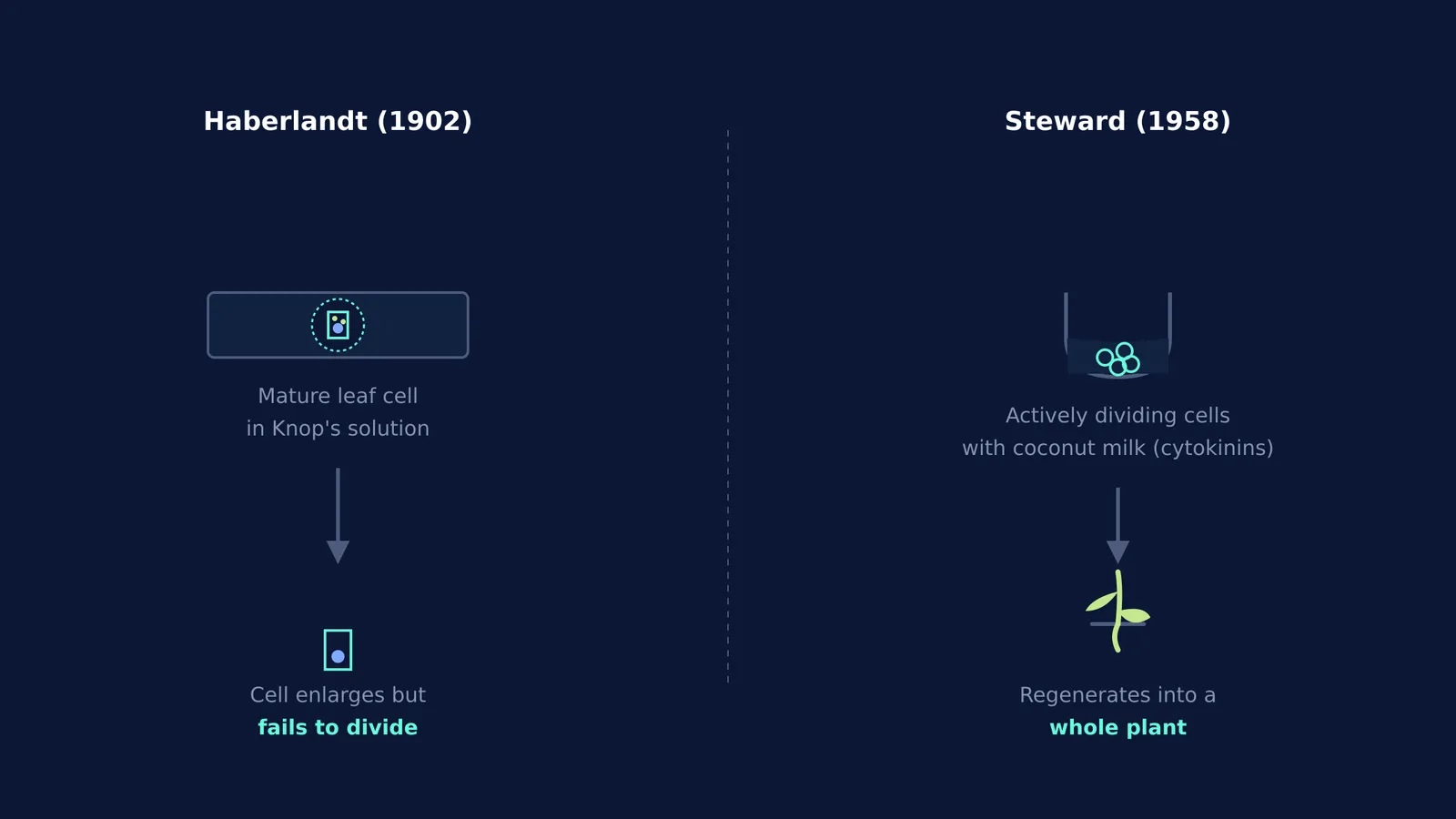
He placed these highly specialized cells into hanging drops on glass slides containing Knop's solution, a simple mixture of mineral salts, supplemented with sucrose for energy. He carefully flamed his instruments to prevent bacterial contamination, taking the first steps towards the sterile conditions that modern laboratories use.
His cells did not die immediately. They remained alive for several weeks, increasing in size and accumulating starch, which showed they were still metabolically active (Springer). However, they failed to divide. He could not produce the artificial embryos he had hoped for.
Why did Haberlandt's experiment fail?
To grow a plant from a single cell, the cell must divide and multiply. Haberlandt's isolated cells expanded, but the nucleus never underwent mitosis.
Modern plant science explains why the 1902 experiment fell short:
Missing chemical triggers: Cell division in plants is controlled by hormones, particularly auxins and cytokinins. In 1902, plant growth regulators were completely unknown to science. Haberlandt predicted that substances driving cell division would eventually be discovered, which turned out to be exactly what was missing.
The wrong cells: Haberlandt used mature, highly differentiated leaf cells. These cells are much harder to reprogram into a dividing state than the actively dividing cells found in plant meristems.
If you have concept gaps in plant anatomy and the cell cycle, the Fermi Concept Library has every concept in biology, each with its own lesson and its place in the map.
What modern tissue culture requires?
Based on Haberlandt's initial hurdles, modern botanists follow this exact checklist to successfully culture plant tissues:
Explant selection: Choose actively dividing tissue (meristem or young shoot) rather than mature leaf cells.
Sterilization: Surface-sterilize the plant material to prevent bacterial and fungal growth.
Nutrient medium: Provide a balanced mix of macronutrients, micronutrients, vitamins, and a carbon source (like sucrose).
Growth regulators: Add the correct ratio of auxins (for root growth) and cytokinins (for shoot growth).
Controlled environment: Maintain optimal temperature, light, and humidity in a sterile growth chamber.
Who is the father of plant tissue culture?
Despite his lack of practical success, Gottlieb Haberlandt is almost universally recognized as the father of plant tissue culture. His 1902 paper was a conceptual breakthrough that moved biology away from merely describing plant anatomy and towards experimentally manipulating it.
He correctly predicted that vegetative cells could be induced to form embryos, a process now called somatic embryogenesis. If you want to dive deeper into how plants develop from single cells, Fermi's AI tutor can work out what you already know and build a plan for the session, starting with the basics of cellular totipotency.
Today, plant tissue culture is a cornerstone of biotechnology and agriculture worldwide. It allows agricultural scientists to rapidly clone disease-free crops, conserve endangered plant species, and develop genetically modified plants that can withstand harsh climates or pests. The medicines, foods, and ornamental plants we rely on today owe a debt to this early research. And it all started with a single, undivided leaf cell on a glass slide in 1902.
For more on how plants grow and reproduce, read about Meristems: apical, intercalary and lateral, and where each lies or how Sipra Guha-Mukherjee and the Datura pollen that grew into embryos pioneered anther culture.


