

On this page
In short
Gideon Sundback perfected the modern zipper in 1913 using the physics of the wedge to convert a simple pull into a secure, lateral locking force.
Before 1913, fastening clothing was a frustrating exercise in buttoning or using clumsy hooks and eyes. While the idea of a sliding fastener existed, earlier versions were unreliable. It was the Swedish-American engineer Gideon Sundback who perfected the design, turning an engineering curiosity into the modern zipper we rely on today.
Who invented the zipper?
The story of the zipper began decades before a practical model was built. In 1851, Elias Howe, the famous inventor of the sewing machine, received a patent for an "Improvement in Fastenings for Garments." However, his device was more of an automatic drawstring than a slide fastener, and he never seriously marketed it.
Forty-two years later, Whitcomb L. Judson, an American inventor, sought a faster way to fasten high button boots. In 1893, Judson patented the "clasp-locker" and debuted it at the Chicago World's Fair. He and his partner Lewis Walker formed the Universal Fastener Company to sell the product, but clothing manufacturers showed little interest.
Why did early zipper designs fail?
Judson's original clasp-locker was essentially a complicated arrangement of hooks and eyes. The mechanical problem with this design was that it suffered from frequent jamming and had a tendency to come apart unexpectedly. Because the hooks were large and spaced widely apart, any bending or twisting of the garment would cause the mechanism to disengage. It lacked the flexibility and durability required for everyday wear.
In 1913, Gideon Sundback, an electrical engineer working for Judson's company, took on the challenge. Sundback realised that the key to a secure hold was density. His new design, the "Hookless No. 2," increased the number of fastening elements from four per inch to 10 or 11 per inch (about one every 2.5 millimetres).
How does the cup and projection mechanism lock?
By making the teeth smaller and packing them tightly together, Sundback ensured that the fastener remained locked even when bent or flexed sharply. He replaced the hook-and-eye concept with identical, interchangeable locking members on two fabric tapes.
According to his U.S. Patent 1,219,881, which was officially granted in 1917, each tooth features an elongated cup shape on one end and a corresponding projection on the other. The projection of one tooth nests perfectly within the recessed cup of the adjoining member on the opposite side. This snug fit ensures the teeth stay locked together under tension, solving the fundamental flaw that plagued Judson's earlier attempts.
How does a zipper actually work?
A zipper is an elegant, everyday application of one of the six classical simple machines: the wedge).
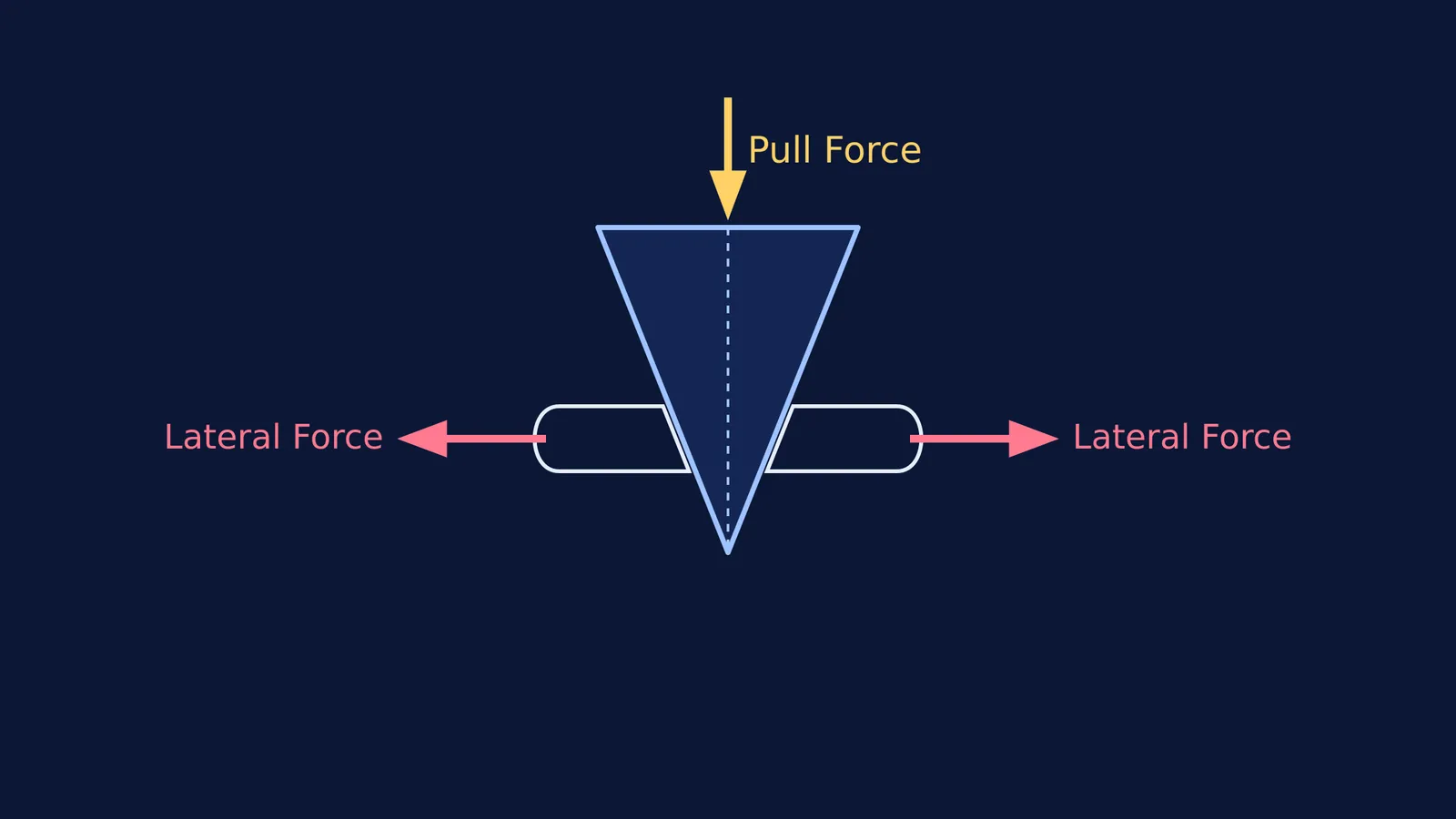
When you pull a zipper up or down, your hand applies a longitudinal force (parallel to the zipper track). However, to lock or separate the metal teeth, they must be pushed sideways (laterally) into one another. The metal slider achieves this translation of force using internal wedges.
Inside the slider is a Y-shaped channel. When closing the zipper, the narrowing outer walls of this channel act as wedges that squeeze the two independent rows of teeth together. As the slider moves, it forces the teeth to elastically open slightly and then snap shut over the corresponding projection.
When opening the zipper, you pull the slider in the opposite direction. A wedge-shaped divider inside the slider, often called the diamond, is driven downward between the interlocked teeth. This central wedge acts as a pry bar, splitting the teeth apart and routing them into the two separate upper branches of the Y-channel.
If you find it hard to picture how forces split along angles, the Simulation Lab has interactive simulations for the ideas that are easier to see than to read.
How does the slider multiply force?
We can calculate exactly how the slider multiplies your effort using the mathematics of the wedge). The mechanical advantage depends on the angle of the internal wedge.
Imagine a zipper slider where the internal wedge has a half-angle of 22 degrees (tan 22° ≈ 0.404). If you pull the slider with a force of 10 Newtons, how much sideways force pushes the teeth together? The wedge formula tells us that the lateral force on each side equals the pulling force divided by twice the tangent of the angle.
Identify the forces: Your pull is 10 N. The slider splits this into two lateral forces (one for each row of teeth).
Use the formula: Lateral Force = Pull / (2 × tan 22°)
Calculate: The result is 10 / (2 × 0.404), which equals approximately 12.4 N.
Because of the wedge's mechanical advantage, your 10 N pull generates over 12 N of sideways locking force on the teeth. The slider does the hard work for you.
How did the zipper get its name?
Sundback originally called his 1913 invention a "separable fastener." For the first few years, the device was primarily used for heavy-duty applications, such as flying suits for the U.S. Navy and money belts, rather than everyday fashion.
The catchy name we use today came a decade later. In 1923, the B.F. Goodrich Company decided to use Sundback's fastener on a new line of rubber galoshes. They coined the term "zipper" because of the distinct zipping sound the metal teeth made when sliding closed. The name stuck, transitioning from a brand of boots to the universal name for Sundback's invention.
It was not until the 1930s that the zipper saw widespread adoption in men's trousers. Today, it remains one of the most ubiquitous mechanical devices in the world.


