

On this page
What is Zipf's law of word frequency?
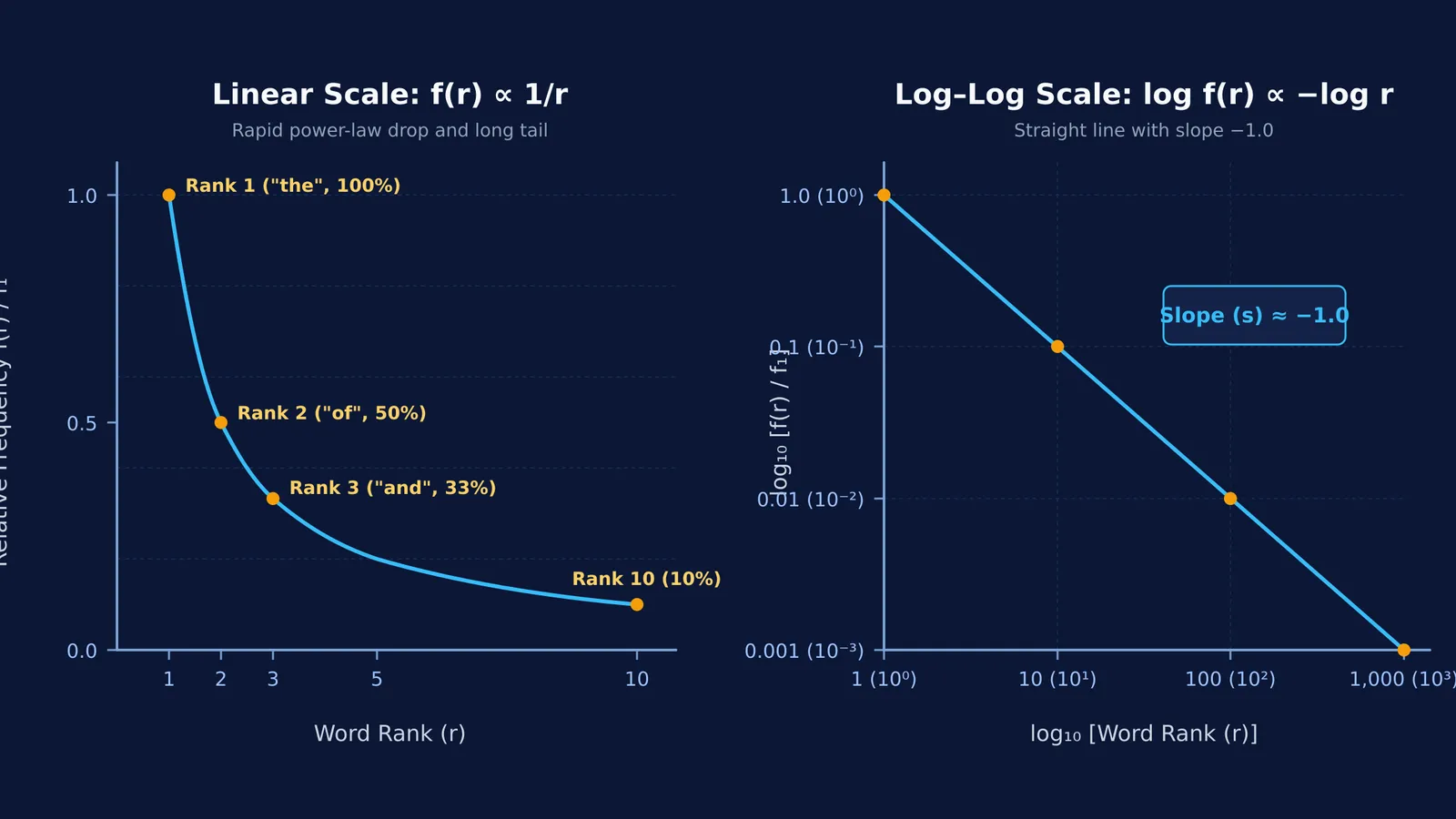
In any large sample of English writing, a single word dominates: "the" accounts for roughly 7% of all words in typical corpora analyzed in quantitative reviews by Steven Piantadosi in 2014. The second most common word, typically "of", appears roughly 3.5% of the time—nearly half as often. The third most common word, "and", appears roughly one-third as often.
This regularity is Zipf's law: in any large corpus, a word's occurrence frequency f(r) is inversely proportional to its popularity rank r:
f(r) = C / rˢ
Here, C is a normalising constant and s is an empirical exponent near 1. When s = 1, rank multiplied by frequency is constant (r × f(r) ≈ C). The drop across ranks is steep: rank 2 appears at half the baseline (~3.5%), rank 3 at one-third (~2.3%), and rank 10 at one-tenth (~0.7%).
Unlike bell curves or standard probability distributions that cluster around an average, Zipf's law is a power law with extreme "heavy tails". A tiny elite of grammatical words forms most of what you read, while thousands of specific nouns, verbs, and adjectives appear once or twice and then vanish.
How did George Zipf discover the rank-frequency rule?
The law is named after Harvard linguist George Kingsley Zipf (1902–1950). In his 1932 monograph *Selected Studies of the Principle of Relative Frequency in Language* and his 1935 book *The Psycho-Biology of Language*, Zipf measured the statistical structure of speech.
To test his hypothesis on a large vocabulary, Zipf drew upon word counts compiled by Miles L. Hanley at the University of Wisconsin. Hanley's team indexed James Joyce's 1922 novel *Ulysses*, tallying 260,430 word tokens and 29,899 unique word types. Plotted on logarithmic axes (a log–log plot), word rank against frequency formed a straight line with a slope close to −1.
Zipf was not the first to spot the pattern. In 1916, French stenographer Jean-Baptiste Estoup observed in *Gammes sténographiques* that word rank multiplied by frequency was constant in French shorthand. Earlier, in 1913, German physicist Felix Auerbach noted a similar power law for German city populations. But Zipf collected cross-linguistic data across English, German, Latin, and Chinese, showing the relationship was universal.
Modern data science has confirmed Zipf’s insight at scale. In a 2016 study in *PLOS ONE*, researchers analyzed over 30,000 English texts from Project Gutenberg and found that a pure power law fit more than 40% of texts across their entire frequency domain with only a single parameter.
Why do languages obey the principle of least effort?
In *Human Behavior and the Principle of Least Effort* (1949), Zipf proposed a behavioral mechanism for this distribution, arguing that language balances two competing economies:
The speaker's economy: Minimizing effort by reusing a small vocabulary of short, versatile words.
The listener's economy: Minimizing confusion with distinct, unambiguous words for each meaning.
If speakers dominated completely, language would collapse into a few vague words. If listeners dominated, every concept would need a unique word, creating an impossible vocabulary. Natural language represents a mathematical compromise between these forces.
Power laws maximize information transmission under effort constraints, connecting Zipf's observations to the entropy equations of Claude Shannon and the prefix codes of David Huffman. In 2023, Guido Linders and Max Louwerse confirmed that this least-effort balancing act holds not only in literature, but across spoken dialogue and nonverbal communication.
How does Zipf's law change how you study?
Zipf's law carries direct consequences for how you learn a language or study a technical discipline. Because frequencies follow an inverse power curve rather than an even spread, study effort yields rapid early gains followed by a long plateau.
In second-language acquisition, linguist Paul Nation demonstrated in the *Canadian Modern Language Review* that mastering the 1,000 most frequent word families covers roughly 75% to 80% of running text. However, because of the Zipfian tail, reaching 95% coverage requires 3,000 to 4,000 word families, and unassisted fluent reading at 98% coverage requires 8,000 to 9,000 word families.
The same distribution governs STEM learning:
High-frequency core: Governing principles—such as Newton's laws, conservation principles, or calculus fundamentals—underpin most problems you encounter.
Long-tail variations: Thousands of specialized question setups and edge cases form a vast tail where individual patterns rarely repeat.
Treating every problem as equally likely traps students into memorizing niche tricks while foundational understanding stays weak. Instead, use Zipf's law to guide study:
Master core principles: Derive and apply fundamental laws with zero hesitation before chasing advanced variations.
Reduce tail problems to core laws: When facing an unfamiliar question, identify the governing principle before checking the solution.
Log rare variations: Track unusual setups in an error log with spaced reviews to retain edge cases.
To build systematic intuition across foundational STEM subjects, the Fermi Concept Library organizes each concept with its own structured lesson and place in the map. When applying those principles across the long tail, the Fermi Problem Library provides worked problems with a step-by-step solver that explains the reasoning rather than printing an answer. If you are uncertain where your conceptual gaps lie, Fermi's AI tutor can work out what you already know and build a plan for your session.


