

On this page
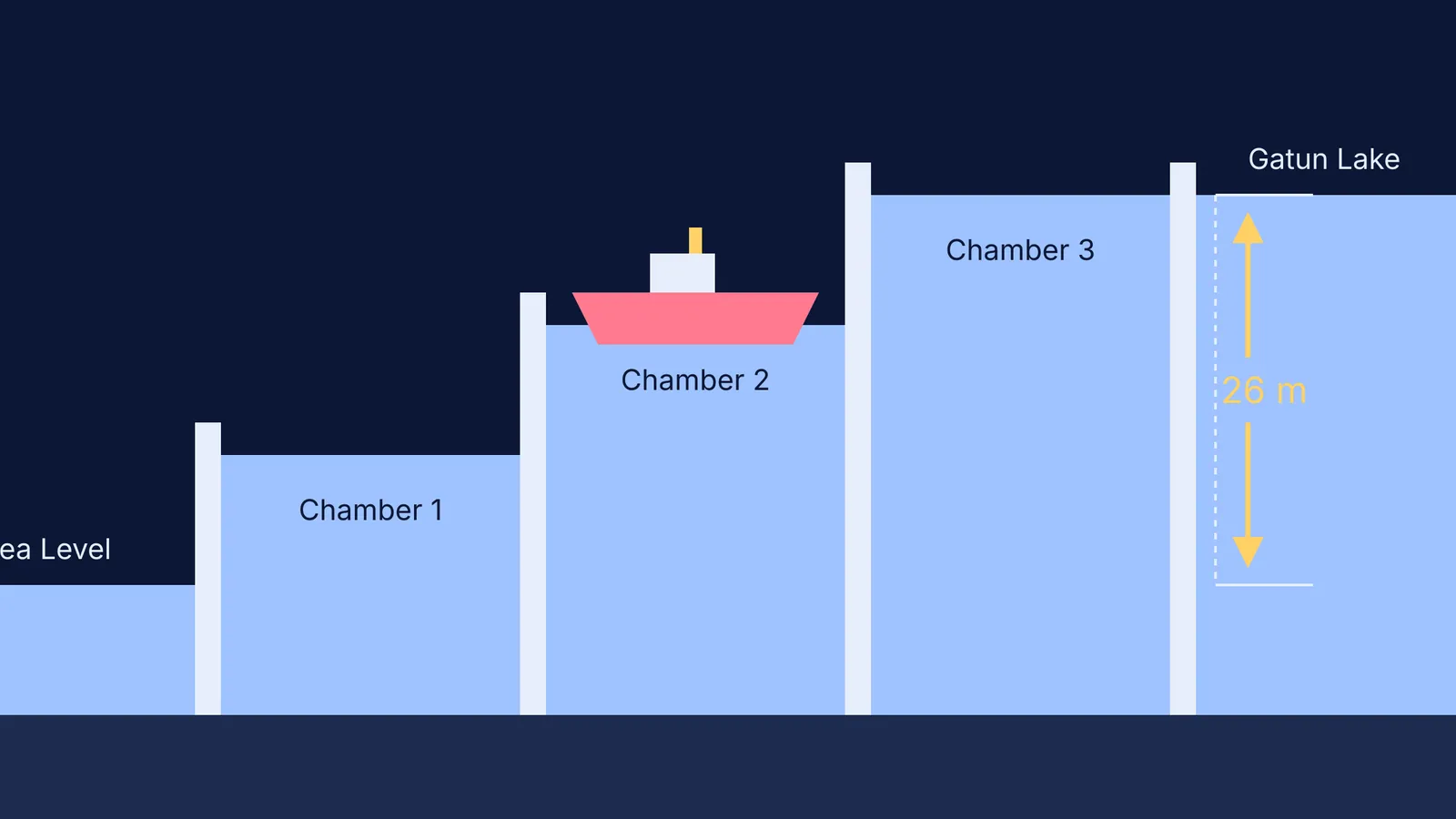
When engineers sought to connect the Atlantic and Pacific Oceans in the early 20th century, they faced a massive geographical hurdle: the Isthmus of Panama was not flat. The journey required traversing Gatun Lake, a vast artificial reservoir situated 26 metres (85 feet) above sea level 1. To move ocean-bound ships up and over this rugged continental divide, the canal relies on a marvel of civil engineering that functions entirely without mechanical water pumps. Even over a century after its opening, the mechanism stands as one of the most brilliant applications of fundamental physics on a planetary scale.
Who was George Goethals?
In 1907, US President Theodore Roosevelt appointed George Washington Goethals, a seasoned military officer, as the Chief Engineer of the Panama Canal project 2. Before Panama, Goethals had earned a formidable reputation by designing high-lift lock systems in the United States. He brought a rigorous, disciplined leadership style to a project that had previously struggled with technical setbacks and rampant tropical diseases.
Goethals oversaw a vast, multicultural workforce and dealt with the extreme logistical challenges of excavating the Panamanian jungle. By coordinating the massive excavation of the Culebra Cut, overseeing the immense concrete pours required for the locks, and strictly enforcing the health and sanitation measures needed to protect workers from malaria, Goethals successfully guided the project to completion in 1914.
How do the Panama Canal locks work?
The locks act as a giant, stepped water elevator for vessels of all sizes. A ship entering from the ocean side sails into the first rectangular lock chamber, and massive, watertight steel doors swing shut behind it. Once the vessel is secured, water is allowed to flow into the chamber from above. As the water level rises inside the enclosed concrete walls, the buoyant force lifts the ship until it is perfectly level with the water in the next step.
There are three sets of locks in total to complete the crossing. The Gatun Locks lift ships up three consecutive steps on the Atlantic side to reach the lake. On the Pacific side, the Pedro Miguel and Miraflores locks bring vessels back down to sea level. Visualising the equalization of water levels in adjacent chambers can be tricky. The Fermi Simulation Lab has interactive simulations for the ideas that are easier to see than to read, letting you observe how pressure differences drive fluid flow across boundaries.
How is the water moved without pumps?
The entire lifting process relies purely on gravity. Water from the elevated Gatun Lake naturally flows downhill through giant tunnels, or culverts, that are built directly into the concrete lock walls. When the massive control valves are opened, the water rushes through these passageways and bubbles up through holes in the chamber floor to lift the vessel safely.
Just as Pascal's law in hydraulic machines shows how fluid pressure distributes uniformly to lift a heavy car in a garage, the canal uses the natural hydrostatic pressure of Gatun Lake's water column to raise enormous, fully loaded cargo ships. Once the ship is safely through, the water used to lift it is eventually flushed downhill and out into the ocean. Unlike the energy lost to heat and friction as work in irreversible expansion in thermodynamic systems, this gravity-fed water transfer is an incredibly efficient, zero-emission way to lift massive objects.
How much work does the water do?
Let us calculate the physics of this monumental lift. Imagine a loaded modern cargo ship with a mass of 50,000 tonnes (which is 50,000,000 kg). To lift it 26 metres to the surface level of Gatun Lake 1, its gravitational potential energy must undergo a dramatic increase.
The work done (W) is calculated as mass (m) times the acceleration due to gravity (g) times height (h):
W = m × g × h W = 50,000,000 kg × 9.8 m/s² × 26 m W = 12,740,000,000 Joules (or roughly 1.27 × 10¹⁰ J)
It would take an immense and costly amount of electricity for mechanical pumps to generate 12.7 billion Joules of useful work per ship. Instead, the canal harnesses the potential energy of the falling rainwater stored in Gatun Lake to do this heavy lifting for free. If you want to practice calculating the potential energy required to lift heavy masses against gravity, the Fermi Problem Library has worked problems with a step-by-step solver that explains the reasoning rather than printing an answer.


