

On this page
Born in 1939, George Carruthers developed an interest in space and science fiction early on, reading avidly about early rocketry concepts (Wikipedia). By age 10, he had built his first telescope using cardboard tubing and mail-order lenses bought with money earned from a delivery route. His father, a civil engineer, strongly encouraged his mathematical and scientific pursuits. After his father's sudden death, the family moved to Chicago, where Carruthers spent his time in public libraries and the Adler Planetarium. He won multiple science fairs during his youth, nurturing a curiosity that would eventually lead him to earn a Ph.D. in Aeronautical and Astronautical Engineering from the University of Illinois in 1964.
What did the Apollo 16 ultraviolet camera do?
When astronauts John Young and Charles Duke landed on the Moon in April 1972 during the Apollo 16 mission, they deployed a gold-plated instrument designed by Carruthers: the Far-Ultraviolet Camera/Spectrograph (NASA). This was effectively the first lunar observatory.
Why put a telescope on the Moon? Earth's atmosphere blocks most ultraviolet light from space, which protects life on the surface but frustrates astronomers. By placing the camera on the lunar surface, Carruthers could observe the universe in far-ultraviolet wavelengths without atmospheric interference.
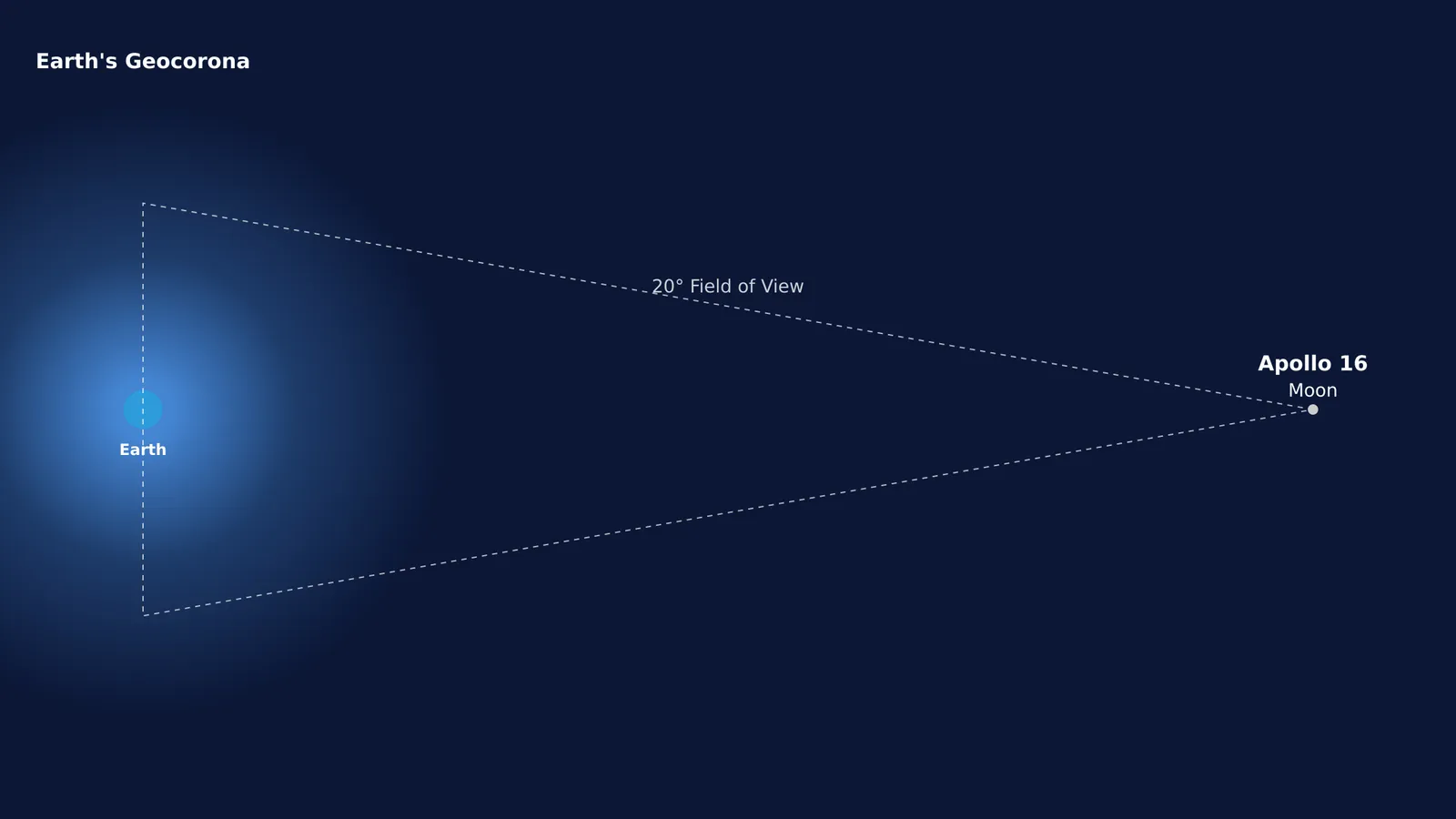
The camera's most famous target was not a distant galaxy, but Earth itself. It captured the first large-scale images of the geocorona, a vast, glowing cloud of neutral hydrogen that surrounds our planet. These images proved that this halo extended much further into space than scientists had previously realised, providing key data on how Earth slowly loses its atmosphere to space. Over billions of years, water vapour in the lower atmosphere is broken apart by solar radiation, and the resulting lightweight hydrogen atoms slowly escape. Carruthers' images provided the first direct, visual evidence of the scale of this planetary water loss.
How does the camera see hydrogen?
The camera detected hydrogen by looking for a specific wavelength of light: 121.6 nm, known as Lyman-alpha radiation (NASA).
When neutral hydrogen atoms in the outermost layers of Earth's atmosphere absorb ultraviolet radiation from the Sun, their electrons jump to a higher energy level. As they drop back down to the ground state, they release energy by emitting a photon of exactly 121.6 nm light. This process is known as resonant scattering.
If you are calculating electron transitions in the Lyman series for JEE Physics, you are dealing with the exact same mechanism. Working through Hydrogen spectrum problems: energy levels, series and wavelengths is a great way to master the maths behind this phenomenon. For a broader view of where this sits, you can also review how Electromagnetic waves: the spectrum, E and B, and board questions connect.
Understanding phenomena like the geocorona requires a strong grasp of atomic structure. If you find these concepts hard to picture or do not know where to start, Fermi's AI tutor can work out what you already know and build a plan for the session, drawing the figure and checking your understanding as it goes.
How to build an instrument-making career?
George Carruthers was an engineer who built things, not just a theorist. Like aerospace engineer Kalpana Chawla, his work sits directly at the intersection of physics and practical engineering. If you want to design instruments that end up in space, here is a framework to guide your early steps:
Master the fundamentals: Space instruments rely on a deep knowledge of optics, electromagnetic waves, thermodynamics, and materials science. Focus heavily on mastering these core topics in Class 11 and 12 physics.
Build things yourself: Carruthers built a telescope from cardboard at age 10. Start with hands-on projects, like wiring basic electrical circuits, programming a microcontroller, or assembling a simple spectroscope using a diffraction grating.
Study at the intersection: Consider degrees that blend pure science with rigorous engineering principles, such as engineering physics, aerospace engineering, or applied physics.
Solve practical problems: Space is an extreme environment characterised by vacuum pressure, massive temperature swings, and intense radiation. Practise thinking through these real-world constraints. When facing tough physics problems, the Fermi Problem Library has worked problems with a step-by-step solver that explains the reasoning rather than printing an answer, helping you build this analytical mindset.


