

On this page
George Atwood had a problem every physics teacher still knows: things fall too fast to watch. In his 1784 book, A Treatise on the Rectilinear Motion and Rotation of Bodies, he noted that if you shorten the drop to make it manageable, "the times of motion will be so small as to render the observation of them very precarious and unsatisfactory." So he built a machine that makes gravity act slowly.
What was the Atwood machine originally built to prove?
Atwood was a tutor at Trinity College, Cambridge, a Fellow of the Royal Society and a popular lecturer who used many demonstrations, according to his MacTutor biography. The same biography says the machine was made to demonstrate "the laws of uniformly accelerated motion due to gravity". London instrument maker George Adams built it to Atwood's design. A description first appeared in French in 1780, and Alessandro Volta had asked for one of the machines.
In the Treatise, Atwood says the instrument tests five quantities: the mass moved, the constant force moving it, the distance covered from rest, the time taken and the velocity gained. In modern terms, that is Newton's second law and the equations of uniform acceleration, checked against a clock. Atwood described twelve demonstration experiments, all involving timing, notes Kenyon College's early apparatus collection.
How did Atwood slow gravity down?
In the Treatise he explains why Galileo's ramps would not do: rolling balls spin, and on a ramp you cannot change the force without changing the mass moved. (See Galileo's inclined plane and free fall for that earlier story.) His own design, from Section VII:
Two equal boxes hang from a fine silk line over a pulley wheel, so their weights cancel.
The pulley's axle rests on four friction wheels. Atwood reports that 1.5 to 2 grains was enough to start the balanced system moving.
A small extra weight on one box drives the whole mass.
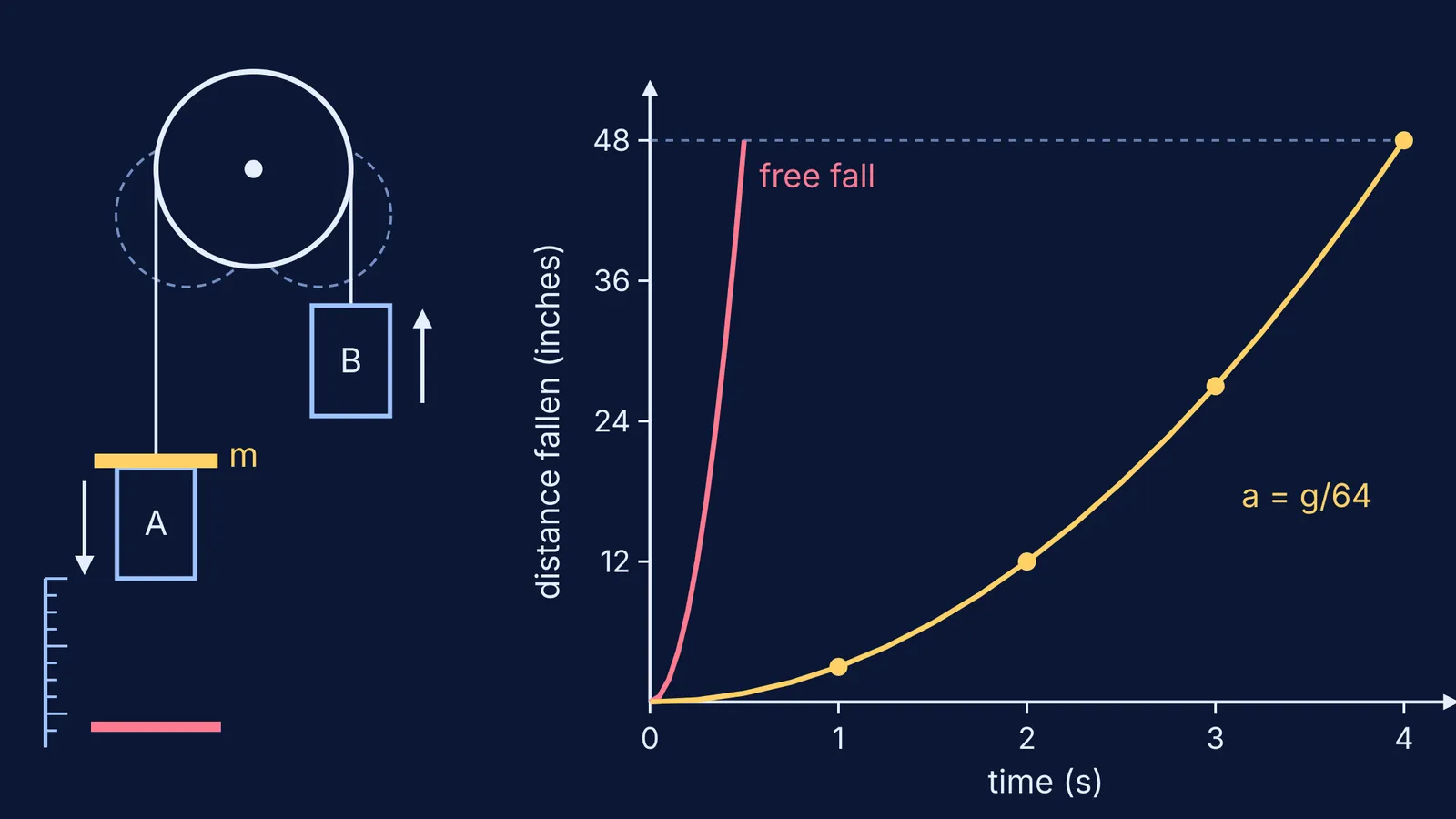
A seconds pendulum ticks, and you hear the falling box hit a stage set on a 64-inch scale.
A ring lets the box pass through but lifts off a bar-shaped rider. With the force removed, the box carries on at a steady speed, so its velocity can be measured directly.
He even measured his pulley's inertia: a 30-grain weight wound on the wheel fell about 38.5 inches in 3 seconds, so the wheels acted like 2¾ ounces at the rim.
How did the machine test F = ma?
The first experiments in the Treatise use a moving mass of 64m driven by a force of m. The box fell 3, 12 and 27 inches in 1, 2 and 3 seconds. Distance grows as time squared, just as uniform acceleration predicts.
Next he kept the mass at 64m and used forces of m, 2m and 3m for 2 seconds. The falls were 12, 24 and 36 inches. With the mass fixed, acceleration grew in step with the force: the second law, timed by a pendulum.
A free fall of 48 inches takes about half a second. Atwood calculated that his 64m system took 3.99 seconds to cover the same 48 inches.
How do you solve an Atwood machine problem for JEE?
Newton's second law is in Unit 3, Laws of Motion, of the JEE Main 2027 syllabus published by NTA. Moment of inertia is in Unit 5, so both the ideal machine and Atwood's real one draw on syllabus topics.
Masses of 3 kg and 2 kg hang over a light, frictionless pulley. Take g = 10 m/s².
Draw a free-body diagram for each mass: weight down, tension T up.
Choose the direction of motion: 3 kg down, 2 kg up, both with acceleration a.
Write 3g − T = 3a for the heavier mass and T − 2g = 2a for the lighter one.
Add the two equations: g = 5a, so a = (m1 − m2)g/(m1 + m2) = 2 m/s².
Substitute back: T = 2(10 + 2) = 24 N, which matches T = 2m1m2g/(m1 + m2).
Give the pulley mass and its rotation adds I/r² to the denominator: a = (m1 − m2)g/(m1 + m2 + I/r²), and the tensions on the two sides are no longer equal. That I/r² term is exactly what Atwood measured as the "equivalent mass" of his wheels. See our guides to pulleys with mass and to pulley constraint relations, for blocks that move at different rates.
If the two tensions keep tripping you up, the Fermi Problem Library has worked problems with a step-by-step solver that explains the reasoning rather than printing an answer. For motion that is easier to see than to read, the Fermi Simulation Lab has interactive simulations.
Then try Atwood's test on paper: keep 64m, change the rider and predict the 2-second fall.


