

On this page
In short
Before Fritz Pregl, determining the chemical formula of a substance required destroying relatively large amounts of it. He miniaturised the combustion train to work with just 3 to 5 milligrams, a breakthrough that won him the 1923 Nobel Prize in Chemistry.
Fritz Pregl (1869–1930) was an Austrian chemist and physician who solved a frustrating bottleneck in organic chemistry. When isolating rare biological compounds like bile acids at the University of Graz, he found himself with too little material to analyse. His solution was not to find more material, but to shrink the laboratory. His work transformed how natural product chemistry was conducted in the twentieth century, accelerating the discovery of new molecules.
What is combustion analysis?
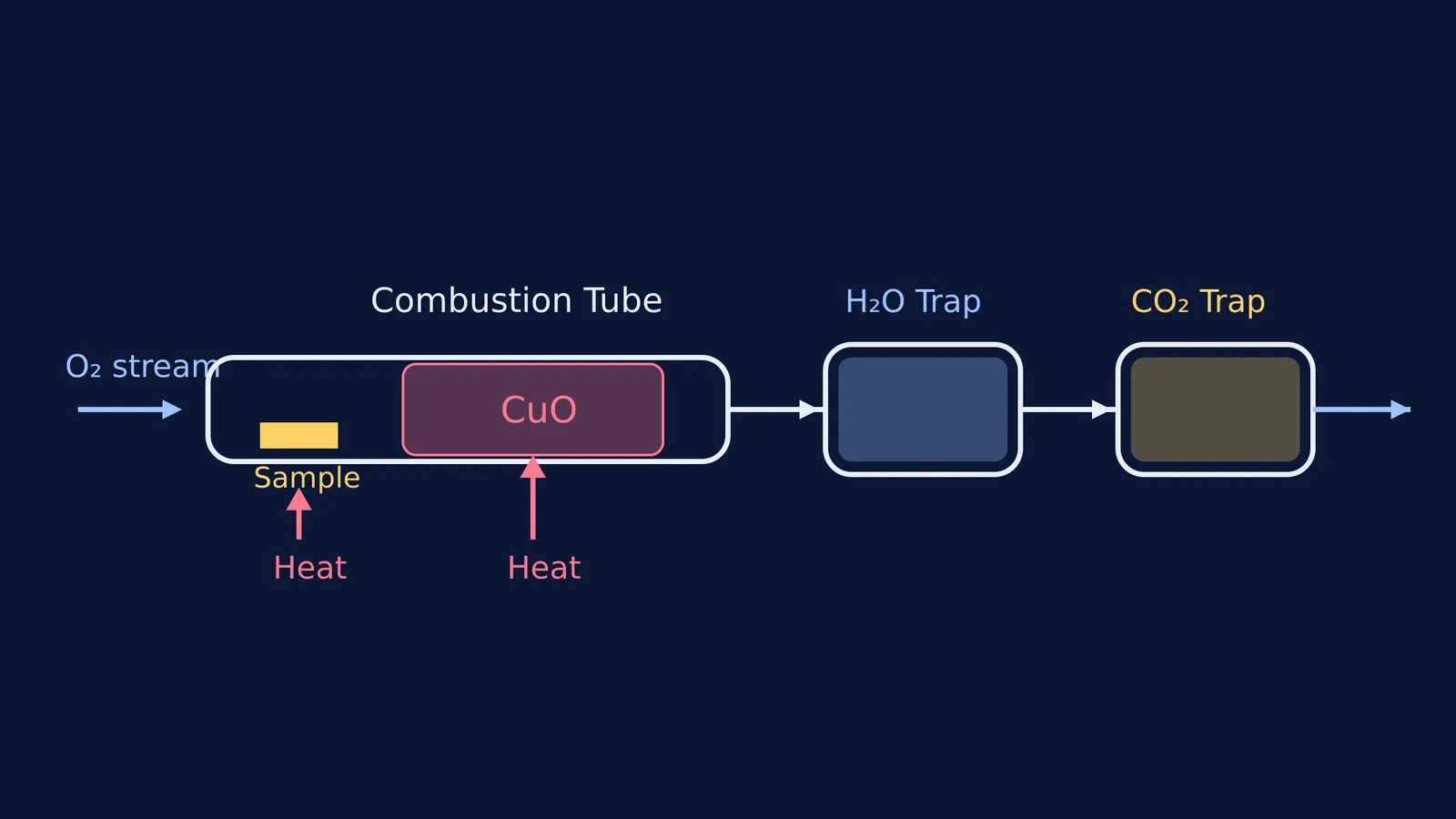
Since the 1820s, chemists had determined the empirical formula of organic compounds by burning them. The technique, invented by Joseph Louis Gay-Lussac and refined by Justus von Liebig, is known as a combustion train. It became the cornerstone of analytical chemistry, allowing scientists to calculate the exact ratio of elements in any newly discovered substance. This method is foundational because the empirical formula is the first step in identifying an unknown compound's structure. Without knowing the basic ratio of elements, a chemist cannot begin to sketch out how the atoms are bonded together.
You may have encountered these calculations in Class 11 stoichiometry or when studying Carius and Liebig quantitative analysis. The process relies on three steps:
Oxidation: The pure organic sample is heated to high temperatures in a stream of oxygen over copper(II) oxide, which oxidises all carbon into carbon dioxide (CO₂) and all hydrogen into water vapour (H₂O).
Water trap: The combustion gases flow through a pre-weighed tube containing a hygroscopic agent, such as calcium chloride or magnesium perchlorate, which absorbs the water.
Carbon dioxide trap: The remaining gas passes into a second pre-weighed tube containing a strong base, like potassium hydroxide, which absorbs the CO₂.
By weighing the two tubes before and after the experiment, chemists can calculate exactly how much carbon and hydrogen the original sample contained. If you struggle with the mole concept calculations that follow such experiments, the Fermi Problem Library provides a step-by-step solver that explains the reasoning rather than printing an answer.
How did Fritz Pregl scale it down?
The standard Liebig method worked flawlessly for bulk chemicals, but it required substantial starting material. For a researcher extracting trace amounts of hormones or enzymes from biological fluids, destroying half a gram just to find its formula was unworkable. In his early work on bile acids, Pregl spent years isolating tiny amounts of material, only to face the prospect of destroying it all in a single macro-analysis.
Pregl painstakingly redesigned the glass apparatus to handle microscopic quantities. He succeeded in lowering the minimal amount of substance required by a factor of 50. Initially, his microanalysis needed 5 to 13 milligrams, which he later refined to a mere 3 to 5 milligrams. To put this in perspective, 3 milligrams of a typical organic powder is roughly the size of a few grains of sand.
Working at such a small scale introduced massive challenges with precision. A speck of dust or a stray fingerprint could completely ruin the final mass readings. Pregl had to collaborate with instrument makers to develop a sensitive microbalance capable of weighing extremely small samples. He also introduced rigorous handling procedures and a universal filling for the combustion tube, ensuring his milligram-scale analysis maintained the exact same accuracy as the traditional macroanalysis.
His work is a prime example of how methodological improvements drive scientific discovery. Just as Justus von Liebig and the law of the minimum changed agriculture, Pregl's microanalysis changed biochemistry.
What was the impact of organic microanalysis?
Pregl published his findings in his 1917 monograph, *Die quantitative Microanalyse*, and his laboratory at Graz became a training ground for chemists worldwide. He was known for his dedication to teaching, frequently inviting international researchers to learn his meticulous methods firsthand.
Because of his miniaturised combustion train, researchers could finally determine the formulas of rare alkaloids, vitamins, and hormones without needing thousands of litres of starting material. For this transformative contribution to quantitative organic microanalysis, Pregl was awarded the Nobel Prize in Chemistry in 1923.
Mastering chemistry requires both understanding laboratory techniques and applying their mathematical principles. If you are preparing for exams and need to bridge the gap between theory and numericals, Fermi's AI tutor can work out what you already know and build a plan for the session, so you sit down to a clear next step.


