

On this page
Many textbooks say Friedrich Ernst Dorn discovered radon in 1900. The real story teaches a useful skill: telling apart what a scientist measured and what later writers said they found.
Who was Friedrich Ernst Dorn?
Friedrich Ernst Dorn (1848–1916) was a German physicist. In 1895 he became professor of experimental physics at the University of Halle and director of its physics institute (biography of Friedrich Ernst Dorn). He was born in Guttstadt in Prussia, now Dobre Miasto in Poland.
What did Dorn discover in 1900?
In 1900 Dorn published “Die von radioactiven Substanzen ausgesandte Emanation” (“The emanation given off by radioactive substances”) in the proceedings of the natural science society at Halle (details of Dorn’s 1900 paper).
Ernest Rutherford, in Montreal, had just reported a radioactive substance emitted from thorium compounds, which he called an emanation (Rutherford, Philosophical Magazine, 1900). Dorn confirmed this and found that radium gives off a similar emanation.
The Royal Society of Chemistry still lists Friedrich Ernst Dorn as the discoverer of radon, in 1900 (RSC periodic table: radon). The same page notes that in 1899 Rutherford and Robert Owens detected a radioactive gas from thorium, and Pierre and Marie Curie detected one from radium.
Did Dorn really discover radon?
This is where historians of science tell a more careful story. According to the Linda Hall Library’s profile of Dorn, J.L. and V.R. Marshall read the original papers in 2003 and found that Dorn said only that radium gives off an emanation that is radioactive. In the profile’s words, “He said nothing about a gas, and he did not call it radium emanation.” Nor did he propose a new element. The profile suggests the popular story most likely comes from Mary Elvira Weeks’s book *The Discovery of the Elements*.
By 1902, the same profile says, Rutherford and Frederick Soddy suspected the emanations were a gas and a new element. In 1903 they published “Condensation of the radioactive emanations” (Rutherford and Soddy, 1903). In 1908 William Ramsay and Robert Whytlaw-Gray collected enough radon to measure its properties and found it was the heaviest gas known (RSC: radon). Ramsay called the element niton, and the name radon was settled only in 1923 (Linda Hall Library).
So a fair answer has three parts: Dorn found the emanation from radium, Rutherford and Soddy identified it as a gas and a new element, and chemists later agreed the name.
Ramsay’s route to the noble gases is a story of its own: see how a tiny density gap revealed argon. Radon also starred in Harriet Brooks’s experiments on radioactive recoil.
How does radium turn into radon?
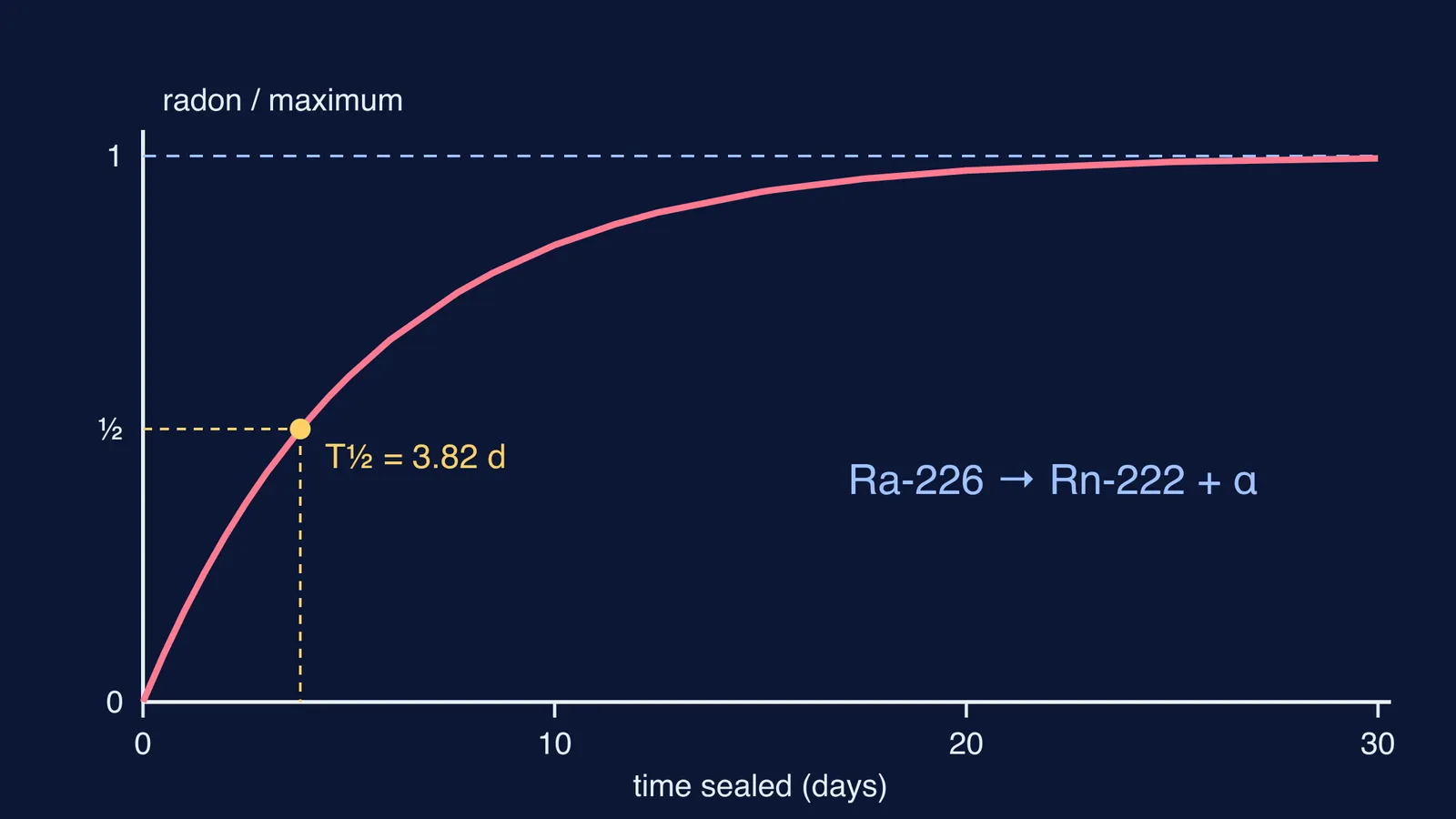
Radium-226 decays by alpha emission into radon-222, with a half-life of about 1600 years (isotopes of radium). Radon-222 has a half-life of 3.8215 days (radon data).
Write the decay: Ra-226 (Z = 88) → Rn-222 (Z = 86) + an alpha particle (He-4, Z = 2).
Check the balance: mass numbers 226 = 222 + 4, and atomic numbers 88 = 86 + 2.
Seal radium in a glass tube. Radium decays so slowly that it acts as a steady source, so radon builds up towards a steady level: fraction of the maximum = 1 − (1/2)^(t / 3.82 days).
After 3.82 days the radon is at half its maximum. After 7.64 days it is at three-quarters. After 15.3 days (four half-lives) it is at 1 − 1/16, about 94%.
Pump that radon into a separate tube and it decays by the same steps: after 15.3 days, 1/16 is left.
For the full maths, read radioactive decay and half-life, worked out. If growth-and-decay curves are hard to picture, the Fermi Simulation Lab has interactive simulations for ideas that are easier to see than to read. If you keep choosing the wrong method on decay numericals, the Fermi Problem Library has worked problems with a step-by-step solver that explains the reasoning rather than printing an answer.
Why does radon matter today?
The World Health Organization describes radon as a radioactive gas with no smell, colour or taste, produced when uranium in rocks and soils decays (WHO fact sheet on radon). WHO estimates that radon causes between 3% and 14% of lung cancers in a country, depending on average radon levels and how many people smoke. If you are worried about radon where you live, ask your local health authority. For health concerns, talk to a doctor.
How can you check who discovered an element?
Use this checklist whenever a textbook gives a name and a date:
Find the original paper: its title, journal and year.
Separate what was measured (“radium gives off something radioactive”) from what was concluded (“it is a new gas”).
Ask who first showed what the substance is, and how.
Check when and by whom the name was agreed.
Look for people working on the same thing at the same time, like Rutherford, Owens and the Curies.
Try it on the next element in your syllabus.


