

On this page
In 1930 Wolfgang Pauli proposed a particle with no charge and almost no interaction with matter. It solved a puzzle in beta decay, but it seemed impossible ever to catch. A quarter of a century later Frederick Reines and Clyde Cowan caught it. This post is about how they designed the experiment, with the energy arithmetic that made it work and what their approach can teach you about designing any test.
Why was the neutrino needed?
In beta decay a nucleus emits an electron, but measurements of that electron suggested that energy was going missing. The 1995 Nobel press release recounts how Pauli, in a 1930 letter, offered what he called a "desperate solution": a light, neutral particle that carried off the missing energy. Enrico Fermi then built a theory of the weak force around it. For Pauli's side of the story, read our post on Wolfgang Pauli and the exclusion principle.
You already meet this particle in school. The current NCERT Class 12 chapter on Nuclei states that a free neutron decays into a proton, an electron and an antineutrino, with a mean life of about 1000 s.
Why did catching it seem impossible?
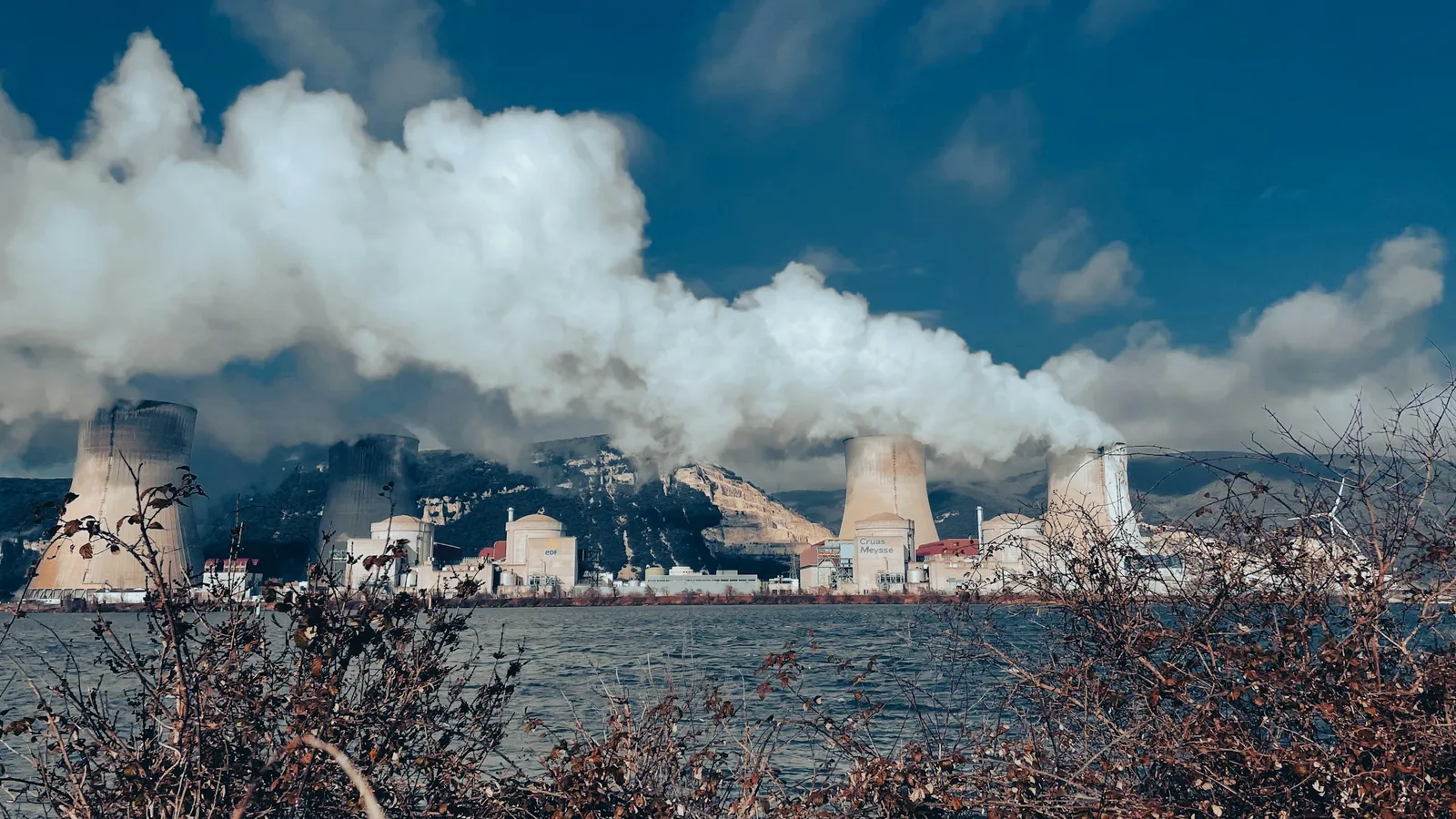
The press release explains that Hans Bethe and Rudolf Peierls estimated you would need a target several light years thick to stop neutrinos from radioactive sources efficiently. The answer was to use a far more intense source: a nuclear reactor. Reactors were estimated to give a neutrino flow of about 10¹² to 10¹³ per second per square centimetre.
Who were Reines and Cowan?
Reines was born in Paterson, New Jersey, on 16 March 1918 and died on 26 August 1998, according to his Nobel facts page. In his Nobel autobiography he describes how, at Los Alamos, he formed "an extremely fruitful collaboration" with another staff member, Clyde Cowan. They first considered using a nuclear bomb test as the source, then chose the Hanford reactor, where they saw the first hints of a signal in 1953. In 1955 they moved to the new Savannah River reactor in South Carolina.
How did the detector work?
The press release describes the design. The reaction was
antineutrino + proton → neutron + positron.
The target was about 400 litres of water with cadmium chloride dissolved in it, between large liquid scintillation detectors. Two things then happen:
The positron quickly meets an electron and both are annihilated, giving two photons that the detectors record at the same moment.
The neutron slows down in the water and is captured by a cadmium nucleus, which gives off more photons about a microsecond or so later.
Only that pair of signals, in that order and with that delay, counted as a neutrino. The press release notes that Reines and Cowan saw the importance of detecting both the neutron and the positron to reduce the risk of a false reading. Even so, they recorded only a few events per hour.
Their report, Detection of the Free Neutrino: a Confirmation, appeared in Science on 20 July 1956, with Cowan as first author alongside Reines, Harrison, Kruse and McGuire.
Worked example: the energy to make it happen
Use masses from NIST: neutron 939.565 MeV, proton 938.272 MeV and electron or positron 0.511 MeV.
Step 1: minimum antineutrino energy. The products (neutron + positron) are heavier than the proton, so the antineutrino must supply the difference. Ignoring the small recoil of the products:
E_min = 939.565 + 0.511 − 938.272 = 1.804 MeV.
Only reactor antineutrinos above about 1.8 MeV can trigger the reaction.
Step 2: the first signal. When the positron annihilates with an electron, almost at rest, the total energy is 2 × 0.511 = 1.022 MeV. Momentum must be conserved, so it comes out as two photons of 0.511 MeV each, travelling in opposite directions. The press release describes these being recorded at the same moment in the two detectors on either side of the target.
Common mistakes:
Using the proton mass for the neutron. They differ by about 1.3 MeV, which is most of the threshold.
Forgetting the positron's mass. It adds 0.511 MeV to the threshold.
Expecting one photon from annihilation. A single photon cannot conserve momentum here.
For the antimatter half of this story, see Paul Dirac and the prediction of antimatter.
How was the work recognised?
Reines received half of the 1995 Nobel Prize in Physics "for the detection of the neutrino". The press release credits the work he did "together with the late Clyde L. Cowan, Jr.", since Cowan had died before the prize was awarded. It also notes how far the field has come: Reines and Cowan used about half a cubic metre of water, while experiments in the 1990s used many thousands of cubic metres.
What can a student take from Reines and Cowan?
Change the source when the target cannot change. A brighter neutrino source made an impossible experiment merely very hard.
Ask for two pieces of evidence. The delayed coincidence is a model for checking any surprising answer in two independent ways.
Keep going after the first hint. Hanford gave a hint; Savannah River gave the result.
If beta decay and antiparticles still feel abstract, the Fermi Concept Library covers every concept in physics, chemistry, biology, mathematics and computing, so you can revise each idea before tackling problems.
Try it now: write the beta-minus decay of a free neutron and check that charge and energy both balance using the NIST masses above.


