

On this page
In 1950, Harvard astronomer Fred Whipple proposed that a comet has a single solid core made of ice and dust. Thirty-six years later, a spacecraft flew past Halley's comet and photographed that core.
What was Fred Whipple's dirty snowball model?
Whipple set out his idea in "A comet model. I. The acceleration of Comet Encke", published in The Astrophysical Journal in March 1950. He called comets "icy conglomerates". According to Astronomy magazine's obituary of Whipple, these were frozen water, ammonia, methane and carbon dioxide mixed with dust. The phrase "dirty snowball" came from the popular press, not from Whipple.
The model has three parts:
One solid nucleus, rather than a loose cloud of separate pebbles.
Ices that turn straight from solid to gas (sublimate) as the comet nears the Sun, dragging dust out with them to form the glowing coma and tail.
A push from that escaping gas. Like a rocket's exhaust, gas leaving one side of the nucleus shoves the nucleus the other way.
Whipple was born in Iowa in 1906 and led the Smithsonian Astrophysical Observatory from 1955 to 1973, according to the Harvard Gazette's obituary.
Why did comets need a new model?
The clue was a comet that would not keep time. Comet Encke returns to the Sun every 3.3 years, and from 1786 to 1819 it kept arriving earlier than Newton's gravity predicted. Its orbit got shorter by about 2.7 hours each time round, which added up to a difference of about 5 days over 10 orbits, as Zdenek Sekanina of NASA's Jet Propulsion Laboratory recounts. For much of the 19th century, the favourite explanation was a thin "resisting medium" in space that slowed the comet.
Sekanina describes how Whipple's paper explained the drift instead as recoil from gas, mostly water vapour, escaping from a spinning nucleus. On a spinning core, the warmest spot lags behind the point directly under the Sun, like the hottest part of a day coming after noon, so the push has a part along the orbit. Depending on which way the nucleus spins, that push can speed the comet up or slow it down.
How did Giotto confirm the model at Halley's comet?
On 13 March 1986, the European Space Agency's Giotto probe passed 596 km from Halley's nucleus. ESA's summary of the encounter lists what it found:
A dark, peanut-shaped body about 15 km long and 7 to 10 km wide.
A porous, fluffy texture, with a density as low as 0.3 g/cm³, about a third of water's.
Seven jets throwing out about three tonnes of material per second.
Water making up about 80% by volume of all the material the comet threw out, with carbon monoxide at about 10%.
The surface was the surprise. ESA reports that it reflected only 2-4% of incoming light, putting comets among the darkest objects in the Solar System, and that only a relatively small fraction of the nucleus was active. That still fits Whipple's picture: the ice was there, but hidden under dark material, and escaping from only a few active areas.
Is a comet a dirty snowball or an icy dirtball?
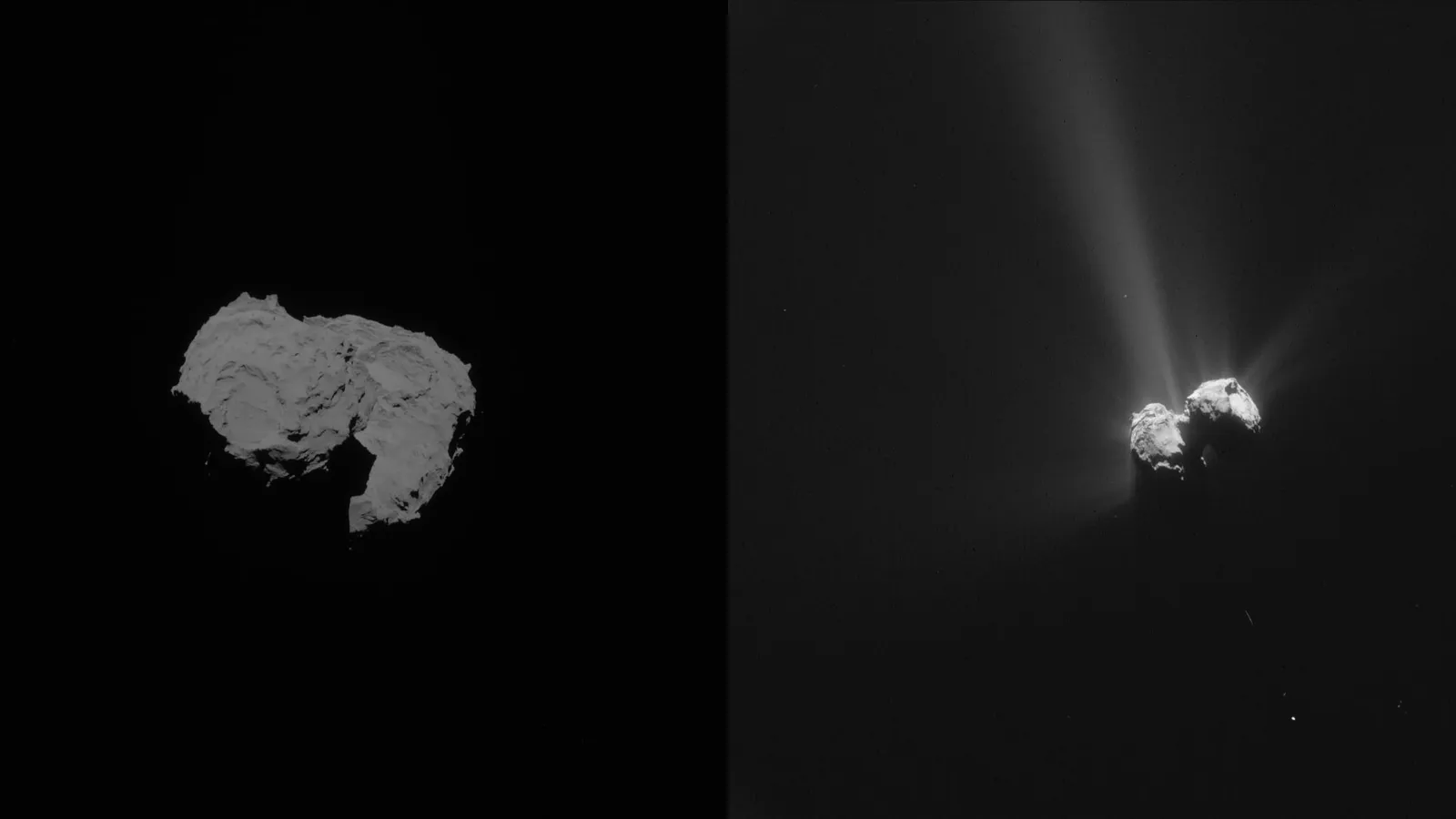
Later missions changed the balance between ice and dust. After ESA's Rosetta probe spent two years at Comet 67P, The Planetary Society's review noted a density of just 470 kg/m³, very few exposed water-ice patches, and suggested that "an icy dirtball may be a better description rather than a dirty snowball." The details shifted, but Whipple's main ideas held up: a solid nucleus, ice turning to gas in sunlight, and gas jets that nudge the orbit.
How can you use Whipple's comet in physics class?
Here is a rough estimate using ESA's Halley numbers from the Giotto section above.
Treat the nucleus as an ellipsoid with semi-axes 7.5 km, 4 km and 4 km.
Volume = (4/3)π × 7.5 × 4 × 4 km³ ≈ 503 km³ ≈ 5.0 × 10¹¹ m³.
Mass at the low-end density of 300 kg/m³ ≈ 1.5 × 10¹⁴ kg.
Losing 1% of that mass (1.5 × 10¹² kg) at 3,000 kg/s takes about 5 × 10⁸ s, or roughly 16 years of non-stop jetting.
The jets only run strongly near the Sun, so in reality that 1% is spread over many orbits. That is why a comet can survive many returns but will not last forever.
The same story covers chapters you already study: Newton's third law (the recoil), sublimation (the ice) and Kepler's laws (the orbit). If the recoil is hard to picture, the Fermi Simulation Lab has interactive simulations for ideas that are easier to see than to read. To revise sublimation or momentum on its own, the Fermi Concept Library gives each concept its own lesson.
Next time a comet shows up in the news, ask which way its jets are pointing.


