

On this page
When you leave a glass of water open in a warm room, the water eventually evaporates. This happens because some molecules at the surface have enough energy to break free and enter the gas phase. If you put a lid on the glass, those escaping molecules build up pressure inside. This is known as vapour pressure. If you are studying for JEE, NEET or Class 12 board exams, you will spend a lot of time on solutions and their properties. The foundational principle behind how mixtures of liquids behave is Raoult's law.
But where did this rule come from, and how exactly does it work?
Who was François-Marie Raoult?
François-Marie Raoult was a French chemist born on 10 May 1830 (Wikipedia). He did not follow a traditional academic path right away. After working as an instructor and professor at various schools across France, he took charge of chemistry classes at the University of Grenoble in 1867. His work impressed the university so much that he was appointed to the Chair of Chemistry there in 1870, a position he held until he died in 1901.
At Grenoble, Raoult began his most famous physical research: measuring how dissolved substances change the physical properties of a solvent.
How did he discover the vapour pressure law?
Raoult did not start by measuring vapour pressure. In 1878, he published his first paper on how adding a solute depresses the freezing point of a liquid. He carefully recorded temperatures, establishing in 1882 that if you dissolve one molecule of a substance in 100 molecules of any given solvent, the solidification temperature drops by 0.63 °C (Wikipedia).
He soon realised that this relationship applied to vapour pressure as well. In 1887, Raoult published his General Law of Vapor Pressure, proving that the drop in pressure depends on the ratio of solute to solvent molecules. This breakthrough gave chemists a reliable way to calculate the molecular weights of unknown substances long before modern instruments existed.
What is Raoult's law of vapour pressure?
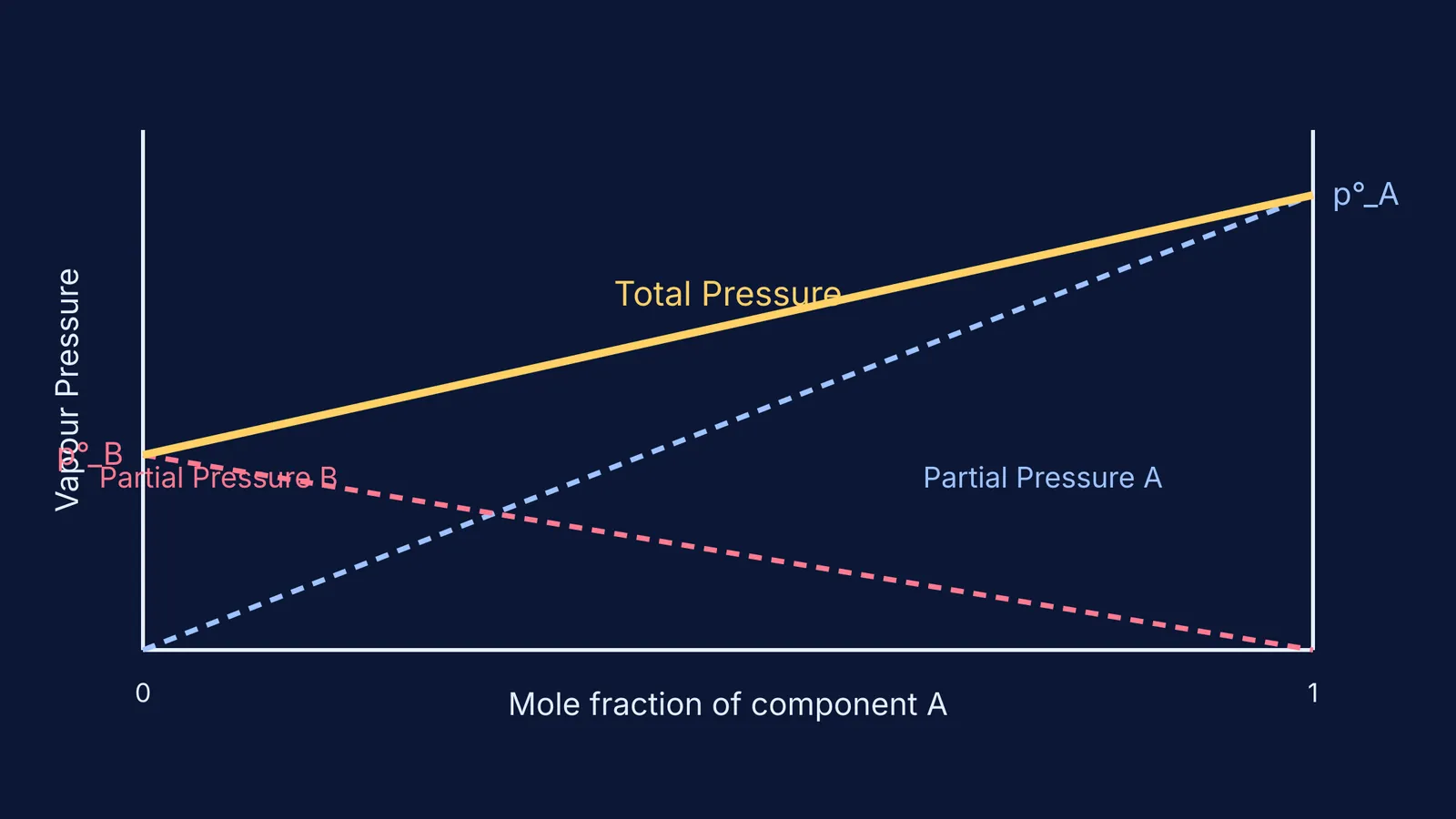
Raoult's law states that the partial pressure of each component in an ideal mixture of liquids is equal to the vapour pressure of the pure component multiplied by its mole fraction in the mixture (Wikipedia).
For a single component, the formula is: p_i = p°_i × x_i
Where:
p_i is the partial vapour pressure of the component above the solution.
p°_i is the equilibrium vapour pressure of the pure component.
x_i is the mole fraction of the component in the liquid.
When you dissolve a non-volatile solute (like salt or sugar) in a volatile solvent (like water), the solute particles block solvent molecules from escaping the surface. Therefore, the relative lowering of vapour pressure is simply equal to the mole fraction of the solute.
You use similar logic when Finding molar mass from osmotic pressure: a worked example, as osmotic pressure is another colligative property.
When does a solution not follow Raoult's law?
While Raoult's law works perfectly for ideal solutions, most real-world mixtures show some deviation (Wikipedia). An ideal solution assumes that the intermolecular forces between unlike molecules are exactly the same as the forces between like molecules.
In reality, mixing two different liquids often changes how tightly the molecules hold onto each other.
Negative deviation: If the new bonds between different molecules are stronger than the original bonds, the molecules are held back from escaping into the vapour phase. The total vapour pressure ends up lower than Raoult's law predicts. A mixture of chloroform and acetone is a classic example of this.
Positive deviation: If the new bonds between different molecules are weaker than the original bonds, the molecules escape more easily. The total vapour pressure is higher than what Raoult's law predicts. Ethanol and water mixed together show positive deviation.
How do you calculate vapour pressure with Raoult's law?
Here is a worked example to show how the law functions in practice. Suppose you have an ideal solution made by mixing two volatile liquids, A and B. (For a refresher on concentration, see Mixing and diluting solutions: finding the final molarity).
The problem:
Pure vapour pressure of A (p°_A) = 400 mm Hg
Pure vapour pressure of B (p°_B) = 600 mm Hg
Moles of A = 1 mol
Moles of B = 3 mol
Find the total vapour pressure of the solution.
Step 1: Find the mole fractions. Total moles = 1 mol + 3 mol = 4 mol. Mole fraction of A (x_A) = 1 / 4 = 0.25 Mole fraction of B (x_B) = 3 / 4 = 0.75
Step 2: Calculate the partial pressures using Raoult's law. p_A = 400 × 0.25 = 100 mm Hg p_B = 600 × 0.75 = 450 mm Hg
Step 3: Find the total vapour pressure. Total pressure (p) = p_A + p_B = 100 + 450 = 550 mm Hg.
If you find yourself getting stuck on numericals like this during your study sessions, the Fermi Problem Library has worked problems with a step-by-step solver that explains the reasoning rather than printing an answer. And if you need to trace your way back to the basics of ideal and non-ideal solutions, the Concept Library contains every concept in physics, chemistry, biology, mathematics and computing, each with its own lesson and its place in the map.


