

On this page
In 1868, Dutch physiologist Franciscus Donders sought to measure the speed of thought. By developing the subtraction method, he proved that mental processes take measurable amounts of time. His work is the foundation of mental chronometry—and it explains why preparing for an exam takes more than just memorising facts.
What is Donders' subtraction method?
Franciscus Donders published a landmark paper in 1868 titled "On the speed of mental processes". Before this, many scientists believed that mental operations were instantaneous. Donders realised that if a complex task requires all the mental steps of a simpler task plus one extra step, you can measure the time taken for that extra step by subtracting the reaction time (RT) of the simpler task from the more complex one.
The three reaction time tasks (A, B and C)
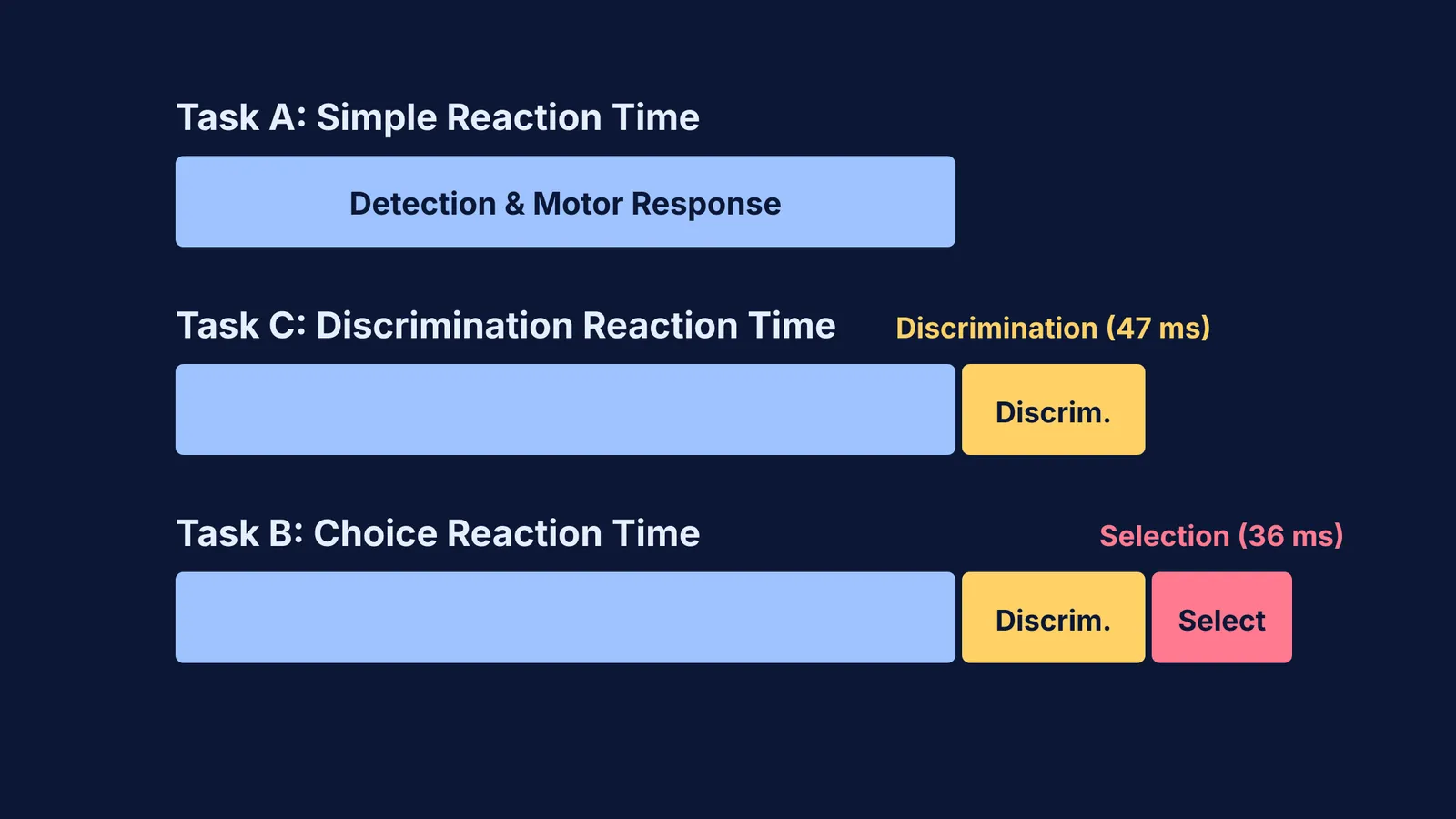
Donders designed an experiment with three types of reaction tasks to isolate specific mental events:
Task A (Simple Reaction Time): One stimulus and one response. For example, a person presses a button as soon as they hear a sound or see a light. The time taken is typically around 200 milliseconds (about 160 milliseconds for an auditory stimulus and 190 milliseconds for a visual one). This task measures the baseline time for detecting a stimulus and executing a motor response.
Task C (Discrimination Reaction Time): Multiple stimuli, but a response is required for only one. Often called a "Go/No-Go" task, this requires the brain to detect the stimulus and then discriminate whether it is the correct one. Donders reported that Task C took 47 milliseconds longer than Task A. This extra 47 milliseconds is the time the brain takes for stimulus discrimination.
Task B (Choice Reaction Time): Multiple stimuli, each requiring a different response. The brain must detect the stimulus, discriminate what it is, and then select the correct response. Donders found that Task B took 36 milliseconds longer than Task C. This extra 36 milliseconds isolates the response selection time.
Why choice reaction time matters for learning
Donders' experiment highlights a crucial principle of learning: choice takes time and effort. When you answer a complex multiple-choice question, you are performing a Task B operation.
First, you must detect and read the question (baseline). Next, you must discriminate the concept (what is this question actually asking?). Finally, you must select the correct rule or formula and apply it (response selection).
If a student only practices reciting facts, they are practicing Task A. They might know the definitions perfectly, but when faced with an exam that requires discriminating between similar concepts and selecting the right method, their cognitive load increases. This mismatch is a classic example of flawed judgments of learning, where students misjudge their own readiness because they haven't tested the selection step.
If you are stuck on knowing which method to apply, Fermi's AI tutor can help. Rather than just giving you the answer, it works out what you already know and builds a plan for the session, guiding you through the reasoning so you practice selecting the right path yourself.
How does the subtraction method explain exam performance?
When you sit an exam like JEE or NEET, time is your most limited resource. Every question requires you to cycle through detection, discrimination, and selection. If your discrimination time is slow because you are unsure of the concept, or your selection time is slow because you are choosing between five different formulas, those milliseconds add up over a three-hour paper.
This is why active learning is so effective. By regularly testing yourself with mixed problem sets rather than just reading a textbook, you are training your brain to speed up the discrimination and response selection phases, much like how understanding Alan Baddeley's working memory model helps you manage cognitive load. A student who has integrated these steps will intuitively recognise the right approach faster than a student who relies on simple recall.
When reviewing a concept, the Fermi Concept Library places each idea in its proper map, helping you see how it connects to others. This contextual understanding directly reduces the time your brain needs to discriminate between similar ideas during an exam.
A plan for active learning
You can apply the lessons of mental chronometry to your own study routine by moving from simple to complex tasks:
Master the baseline (Task A): Start by ensuring you understand the basic definitions and facts. Read the material and confirm you can recall the core ideas without hesitation.
Practise discrimination (Task C): Look at a list of exam questions without solving them, and simply identify which topic or formula each question requires. This trains your brain to quickly classify problems.
Practise selection and execution (Task B): Solve mixed problem sets under timed conditions, and use immediate or delayed feedback strategically to check your answers. This forces your brain to execute all three steps: detecting the problem, discriminating the concept, and selecting the correct method.
If you struggle with the selection phase, the Fermi Problem Library offers worked problems with a step-by-step solver that explains the reasoning. This helps you understand why a particular method was chosen, speeding up your response selection for the next time.
By recognising that every cognitive step has a measurable time cost, you can structure your study habits to train not just your memory, but your speed of thought.


