

On this page
When the Colombian scientist Francisco José de Caldas traveled through the Andes in the early 1800s, an accident changed the course of his research: he broke a thermometer. A self-taught naturalist, astronomer, and engineer, Caldas was deeply interested in mapping the rugged geography of his home country. Exploring the towering mountains, he developed the hypsometer—a robust instrument that used boiling water to map altitude rather than relying on heavy, fragile mercury barometers (Wikipedia: Francisco José de Caldas).
Caldas, known affectionately as "El Sabio" (The Wise) for his vast knowledge, noticed something curious during his expeditions. He found that water did not boil at the standard 100 °C (at sea level) when he was high up in the mountains. Instead, the boiling point was notably lower.
How does a hypsometer work?
Boiling is essentially a battle between two opposing physical forces. Inside the liquid, water molecules are constantly moving and trying to escape as a gas, exerting an outward force known as vapour pressure. Pressing down on the surface of the liquid is the weight of the air column above it, known as atmospheric pressure.
For a bubble of steam to form inside the liquid and rise to the surface, the vapour pressure must be equal to or greater than the atmospheric pressure. Water only boils when its vapour pressure matches the atmospheric pressure pushing down on it.
As you climb a mountain, there is a thinner layer of air pressing down on you. Because atmospheric pressure decreases with altitude, the water molecules face less resistance. Consequently, the water requires less thermal energy (heat) to reach the necessary vapour pressure. By simply measuring the precise temperature at which water boils, you can mathematically calculate your exact height above sea level (Wikipedia: Hypsometer).
Students learning about thermodynamics and vapour pressure can use the Fermi Simulation Lab to see exactly how these forces interact as elevation changes.
How much does the boiling point drop?
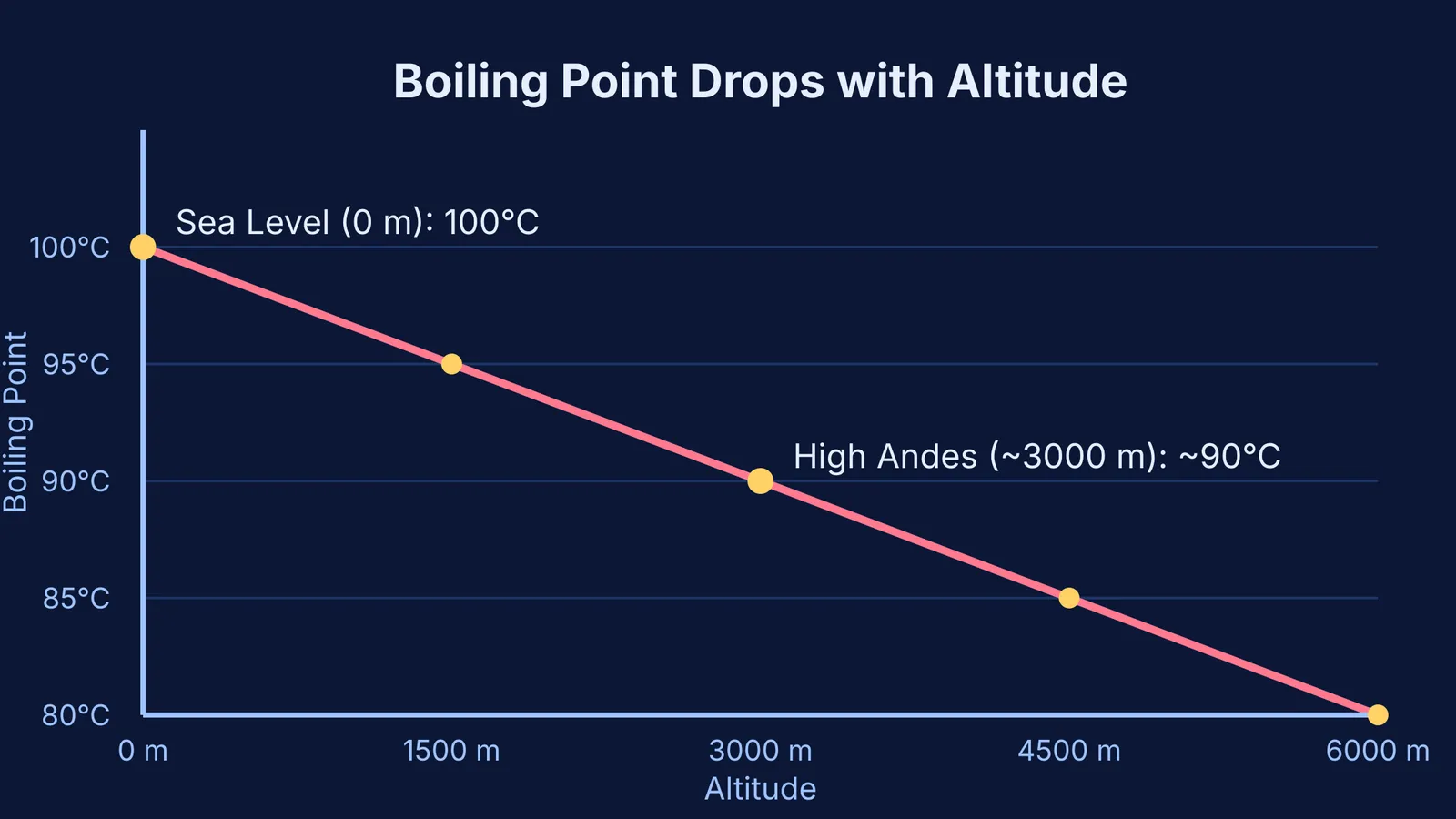
While the exact physics curve comparing pressure and temperature is slightly non-linear, there is a very practical rule of thumb. The boiling point of water drops by roughly 1 °C for every 305 metres of elevation gained (Wikipedia: High-altitude cooking).
If you prefer Imperial units, that translates to a drop of approximately 1 °F for every 500 feet of altitude. For example, at an elevation of 8,000 feet (2,438 metres)—roughly the altitude of many high mountain passes—water boils at 198 °F (92 °C) instead of the standard 212 °F (100 °C).
Why was this discovery a big deal?
When the famous Prussian explorer Alexander von Humboldt met Caldas in Ecuador in 1801, he was utterly astonished. Humboldt was a world-renowned scientist equipped with the best European instruments, but Caldas had independently perfected thermometric hypsometry using very limited resources in the relative isolation of Colombia.
A pressure hypsometer essentially consisted of a small, highly portable boiler and a finely calibrated thermometer. It was much tougher and more practical for field work than carrying a long glass mercury barometer over rocky trails. Caldas used his invention to gather detailed altitudinal data across the Andes. He meticulously observed how specific plant species are linked to their precise elevation zones, sharing his extensive findings with Humboldt. This data exchange contributed immensely to the early study of plant geography and ecology.
Whether you are studying the free expansion of an ideal gas or how Pascal's law operates in hydraulic machines, the core idea remains the same: pressure governs how matter behaves. Caldas simply looked at his boiling kettle, applied a sharp scientific mind, and saw a way to measure the height of the world's greatest mountains.


