

On this page
Why could conventional batteries not power Apollo?
When NASA planned the Apollo lunar voyages in the early 1960s, engineers encountered strict spacecraft weight limits, as documented in NASA technical records on space power systems. Supplying continuous electrical power to life support, navigation computers, and communications for an eight-day round trip required over 1 kilowatt of steady electricity. Packing conventional rechargeable lead batteries would have added thousands of kilograms of dead weight. Solar panels were equally impractical for the Apollo Service Module, which rotated constantly for thermal control and spent extended hours in lunar darkness. NASA needed an electrochemical device that consumed lightweight propellants already stored onboard: cryogenic hydrogen and liquid oxygen.
How did Francis Thomas Bacon make Grove's fuel cell practical?
The operating principle originated in 1839 with William Grove's laboratory demonstration, covered in our review of William Grove and the first working fuel cell. Grove showed that reversing water electrolysis generated current, but his cells relied on expensive platinum and produced negligible power.
British engineer Francis Thomas Bacon realized at Cambridge that fuel cells offered a vital thermodynamic advantage, as recorded in the Royal Society Biographical Memoir of Francis Thomas Bacon:
Beginning in 1932, Bacon transformed the concept into practical hardware through three choices described in his 1960 Nature paper on fuel cell power sources:
Using an alkaline electrolyte: Aqueous potassium hydroxide (KOH) allowed inexpensive nickel catalysts instead of platinum.
Operating at elevated temperature and pressure: Running at 200 °C and 40 atmospheres accelerated sluggish oxygen reduction kinetics.
Passivating the cathode: Pre-treating the nickel cathode with lithium hydroxide formed a corrosion-resistant lithiated nickel oxide layer.
By 1959, Bacon demonstrated a 40-cell stack delivering 5 kilowatts at 60% efficiency, powering an arc welder and a 2-ton forklift truck, as recorded in NASA Technical Memorandum 102366.
How did dual-porosity electrodes solve three-phase flooding?
The central obstacle in gas-liquid fuel cells is maintaining the three-phase boundary where solid metal, gaseous reactant, and liquid electrolyte meet simultaneously, an issue analyzed in Bacon's 1979 historical survey in the Journal of The Electrochemical Society. Excessive gas pressure bubbles into the electrolyte, while excessive liquid floods catalyst pores—forcing reactants to diffuse through liquid 10,000 times slower than in gas.
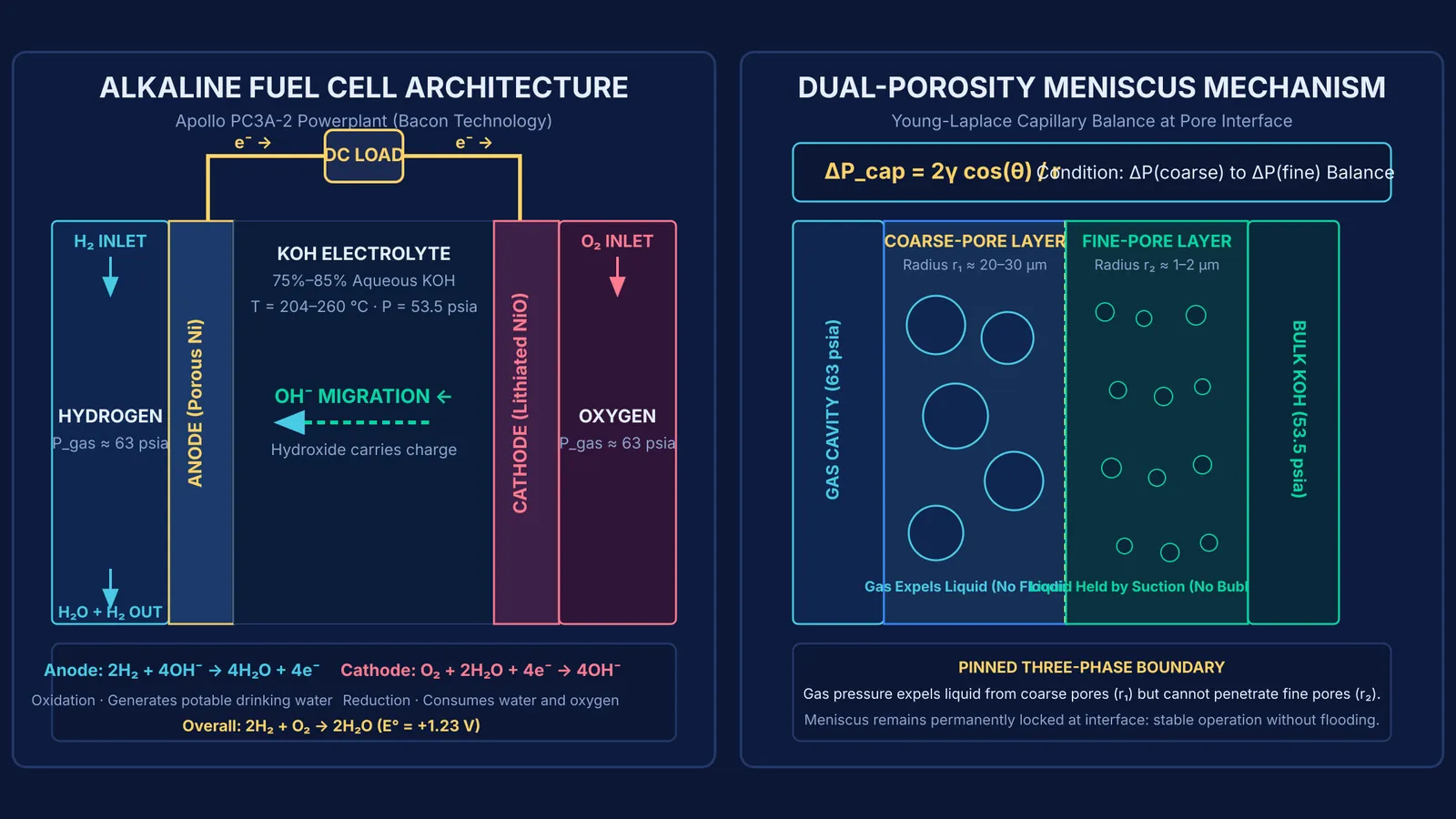
Bacon overcame this by inventing dual-porosity sintered nickel electrodes with two distinct layers:
A coarse-pore layer facing the gas cavity, with pores of 20 to 30 micrometres.
A fine-pore layer facing the liquid electrolyte, with pores of 1 to 2 micrometres.
By the Young-Laplace equation, capillary entry pressure is inversely proportional to pore radius (ΔP = 2γ cos θ / r). Maintaining gas pressure slightly above electrolyte pressure drives liquid out of the large pores, while the higher capillary entry pressure of the narrow pores prevents gas breakthrough. The electrolyte meniscus remains locked at the microscopic interface, preventing flooding across hundreds of operating hours.
What made Bacon's alkaline cell essential for lunar flight?
In 1959, aerospace manufacturer Pratt & Whitney licensed Bacon's patents to engineer Apollo's PC3A-2 powerplant. To save weight, engineers reduced pressure to 50–60 psi (0.35–0.41 MPa) and raised KOH concentration to 75%–85% at 204 °C to 260 °C, as documented in NASA Technical Memorandum 102366 on space fuel cells.
Three 1.5-kilowatt powerplants were mounted in Sector 4 of the Apollo Service Module, connected in parallel to supply a 28-volt direct-current bus. Each 100-kilogram (220-pound) unit met mission loads ranging from 563 to 1,420 watts, with peak capacity reaching 2,295 watts.
The reaction's chemical byproduct was pure drinking water, documented in NASA technical reports on space power systems. Astronauts drank this water and rehydrated meals with it, saving hundreds of kilograms of launch mass. As reported in the BBC historical retrospective on Apollo technology, President Richard Nixon told Bacon at the White House in 1969: "Without you, Tom, we wouldn't have gotten to the Moon."
When visualizing how ionic gradients and capillary boundaries govern electrochemical reactions, the Fermi Concept Library connects cell electromotive force, reaction quotients, and half-cell stoichiometry into a single conceptual map.
How much power and drinking water did Apollo generate?
Hydroxide ions carry negative charge across the KOH electrolyte:
Anode: 2 H₂ + 4 OH⁻ → 4 H₂O + 4 e⁻
Cathode: O₂ + 2 H₂O + 4 e⁻ → 4 OH⁻
Overall reaction: 2 H₂ + O₂ → 2 H₂O
At 298 K, standard Gibbs free energy of liquid water formation is ΔG° = −237.2 kJ/mol, cited in electrochemical thermodynamic benchmarks. Using the relationship between cell EMF and Gibbs energy (ΔG° = −nFE°) with n = 2 electrons transferred yields an ideal potential of E° ≈ 1.23 V.
Under typical loads, operating potential drops to roughly 0.80 V. Each mole of reacted H₂ produces 192,970 coulombs (Q = 2F), delivering 154.4 kJ of electrical work (0.0429 kWh). One kilowatt-hour consumes 23.32 moles of H₂, producing 0.420 kilograms (420 mL) of water.
At a steady 1.4-kilowatt spacecraft load (33.6 kWh per day), the fuel cells yielded 14.1 litres of pure water daily—meeting the 2.5 to 3 litres daily requirement for each of the three astronauts while lighting cabin systems.
When mastering multi-step physical chemistry problems, the Fermi Problem Library provides worked problems with a step-by-step solver that explains the underlying reasoning rather than just printing an answer.


