

On this page
In 1925, two chemists, Franz Fischer and Hans Tropsch, solved a massive problem for countries with coal but no oil. Working at the Kaiser Wilhelm Institute for Coal Research in Mülheim, Germany, they discovered a way to turn synthesis gas (a mixture of carbon monoxide and hydrogen) into liquid hydrocarbons. Today, the Fischer-Tropsch process they invented is being reimagined to create sustainable aviation fuel.
What is the Fischer-Tropsch process for synthetic fuel?
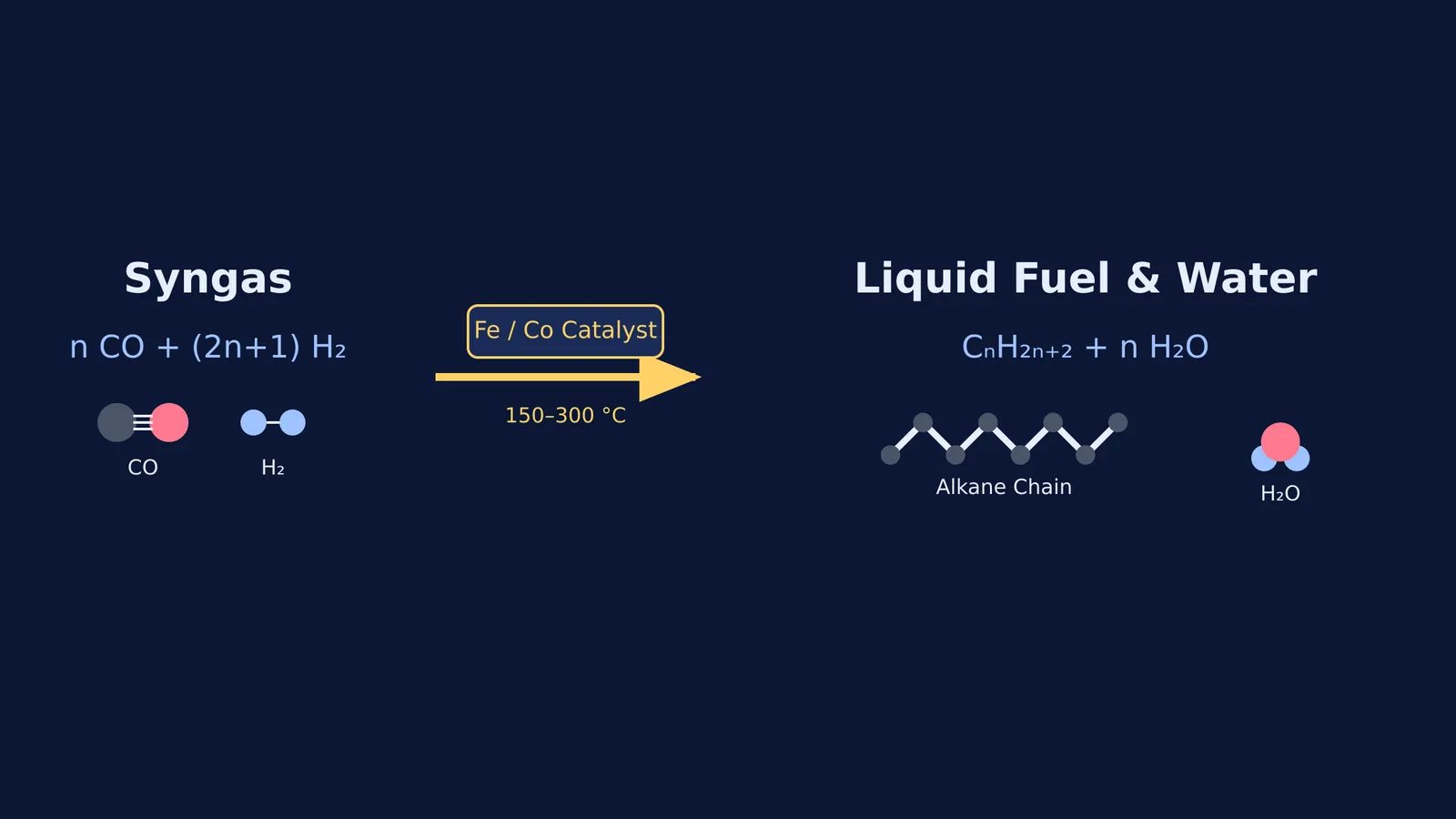
The Fischer-Tropsch (FT) synthesis is a chemical reaction that converts syngas (carbon monoxide and hydrogen) into liquid hydrocarbons like gasoline and diesel. The reaction takes place over a metal catalyst, typically iron (Fe) or cobalt (Co), at temperatures between 150 °C and 300 °C (Wikipedia).
Because the process builds hydrocarbon chains carbon by carbon, it produces a statistical mix of lengths, from methane to heavy waxes. The overall chemical equation for making an alkane chain is:
n CO + (2n+1) H₂ → CₙH₂ₙ₊₂ + n H₂O
The process is highly exothermic, meaning it releases a significant amount of heat. Keeping the reactor at the right temperature is one of the main engineering challenges in a large-scale plant.
The idea that a catalyst provides a surface or intermediate step without being consumed dates back to Elizabeth Fulhame and the first idea of how catalysts work. Stripping oxygen away from carbon to leave hydrogen-rich chains is a common theme in chemistry, seen also in laboratory techniques like the Clemmensen vs Wolff-Kishner reductions.
How did Fischer and Tropsch make the discovery?
Fischer and Tropsch did not start with perfect hydrocarbons. Their early attempts produced a mixture of oxygenated compounds, but by 1925, they had refined the catalyst and reactor conditions to produce high-quality synthetic oil at atmospheric pressure.
The choice of catalyst was crucial. They avoided nickel, which tended to produce too much methane gas, and instead focused on iron and cobalt. Cobalt proved better for longevity, while iron was cheap and handled the carbon-rich gases from coal perfectly.
If you are trying to understand the sequence of bond-breaking and bond-forming in organic chemistry, the Fermi Concept Library maps every concept in chemistry, each with its own lesson. By breaking down the elementary steps, you can trace exactly how small molecules assemble into complex chains.
Why do we still use the Fischer-Tropsch process today?
Historically, the process was used when a country had abundant coal but lacked petroleum. During World War II, Germany relied heavily on FT synthesis; by 1944, it supplied 25% of the country's automobile fuel and 9% of its total war fuel (Wikipedia). After the war, South Africa's Sasol scaled the process to become the largest producer of synthetic fuels in the world, a position it still holds today.
Today, the Fischer-Tropsch process is vital for the transition to green energy. In "Power-to-Liquid" (PtL) setups, renewable electricity splits water to make green hydrogen, which is then mixed with carbon dioxide captured from the air. The resulting syngas is fed into an FT reactor to create carbon-neutral aviation fuel (SAF).
When studying chemical kinetics and industrial processes, picturing the exact role of pressure, temperature and catalysts can be difficult. The Fermi Simulation Lab provides interactive simulations for ideas that are easier to see than to read. You can interact with parameters like these to see how they shift the equilibrium and reaction rate. If you get stuck on a homework problem about reaction quotients, Fermi's AI tutor can work out what you already know and build a plan for the session to master the concept.
How do you balance the Fischer-Tropsch equation?
When balancing industrial chemical equations, the key is tracking the atoms. For the Fischer-Tropsch production of a single octane molecule (C₈H₁₈) found in petrol, you can derive the exact stoichiometry step by step:
You need 8 carbon atoms, which means starting with 8 CO molecules.
The 8 CO molecules also bring 8 oxygen atoms into the reaction. In the FT process, oxygen is rejected as water, which means those atoms will form 8 H₂O molecules.
The target alkane (C₈H₁₈) requires 18 hydrogen atoms, and the resulting water (8 H₂O) requires 16 hydrogen atoms. That makes a requirement of 34 hydrogen atoms in total.
Since hydrogen gas comes as diatomic H₂, you therefore need 17 H₂ molecules.
The balanced equation is exactly what the general formula `n CO + (2n+1) H₂` predicts for n = 8:
8 CO + 17 H₂ → C₈H₁₈ + 8 H₂O
Working through the stoichiometry confirms why the process needs a synthesis gas heavily enriched in hydrogen to produce useful, long-chain transport fuels.


