

On this page
On 2 July 1900, Ferdinand von Zeppelin's LZ 1, a rigid airship measuring 128 metres in length, lifted off from Lake Constance in Germany. It flew for about 18 minutes, carrying its crew on a 6-kilometre journey. The flight of this massive 420-foot machine proved that a powered, lighter-than-air craft with a solid structure could navigate the skies. But what exactly held such an enormous metal frame aloft?
Zeppelin airship: how it floated?
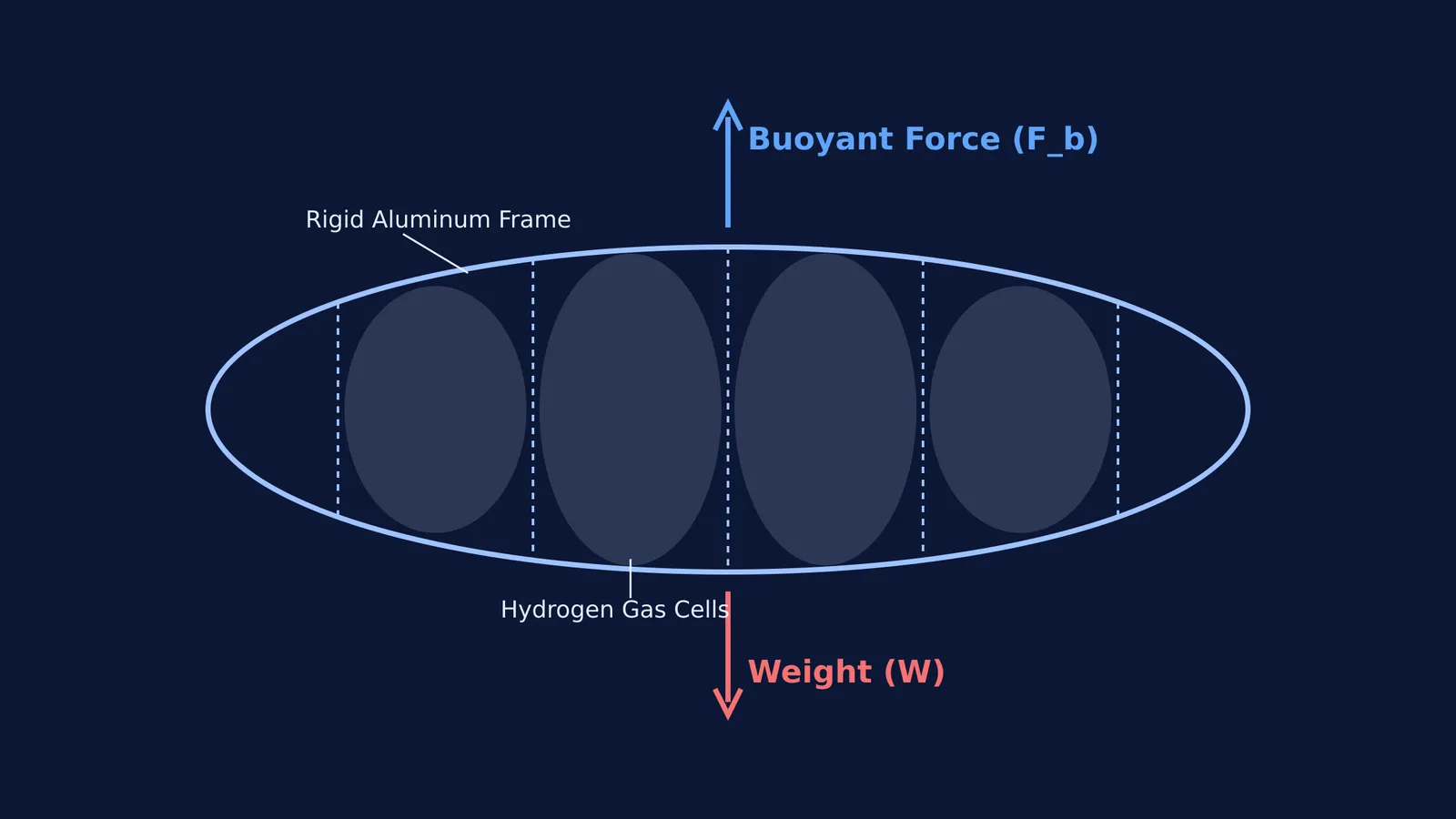
The physics behind a floating Zeppelin is based entirely on aerostatic lift, governed by Archimedes' principle. The principle states that the upward buoyant force on an object is equal to the weight of the fluid it displaces. Because the massive airship displaced a huge volume of surrounding air, the air pushed back up with an equal force.
Unlike soft blimps, which are essentially large balloons that rely on internal gas pressure to keep their shape, a Zeppelin is a "rigid airship". Count Zeppelin's design featured an internal skeleton made of an aluminium alloy. Inside this massive skeleton, the LZ 1 housed 17 separate internal gas cells made of rubberised cloth.
This modular design was the secret to the Zeppelin's success. The gas cells contained approximately 11,300 cubic metres (roughly 399,000 cubic feet) of hydrogen. Because the lifting gas was contained in separate internal bags, a puncture in one cell would not cause the entire airship to crash, and the rigid metal frame ensured the ship kept its aerodynamic, cigar-like shape regardless of the gas pressure inside. The outer fabric envelope merely provided a streamlined surface to reduce drag and protect the internal components.
Why was hydrogen used instead of helium?
The choice of lifting gas comes down to density. Standard air has a density of about 1.22 kg/m³. Hydrogen, the lightest element, has a density of roughly 0.085 kg/m³. This significant difference means that hydrogen provides approximately 1.14 kg of lift per cubic metre.
Helium is often considered the safer alternative because it is inert and non-flammable. However, helium has a higher density of about 0.17 kg/m³, which means it provides less lift than hydrogen (about 1.05 kg/m³). While the safety benefits of helium are obvious today, German Zeppelins continued to use hydrogen for two reasons: hydrogen offered superior lifting capacity for heavy passenger flights, and helium was extremely expensive and subject to a strict US export embargo.
Using hydrogen carried immense risks. Because hydrogen is highly flammable, any spark or static discharge near a leak could lead to disaster, a danger tragically realised in the 1937 Hindenburg fire.
How did Zeppelins control their altitude?
A Zeppelin pilot had to carefully manage the balance between weight and buoyancy.
To climb to a higher altitude, the crew used ballast. By dumping water from tanks located along the hull, they decreased the airship's total weight, allowing the constant buoyant force to push the ship higher. Conversely, to descend, the crew would open gas release valves at the top of the cells, venting hydrogen into the atmosphere and decreasing the total buoyant lift.
If you want to master these mechanics for your exams, reading about Archimedes on buoyancy and levers is a great start. To avoid common pitfalls in your calculations, review our guide on Fluid mechanics: pressure, buoyancy and Bernoulli mistakes. When you are ready to visualise these forces in action, the interactive Simulation Lab provides dynamic models that make the invisible forces of buoyancy easy to see.


