

On this page
The NCERT Class 12 chapter on microbes shows a drawing of a bacteriophage, a virus that infects bacteria, and the Hershey-Chase experiment uses one to show that DNA is the genetic material. But who first realised such a thing existed? The credit usually goes to a largely self-taught microbiologist named Felix d'Herelle. This post covers what he saw, how scientists still count phages using his clear spots, and why his idea is back in the news.
Who was Felix d'Herelle?
His biographer, William Summers of Yale University, describes him in a 2016 essay in the journal Bacteriophage as a "high school dropout" who taught himself microbiology. Even his birthplace was confused: d'Herelle claimed Canada, but a birth certificate found later shows he was born in Paris. He lived from 1873 to 1949.
Before phages, he worked on fermentation and on insect diseases. In Mexico he studied a bacterium that killed locusts and tried using it to control locust swarms, which is why, Summers notes, insect pathologists remember him as a father of biological pest control. While growing those bacteria on agar, he noticed odd clear spots where the bacterial lawn had disappeared.
What did he discover in 1917?
During the First World War d'Herelle was working at the Pasteur Institute in Paris on an outbreak of dysentery among soldiers. A 2025 review in Frontiers in Microbiology summarises the key observation: filtered extracts from patients' stools could destroy cultures of the dysentery bacteria. The filter removed the bacteria themselves, so whatever did the killing was smaller than a bacterium.
On 10 September 1917, at age 44, he published a brief note in the Comptes rendus of the French Academy of Sciences. Summers writes that d'Herelle described the agent as "an obligate intracellular parasite" of bacteria: something that could only multiply inside a bacterial cell. The agent became known as the bacteriophage, from the Greek for "bacteria eater".
Frederick Twort had reported a similar effect in 1915, and the two camps argued about priority for years. Summers's view is that Twort observed the effect but did not interpret it as a virus that reproduces, while d'Herelle proposed and supported exactly that.
Did India play a part?
Yes, twice. A 2020 paper in Notes and Records of the Royal Society describes how the British bacteriologist Ernest Hanbury Hankin reported in 1896 that water from the Ganges and Yamuna killed cholera bacteria. d'Herelle later cited Hankin's work as an early sign of phage action. The same paper notes that d'Herelle himself worked in India from 1927 as part of a Bacteriophage Inquiry into plague and cholera.
How do scientists count phages?
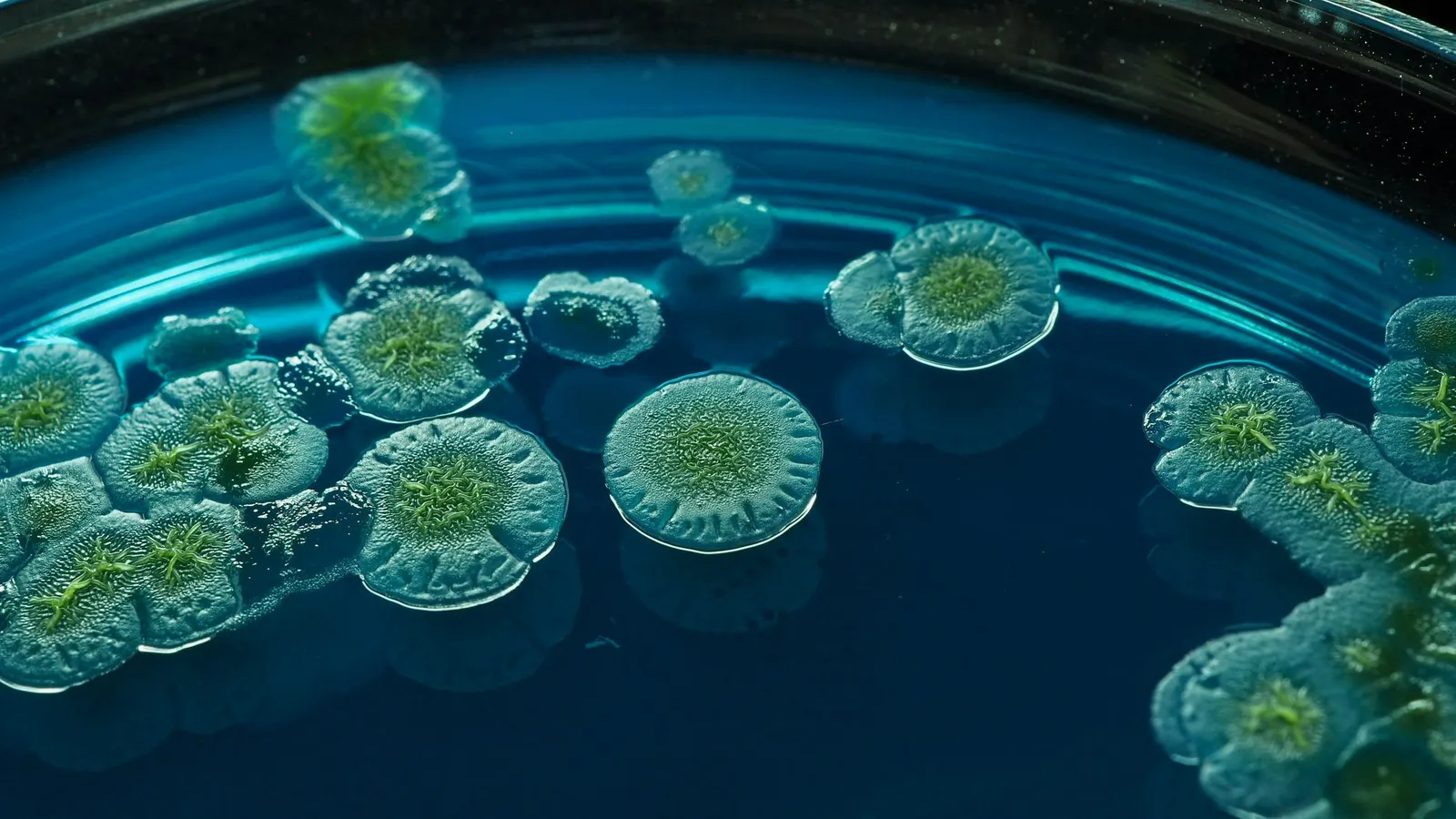
The clear spots d'Herelle saw are called plaques. Each plaque starts from one infectious phage that infects a bacterium, multiplies, bursts it, and spreads to its neighbours. The Frontiers review describes how the plaque assay grew from d'Herelle's 1917 work and how phage samples are diluted in tenfold steps so that plaques can be counted. The count is reported in plaque-forming units (PFU).
Worked example (sample numbers for practice). A phage sample is diluted to 10⁻⁶ (one millionth). You spread 0.1 mL of that dilution on a plate of bacteria and count 150 plaques the next day.
Plaques per mL of the diluted sample: 150 / 0.1 = 1,500 PFU per mL.
Undo the dilution: 1,500 / 10⁻⁶ = 1,500 × 10⁶ = 1.5 × 10⁹ PFU per mL.
Sense check: if the plaques on a plate overlap so much that you cannot count them, plate a higher dilution instead.
Why are phages back in the news?
d'Herelle spent much of his later career trying to treat infections with phages, an idea that faded once antibiotics arrived. A 2023 review in Cell by Strathdee and colleagues says rising antimicrobial resistance has revived phage research, and that a therapeutic phage should preferably be lytic (kill its host by bursting it), kill efficiently, and be fully characterised to rule out side effects.
Which ideas from this connect to your syllabus?
Viruses need a host cell. d'Herelle's "obligate intracellular parasite" is the same idea your textbook uses for all viruses.
Phages in genetics. The Hershey-Chase experiment used phages labelled with radioactive phosphorus and sulphur to show that DNA, not protein, enters the bacterium.
Microbes in human welfare. The NCERT Class 12 chapter shows a bacteriophage in its figure of viruses. Check your exam's current syllabus for how much detail is needed.
What can a student take from d'Herelle's way of working?
Follow the odd result. Clear spots on a plate looked like a nuisance. He treated them as data.
Use a filter to ask a question. Passing the extract through a filter that stops bacteria told him the agent was smaller than a bacterium.
State a testable idea. "A parasite that multiplies inside bacteria" predicted that the killing agent would grow in number, which he could check by serial transfer.
Dilution arithmetic like the plaque count above trips up many students. The Fermi Problem Library has worked problems with a step-by-step solver that explains the reasoning rather than printing an answer.
Try it now: if 0.1 mL of a 10⁻⁷ dilution gives 42 plaques, what is the titre of the original sample?


