

On this page
Your phone, your laptop and many home appliances run on microprocessors. The first commercial one came from a small team at Intel. Its chip design was led by a young Italian physicist, Federico Faggin.
Who designed the Intel 4004?
Four engineers share the credit. The Computer History Museum says Ted Hoff and Stanley Mazor conceived the 4004 as a 4-bit processor. It also says Federico Faggin, assisted by Masatoshi Shima, put the design onto silicon in 1971.
Ted Hoff (Intel) came up with the architecture: a small general-purpose processor instead of many custom calculator chips.
Stan Mazor (Intel) worked with Hoff on the specification.
Federico Faggin (Intel) joined in April 1970 and did the actual chip design, according to IEEE Spectrum's Chip Hall of Fame.
Masatoshi Shima came from Busicom, the Japanese calculator company that ordered the chips. He stayed at Intel for six months to help Faggin.
The US government recognised the work in 2009. Faggin, Hoff and Mazor received the National Medal of Technology and Innovation "for the conception, design and application of the first microprocessor". The Computer History Museum notes that all four shared the 1997 Kyoto Prize.
How did a calculator order become the first commercial microprocessor?
In 1969, Busicom asked Intel to design 12 custom chips for a new printing calculator, according to Intel's own history of the 4004. Intel's engineers offered four chips instead, and one of them could be programmed.
That one programmable chip was the key idea. A calculator built from custom logic can only ever be that calculator. A processor that follows a program can become a calculator, a cash register or a traffic-light controller, depending on the software. In May 1971, Intel bought back the rights to sell the chip for everything except calculators, in exchange for returning Busicom's $60,000 investment (Intel).
What made Faggin the right person to build it?
Before Intel, Faggin worked at Fairchild Semiconductor. There, in 1968, he created the MOS silicon-gate technology, according to his Computer History Museum profile. The museum's Silicon Engine timeline says he used that experience to squeeze the 4004's 2,300 transistors into a low-cost 16-pin package.
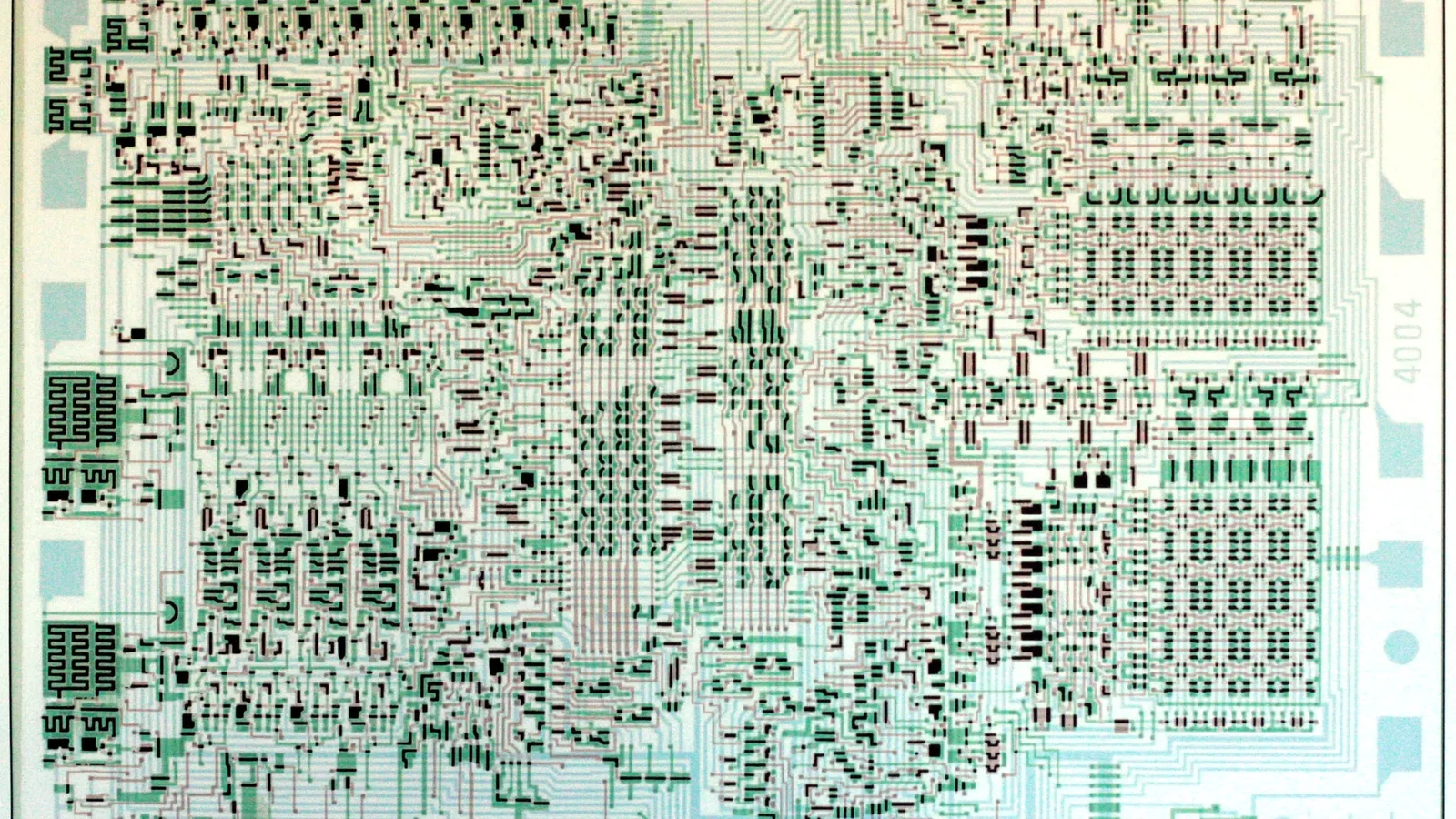
When Faggin joined Intel, he found that almost no design work had been done in five months. Shima was furious when he arrived to check progress (IEEE Spectrum). Faggin worked 70 to 80 hours a week, finished the design by the end of 1970, and delivered a working chip set in March 1971. His initials, "F.F.", are etched along the edge of the 4004.
Intel announced the chip with an advertisement in Electronic News on 15 November 1971 (The Register). The same report gives its key numbers: about 2,300 transistors, a 10-micron process and a clock speed of 740 kHz. Faggin went on to co-found Zilog in 1974, where he conceived the Z80 microprocessor and directed its development (Computer History Museum).
How fast was the 4004? A worked example
You can feel the gap between 1971 and today with Class 11 arithmetic. Use the 740 kHz figure from The Register.
Clock period = 1 / frequency = 1 / 740,000 Hz ≈ 1.35 × 10⁻⁶ s, about 1.35 microseconds per tick.
Take a modern processor clocked at 3 GHz as an example. Its period is 1 / (3 × 10⁹ Hz) ≈ 0.33 nanoseconds.
Ratio = 3 × 10⁹ / 7.4 × 10⁵ ≈ 4,000. Each tick of a 3 GHz clock is about 4,000 times shorter.
Clock speed is only part of the story. Modern chips also do more work per tick and run many cores at once. Moore's law explains the other part: far more transistors on each chip. Our post on Gordon Moore's 1965 prediction covers this.
What can students learn from the 4004 team?
Split the problem. The team divided a calculator into memory, program, input/output and processing. That same split is the core of the Class 11 CBSE unit on computer system organisation. Try drawing the four MCS-4 chips as boxes and labelling which one plays each role.
General beats special when the task might change. Hoff's programmable chip outlived the calculator it was made for. In problem-solving, a method you understand carries over to new questions. A memorised answer does not.
Know the physics underneath. Faggin's silicon-gate work came before the microprocessor. It built on the idea of Jack Kilby's integrated circuit: every part on one chip.
If that gap is semiconductors or logic gates, the Fermi Concept Library gives each concept its own lesson and shows where it sits in the map of physics and computing. If you find switching easier to see than to read, the Fermi Simulation Lab has interactive simulations for ideas like that.
Next time you pick up a phone, remember that its brain began as one small chip with a designer's initials etched along its edge.


