

On this page
Concrete is one of the oldest building materials in the world, and it is exceptionally strong in compression—it can hold up immense weight pushing down on it. However, it is very weak in tension. If you stretch concrete, or if a beam bends and stretches along its bottom edge, it cracks easily.
For decades, engineers patched this weakness by burying steel bars inside the concrete to carry the pulling forces, creating reinforced concrete. But the concrete itself still cracked under heavy loads. In 1928, the French engineer Eugène Freyssinet filed a patent that fundamentally changed how we build: he found a way to stop the concrete from feeling tension at all.
Who was Eugène Freyssinet?
Eugène Freyssinet (1879–1962) was a French structural and civil engineer. Long before he formally patented his invention, he spent years pushing the limits of traditional reinforced concrete. In 1911, he built the Pont le Veurdre with 72.5-metre spans, the longest in France at the time (Wikipedia). By 1923, his design for the St-Pierre-du-Vauvray bridge set a new record with 132-metre hollow arches (Wikipedia).
During these massive projects, Freyssinet noticed a quiet, destructive force. He discovered that concrete "creeps"—it slowly shrinks and deforms over time when kept under continuous stress. This observation was the key to his greatest breakthrough.
How does prestressed concrete work?
Freyssinet’s solution was to pre-compress the concrete. Instead of just laying passive steel bars inside the mould, he used steel wires to squeeze the concrete together before the beam ever carried a load.
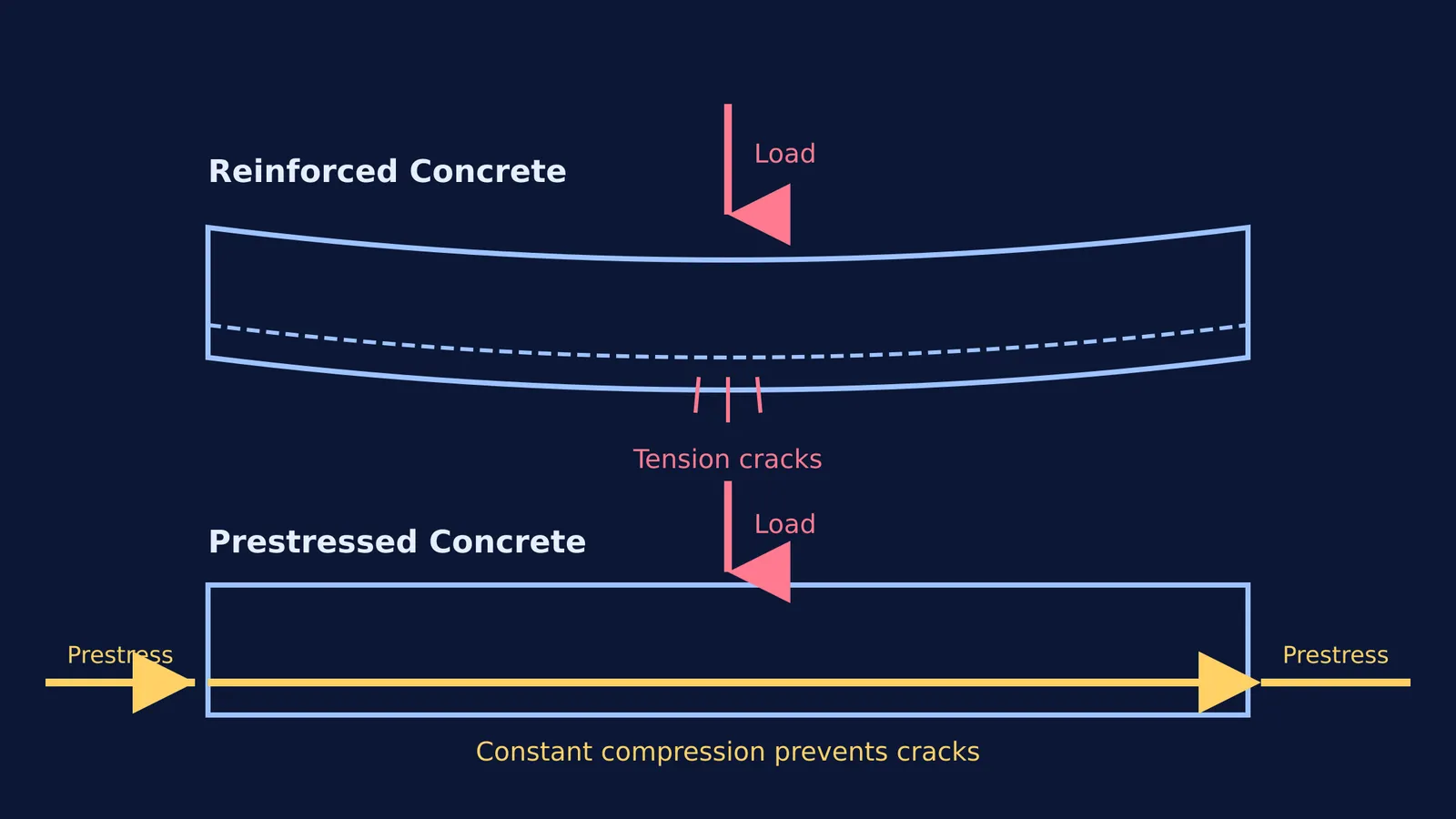
When you stretch a rubber band and let it snap back, it pulls inwards. Freyssinet did the same with steel. In a process called pre-tensioning, high-strength steel wires are pulled tight, and concrete is poured around them. Once the concrete hardens and grips the steel, the tension on the wires is released. The steel tries to shrink back to its original length, pulling the concrete inwards and putting the entire beam in a permanent state of high compression.
When cars or trains drive over a prestressed beam, the load tries to bend the beam and stretch its bottom edge. But because the bottom is already squeezed tightly together, the load must first overcome all that built-in compression. The concrete never goes into tension, so it never cracks.
This makes the mathematics of elasticity and Young's modulus problems crucial to modern civil engineering. To get it right, the initial squeeze must be perfectly calculated to balance the expected load.
Why did Eugène Freyssinet invent prestressed concrete?
Others had tried to squeeze concrete before Freyssinet, but their bridges always failed. The initial squeeze would simply vanish after a few years.
Freyssinet’s genius was combining his invention with his earlier discovery of creep. He realised that as the concrete slowly shrank over time, the tension in the steel wires dropped. If he used ordinary steel, the shrinkage would wipe out the entire squeeze. In his 1928 patent, Freyssinet stated that prestressed concrete would only work if engineers used very high-strength steel stretched to extreme tensions (Wikipedia). Even after the concrete shrank, enough tension would remain in the high-strength steel to keep the beam compressed. This also requires managing other effects like thermal stress in clamped rods, as temperature changes affect the steel's pull.
How does prestressed concrete build longer spans?
Because prestressed concrete uses the entire depth of the beam effectively (with no cracked, useless sections), the structures can be much thinner and lighter. A lighter bridge deck means the bridge spends less of its strength holding up its own weight, allowing it to stretch much further.
Freyssinet proved this to the world in 1930 with the Plougastel Bridge, which featured three massive 180-metre spans, setting a world record for concrete arches (Wikipedia).
Today, prestressed concrete is the standard for long highway overpasses, nuclear containment vessels, and towering skyscrapers. Understanding the balance of forces inside a rigid beam can be difficult from a textbook. The Fermi Simulation Lab offers interactive simulations for the ideas that are easier to see than to read.
How can you spot a prestressed concrete beam?
Next time you are walking under a concrete overpass, look for these three signs of prestressing:
Slender profile: The beam looks too thin to support the road above it.
No cracks: The bottom surface of the beam is smooth and free of the vertical hairline cracks seen in ordinary reinforced concrete.
Anchor plates: At the extreme ends of the bridge, you may see circular steel plates where the high-strength tendons are locked into place.


