On this page
In July 1994 telescopes around the world watched pieces of a comet slam into Jupiter, one after another, for almost a week. The comet had been found sixteen months earlier by a husband and wife and their colleague, comparing photographs. This post covers how the Shoemakers worked, what the discovery reports said, and the impact physics.
Who were Eugene and Carolyn Shoemaker?
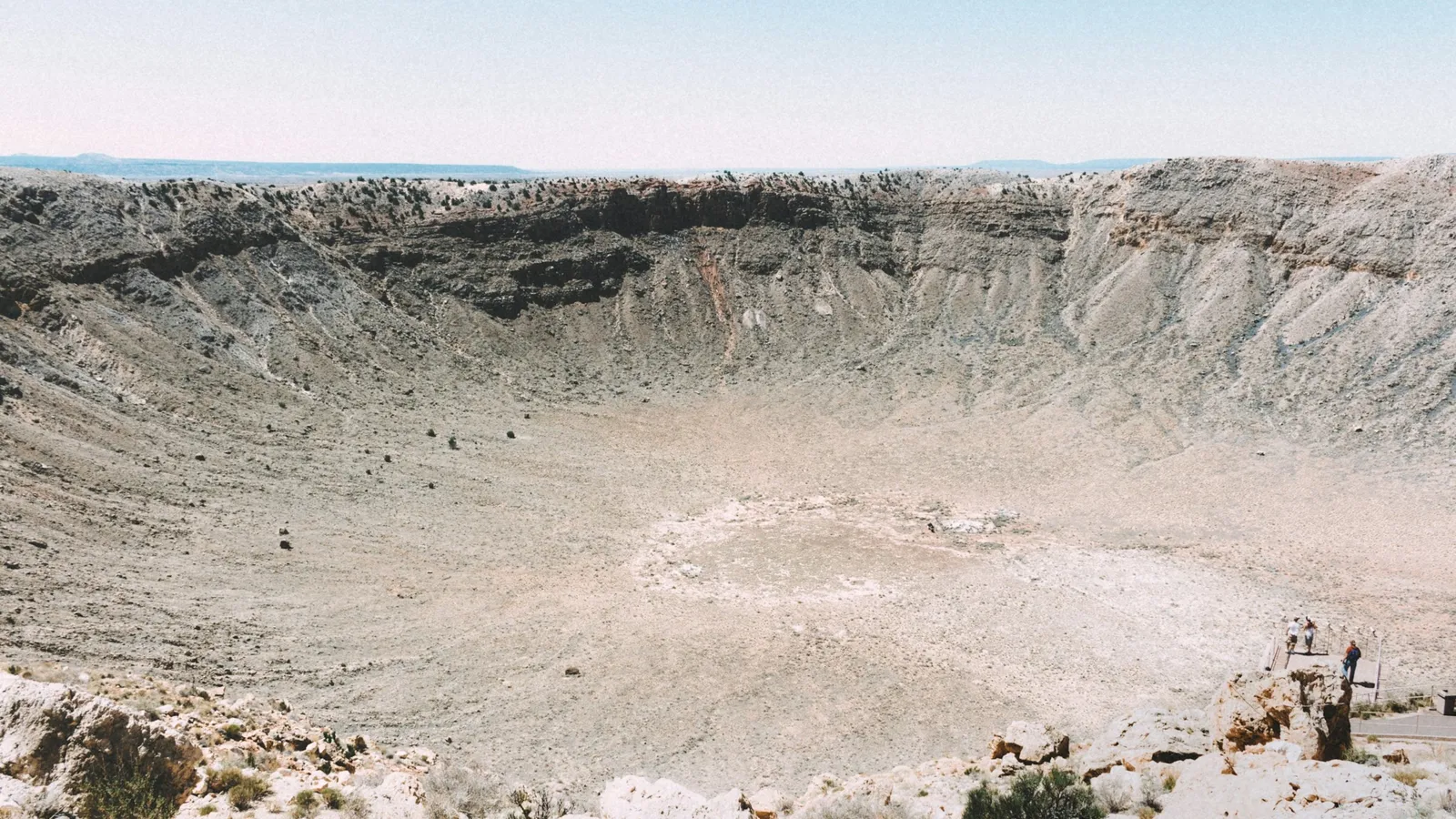
Eugene Shoemaker's obituary in Nature, by Thomas Ahrens, calls him the founder of the scientific study of impact cratering. Born in Los Angeles, he graduated from Caltech at 19 and joined the US Geological Survey in 1948. After his first visit to Meteor Crater in Arizona in 1952 he became convinced that it, and the craters on the Moon, were made by impacts. In 1956 he mapped craters from nuclear explosions in Nevada and found the same overturned layers of rock thrown out around them as at Meteor Crater.
In 1960 he was co-author of a paper in Science, First Natural Occurrence of Coesite, reporting coesite, a high-pressure form of silica, in sandstone at Meteor Crater. The abstract notes this "has important bearing on the recognition of meteorite impact craters".
Physics Today records that Carolyn Shoemaker was born in Gallup, New Mexico, in 1929 and took degrees in history and political science, not physical science. She married Gene in 1951. After raising three children, she began searching for comets and asteroids.
How did they search?
Physics Today describes her method. She studied pairs of photographs of the same patch of sky taken at different times and looked for anything that had moved against the fixed stars. She found about one comet for every 100 hours of work. By 1994 she had discovered 32 comets, more than any living astronomer at the time.
What did they find in March 1993?
The discovery report is IAU Circular 5725. It credits C. S. Shoemaker, E. M. Shoemaker and D. H. Levy with images on films taken with the 0.46-metre Schmidt telescope at Palomar, with a position for 24 March 1993. The appearance was "most unusual": a dense, linear bar about 1 arcminute long with no central condensation. Two nights later J. V. Scotti confirmed it with Spacewatch electronic images and saw a narrow train with at least five separate condensations.
Two months later, IAU Circular 5800, by Brian Marsden, reported an orbit computed by S. Nakano. The comet had passed within 0.0008 au of Jupiter's centre on 8 July 1992, "within the Roche limit", where Jupiter's tides could pull it apart. The same orbit showed the next approach, in late July 1994, would come within 0.0003 au of the centre, smaller than Jupiter's radius of 0.0005 au. In other words, it was going to hit.
When did the pieces hit?
NASA JPL's Small-Body Database keeps orbits for each fragment, lettered A to W. Each orbit is marked valid only until its impact. Fragment A runs to 16 July 1994 at 20:11 UTC, and fragment W to 22 July at 08:05 UTC. Physics Today notes the impacts left vivid dark scars in Jupiter's atmosphere.
How much energy does a fragment carry?
A body falling onto a planet from far away hits at roughly the planet's escape speed. NASA's Jupiter fact sheet gives that as 59.5 km/s.
Worked example, using a hypothetical fragment (the size and density are sample numbers, not measurements):
Check the speed. v = √(2GM/R) with GM = 1.267 × 10¹⁷ m³/s² and R = 7.149 × 10⁷ m gives √(3.54 × 10⁹) ≈ 5.95 × 10⁴ m/s.
Sample mass. A sphere 1 km across (radius 500 m) with density 600 kg/m³ has mass (4/3)π(500)³ × 600 ≈ 3.1 × 10¹¹ kg.
Kinetic energy. ½mv² = 0.5 × 3.1 × 10¹¹ × (5.95 × 10⁴)² ≈ 5.6 × 10²⁰ J.
In TNT terms. One megatonne is 4.184 × 10¹⁵ J, so this is about 1.3 × 10⁵ megatonnes.
Common mistakes: forgetting to square the speed, and leaving km/s unconverted. For scale, the 1992 pass at 0.0008 au was only about 1.7 Jupiter radii from the planet's centre (0.0008 × 1.496 × 10⁸ km ÷ 71,492 km). Our post on gravitational potential energy explains where √(2GM/R) comes from, and our post on Luis and Walter Alvarez covers an impact on Earth.
What can a student take from how they worked?
Combine fields. The team was a geologist, a searcher trained in history and political science, and their colleague David Levy.
Value slow, careful comparison. Hundreds of hours with plate pairs produced the discoveries.
Report the strange thing clearly. The circular described exactly what they saw, a bar, not a smudge.
If escape speed and energy problems still trip you up, the Fermi Problem Library has a step-by-step solver that explains the reasoning rather than printing an answer.
Next step: redo the energy calculation for a fragment half as wide, and explain why the energy falls by a factor of eight.