

On this page
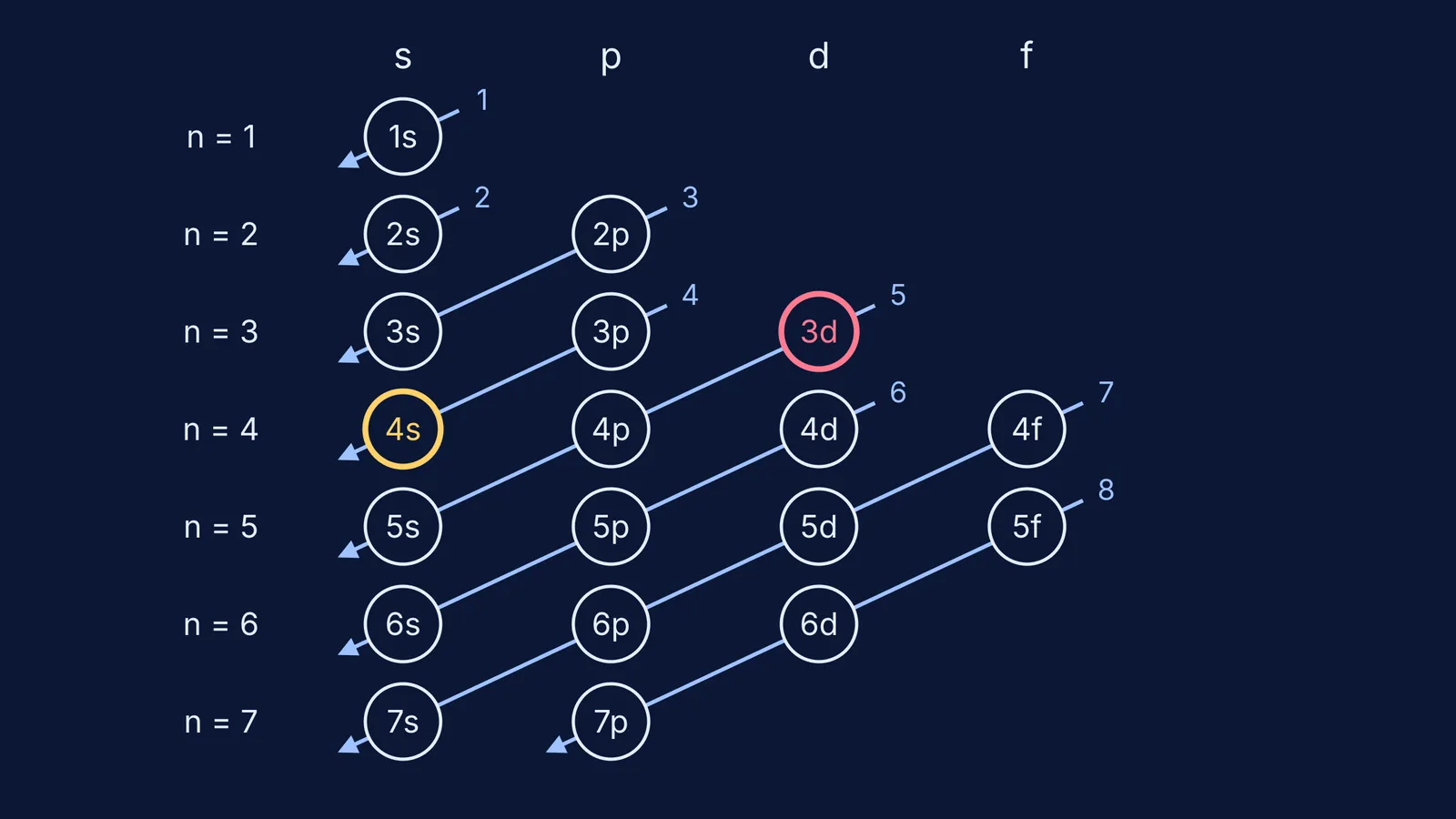
You learned that 4s fills before 3d, probably from a chart of diagonal arrows in Class 11. The rule behind that chart has a name. In 1936, the German physicist Erwin Madelung proposed it as an empirical rule for the order of filling atomic subshells, and chemists still call it the Madelung rule. Knowing what it does not say will save you marks on ions.
Who was Erwin Madelung?
Madelung was born in Bonn on 18 May 1881 and died in Frankfurt on 1 August 1972. In 1921 he succeeded Max Born as Chair of Theoretical Physics at Goethe University Frankfurt, a post he held until he retired in 1949. You may already have met his name twice: the Madelung constant describes the net electrostatic effect of all the ions in a crystal lattice, and the Madelung equations are an alternative form of the Schrödinger equation.
The rule is usually cited to his reference book for physicists, Die mathematischen Hilfsmittel des Physikers, third enlarged edition, published by Springer in Berlin in 1936. Eugene Belokolos's 2017 paper in SIGMA, which tries to explain the rule, cites that book and calls the rule empirical: it summarises what atoms do rather than following from a derivation.
What does the n + l rule say?
The rule has two parts (Aufbau principle):
Electrons are assigned to subshells in order of increasing n + l.
If two subshells have the same n + l, the one with lower n fills first.
Here n is the principal quantum number and l is the azimuthal quantum number: 0 for s, 1 for p, 2 for d and 3 for f.
Worked example: 4s has n + l = 4 + 0 = 4, while 3d has 3 + 2 = 5. Four is smaller, so 4s comes first. Now take 3d, 4p and 5s. All give 5, so lowest n goes first: 3d, then 4p, then 5s.
Group subshells by n + l and the sequence falls out:
n + l = 1: 1s
n + l = 2: 2s
n + l = 3: 2p, 3s
n + l = 4: 3p, 4s
n + l = 5: 3d, 4p, 5s
n + l = 6: 4d, 5p, 6s
n + l = 7: 4f, 5d, 6p, 7s
n + l = 8: 5f, 6d, 7p (then 8s, beyond the known elements)
Read the list top to bottom for the full order. Each line is one diagonal arrow on the chart you memorised.
Was Madelung the first to propose the n + l rule?
No. According to the history summarised in the aufbau principle entry, Niels Bohr formulated the aufbau idea in the early 1920s. Charles Janet suggested a periodic table in which each row corresponds to one value of n + l in 1928, and in 1930 made the quantum basis explicit. The engineer Vladimir Karapetoff was the first to publish the rule itself, also in 1930. Madelung followed in 1936, though he may have known the pattern by 1926.
In the Soviet Union, V. M. Klechkovskii published Justification of the Rule for Successive Filling of (n + l) Groups in JETP in February 1962. As a 2017 exchange of letters in Inference notes, in France the rule is attributed to Klechkowski rather than Madelung.
Does 4s really fill before 3d in every atom?
The rule predicts most neutral-atom configurations; it does not say that electrons enter in that order, or that 4s sits below 3d in energy in every atom. Eric Scerri, writing in Education in Chemistry in 2013, gives scandium's configuration as 1s2 2s2 2p6 3s2 3p6 3d1 4s2 and argues that the 4s orbital actually fills last, so it is natural that it loses electrons first when a positive ion forms.
The rule also has exceptions. The Inference letters put them at about twenty elements whose atoms do not have the configuration you would expect. Chromium and copper are the ones most often tested, and we explain them in why chromium and copper break the aufbau order.
If the arrows still feel like magic, the Fermi Concept Library gives each chemistry concept its own lesson and its place in the map, so you can see how quantum numbers lead to subshells before you memorise any order.
A five-minute check you can do tonight
Order these by n + l with the tie-break: 6s, 4f, 5d, 5p. (Answer: 5p, 6s, 4f, 5d.)
Write iron's configuration, Z = 26: 1s2 2s2 2p6 3s2 3p6 4s2 3d6. Add the superscripts to check they total 26.
Form Fe3+ by removing the 4s electrons first and then one 3d electron, giving [Ar] 3d5. Our guide to electron configuration of ions like Fe3+ and Cu+ has more practice.
Fill 3d5 into boxes one electron per orbital first, as in Friedrich Hund's rule for filling atomic orbitals.
When a configuration goes wrong, check the method, not just the answer. The Fermi Problem Library has worked problems with a step-by-step solver that explains the reasoning rather than printing an answer.


