

On this page
If you have ever synthesised aspirin or prepared a double salt in the chemistry lab, you know the waiting game of gravity filtration. Watching liquid drip slowly through a fluted filter paper tests any student's patience.
The solution to this bottleneck is vacuum filtration. At the heart of this setup is the Büchner funnel: a heavy, flat-bottomed porcelain cylinder that uses a pressure difference to pull solvent through instantly, leaving a clean, dry solid behind.
Who is the Büchner funnel inventor?
The Büchner funnel was invented by the German industrial chemist Ernst Wilhelm Büchner (1850–1924). Born into a family of prominent intellectuals and scientists, he was the nephew of the playwright Georg Büchner and the philosopher Ludwig Büchner.
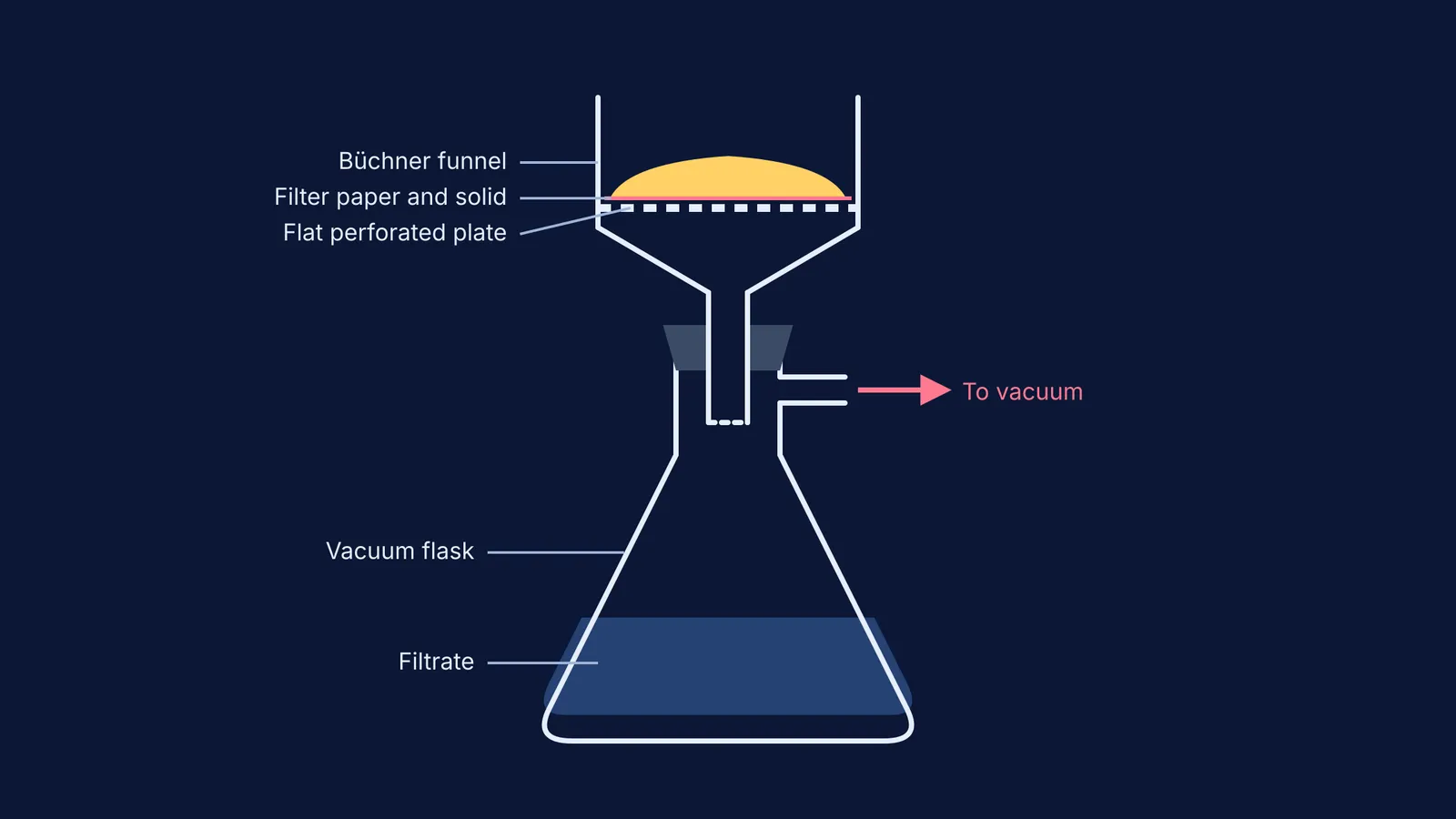
Ernst managed his family's chemical manufacturing business. In 1888, he published the patent for his two most famous inventions: the Büchner funnel and its accompanying thick-walled vacuum flask. His design featured a cylindrical upper body and a flat, perforated plate that supported a circular piece of filter paper.
This flat plate was a significant upgrade. Büchner built upon an earlier design by Robert Hirsch, whose Hirsch funnel had sloped walls and a much smaller perforated base, making it suitable only for tiny quantities of material.
Did Eduard Buchner invent the Büchner funnel?
Because the funnel is so ubiquitous in organic chemistry, students and even experienced scientists frequently misattribute its invention to Eduard Buchner (often spelled without the umlaut).
Eduard Buchner was a highly celebrated German chemist who won the 1907 Nobel Prize in Chemistry for discovering cell-free fermentation. While Eduard's work broke new ground in biochemistry, he had nothing to do with the laboratory glassware that bears a nearly identical name. The robust porcelain funnel belongs entirely to Ernst Büchner, the industrial chemist who was looking for a faster way to separate batches of crystals.
How does vacuum filtration work?
A Büchner funnel is designed to withstand a vacuum. Unlike gravity filtration, which relies on the weight of the liquid, vacuum filtration uses a pressure gradient to force liquid through the barrier.
The funnel is inserted into a Büchner flask (a conical flask with a side-arm) using a rubber bung to create an airtight seal.
A piece of filter paper is placed flat over the perforated plate and moistened with a few drops of the solvent.
A vacuum source, such as a water aspirator or a mechanical pump, is connected to the flask's side-arm.
As the vacuum lowers the pressure inside the flask, atmospheric pressure pushes the mixture rapidly through the filter paper.
This process pulls the liquid into the flask as filtrate and leaves a firmly packed, dry cake of solid crystals on the paper.
If you are working through the stoichiometry of a precipitation reaction and find yourself confused by the percentage yield, the Fermi Problem Library has a step-by-step solver that explains the reasoning behind each calculation. By walking you through the moles and limiting reagents rather than just printing an answer, it helps you spot where a calculation went wrong.
Tips for the chemistry lab
When using Ernst Büchner's invention in your practicals, keep these safety and technique points in mind:
Always clamp the flask: The heavy porcelain funnel makes the setup top-heavy, and the thick rubber vacuum hose will easily pull an unclamped flask over.
Break the vacuum first: When you finish filtering, disconnect the hose from the side-arm before turning off the vacuum pump. If you turn off a water aspirator while the system is closed, water can be drawn backwards into your clean filtrate.
Match the paper size: The filter paper must cover all the holes on the perforated plate but must not creep up the vertical walls, which would allow solid particles to bypass the paper.
Mastering this simple piece of 19th-century equipment will save you a great deal of laboratory time and improve the purity of your recrystallised compounds.


