

On this page
Emmy Noether (1882–1935) moved mathematics away from long calculations and towards the study of underlying structures 1. Often called the mother of modern algebra, she shifted the mathematical focus from solving specific polynomial equations to understanding the broad spaces where those numbers live.
Her 1921 paper, *Idealtheorie in Ringbereichen* (Theory of Ideals in Ring Domains), is a landmark that fundamentally reshaped abstract algebra 1. By introducing powerful finiteness conditions, she changed how mathematicians think about equations, geometry, and number systems.
What is ring theory in abstract algebra?
In mathematics, a ring is an algebraic structure consisting of a set equipped with two binary operations—addition and multiplication—where multiplication distributes over addition 2).
The integers form a ring, and so do polynomials and matrices. Each of these rings has different specific rules (for instance, matrix multiplication depends on order, while integer multiplication does not). Instead of solving a single polynomial equation in one specific system, Noether looked at the patterns that hold true across all these different spaces.
This conceptual approach is why the Fermi Concept Library places every concept in mathematics within its broader map, each with its own lesson, rather than teaching isolated tricks. You understand the whole structure before you memorize the parts.
What are ideals and the ascending chain condition?
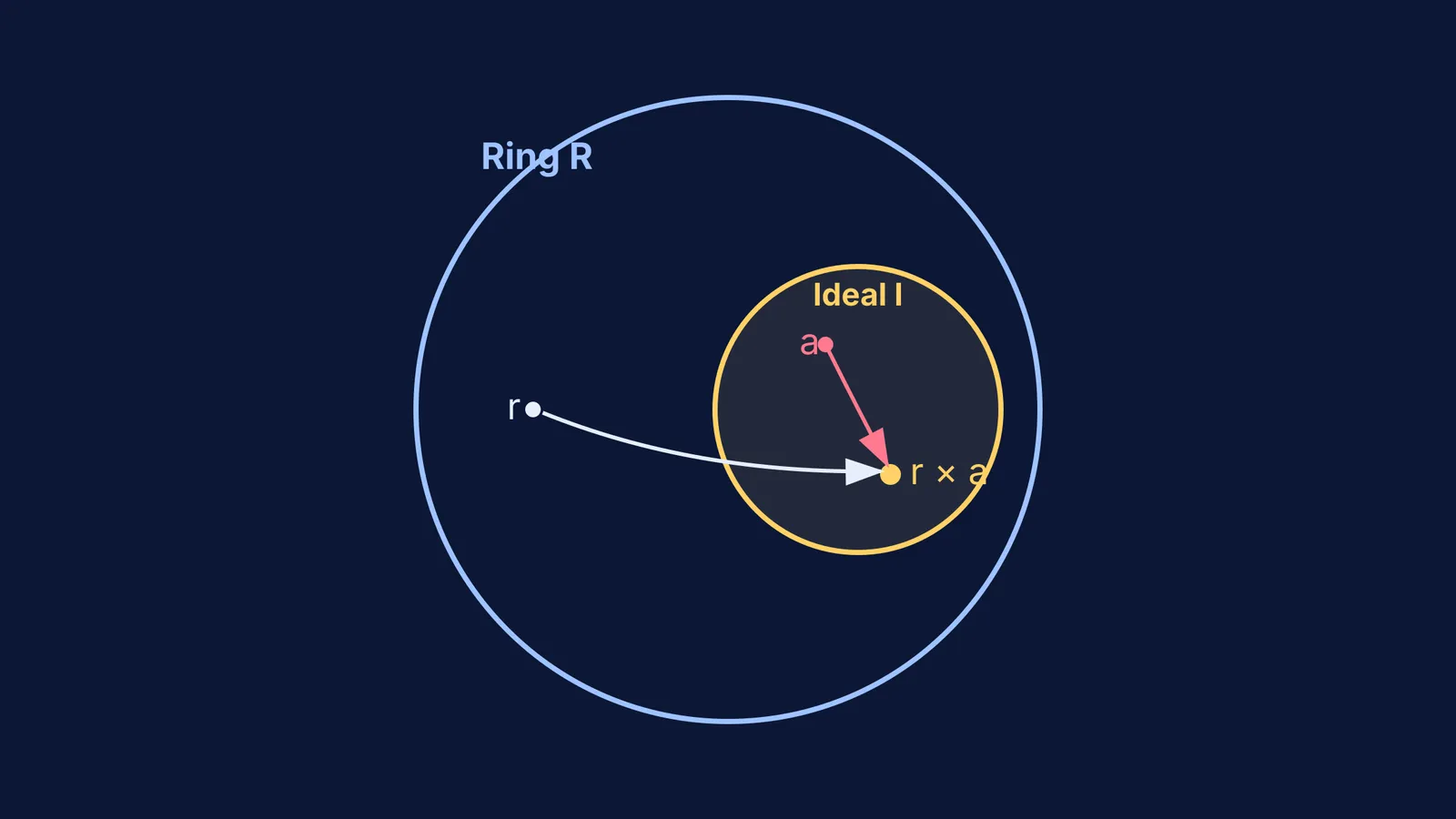
An ideal is a special subset of a ring that absorbs multiplication by any element from the outside ring 3). For example, the even numbers form an ideal within the ring of integers: if you multiply any integer by an even number, the result is always even 3).
Noether defined a property called the ascending chain condition (ACC) for ideals 2). It states that every strictly increasing sequence of ideals must eventually terminate—it cannot grow forever 2). If you have an ideal I₁ contained in I₂, which is contained in I₃, the chain must eventually stop at some Iₙ 1. Rings that meet this condition are now called Noetherian rings 2).
By using this single condition, she proved the Lasker–Noether theorem, showing that every ideal in a Noetherian ring can be decomposed into a finite intersection of primary ideals 1. This generalized earlier work on polynomial rings by Emanuel Lasker, giving mathematicians a tool as fundamental as prime factorization, but for entire abstract structures 1.
How did Noether change the teaching of algebra?
Noether developed her ideas despite facing intense institutional barriers. When she arrived at the University of Göttingen in 1915, the faculty blocked her right to teach, arguing that returning soldiers should not be taught by a woman 1. She worked as an unpaid lecturer under David Hilbert's name until 1919, and only received a small salary starting in 1923 1.
Despite this, she was a legendary teacher. She often ignored formal lesson plans, using her lectures to think through new mathematical problems live at the board 1. Her devoted circle of students, affectionately known as the "Noether Boys," included mathematicians like B.L. van der Waerden and Max Deuring 1. Van der Waerden's 1931 textbook, *Moderne Algebra*, was heavily based on Noether's lectures and helped spread her structural approach worldwide 1.
In 1933, the Nazi government dismissed her from Göttingen due to her Jewish heritage 1. She emigrated to the United States to teach at Bryn Mawr College, leaving behind a European mathematical community that had been permanently altered by her ideas 1.
How to study mathematics conceptually?
Before Noether, mathematics was largely calculational. Her shift to "conceptual mathematics" (*Begriffliche Mathematik*) prioritized universal concepts over specific, cumbersome calculations 1.
Students today face the same choice: memorize dozens of different formulas, or learn the handful of structures that generate them all. When you study a new idea, such as the epsilon-delta definition of a limit or logic algebra, you can use the "Noether Method" to find its structure.
Ask yourself three questions:
What are the elements? (Are you working with numbers, matrices, or functions?)
What operations are allowed? (Can you add them? Multiply them?)
What rules do those operations follow? (Does order matter? Is there a zero element?)
When you get stuck on a calculation, stepping back to see this overarching structure often reveals the path forward. If you are not sure where to start, the Fermi Problem Library has worked problems with a step-by-step solver that explains the reasoning rather than printing an answer. Just like Noether's approach, it focuses on why the math works, not just what the final number is.
Her legacy lives on in the Noetherian structures that form the backbone of modern abstract algebra, proving that the most powerful tool in mathematics is often a change in perspective.


