

On this page
The year is 1887. Thomas Edison's phonograph has been capturing sound on wax cylinders for a decade. The machine works, but copying those cylinders is slow and painful. Enter Emile Berliner, a German-born inventor working in the United States. On 8 November 1887, Berliner received U.S. Patent 372,786 for a machine he called the gramophone. He abandoned Edison's 3D tube, flattened the recording surface into a disc, and changed how the needle dug into the groove. That physical change—from a vertical cut to a lateral cut—is why you still know what a record looks like today, and why the gramophone laid the foundation for the modern music industry.
What is a lateral cut record?
Edison's phonograph used vertical recording. The recording stylus moved up and down into the soft wax, digging a deeper groove for louder sounds and a shallower one for quiet moments. This "hill-and-dale" method had a significant physical flaw: if a sound was too loud, the steep upward kick could launch the needle entirely out of the groove. It required careful handling and restricted the dynamic range of the recording.
Berliner's gramophone used a lateral cut. The depth of the groove stayed exactly the same, and the stylus wiggled from side to side to trace the sound wave. Because the needle was physically locked between two walls of uniform height, it was much harder to knock it off track. This side-to-side motion occurred parallel to the surface of the record, meaning the stylus could make wide swings for loud sounds without ever leaving the groove. It was a more robust physical system that could withstand heavier, cheaper steel needles.
Why did the flat disc beat the cylinder?
If you only look at the physics of speed, Edison's cylinder was actually the superior format. A cylinder has constant linear velocity. Because a cylinder is a uniform tube, the surface moves under the needle at the exact same speed from the start of a recording to the very end. This delivers uniform, consistent audio quality.
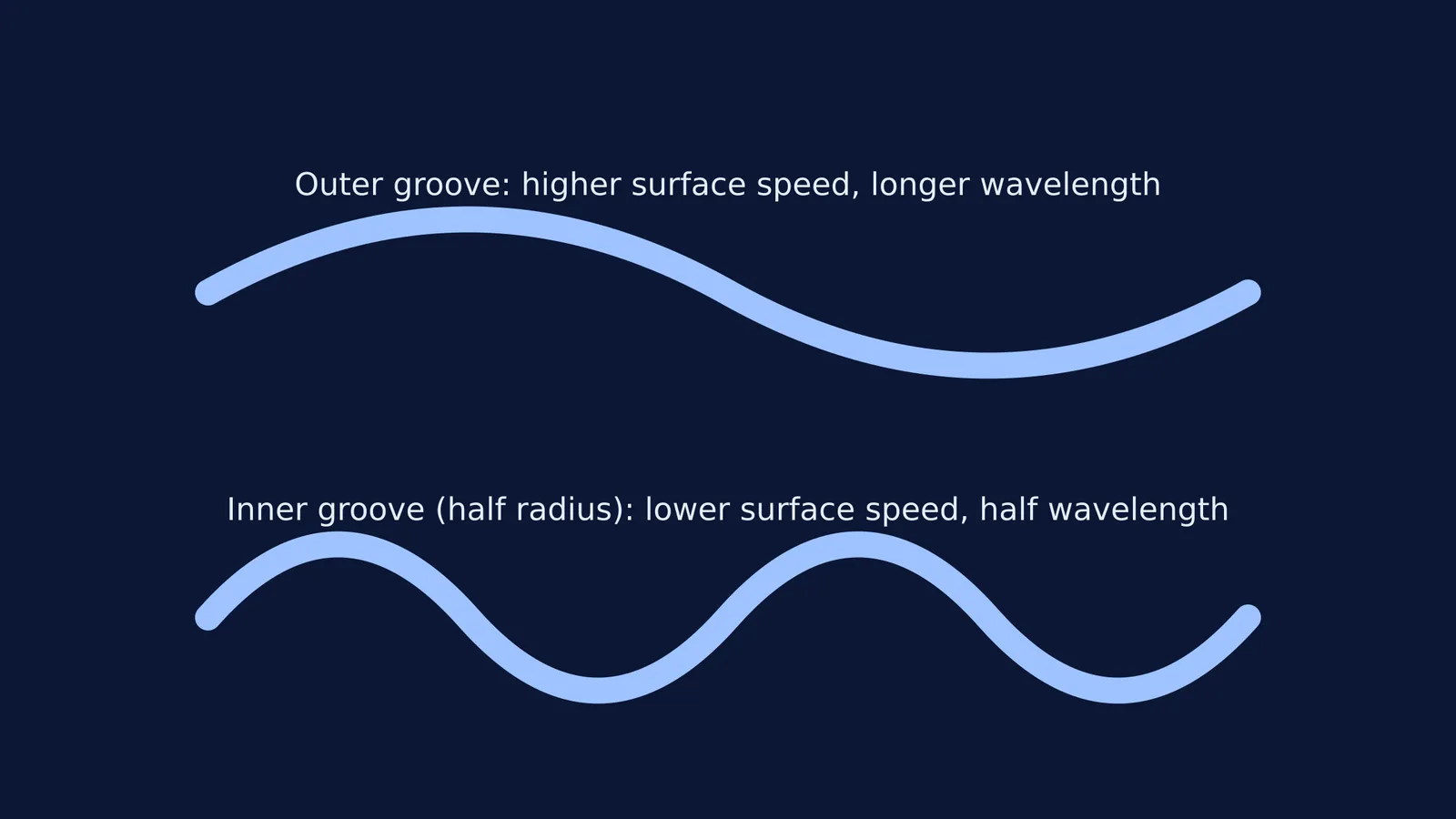
A flat disc, however, has constant angular velocity. The entire disc spins at a fixed rate. As the needle spirals towards the centre, the circumference of each track gets smaller, so the actual surface speed drops. High-frequency sound waves get crowded closely together near the label in a phenomenon known as inner-groove distortion.
But the disc won the format war because of its manufacturing scalability. Edison's fragile cylinders initially had to be copied one by one, or moulded in a fragile, complicated mechanical process. Berliner's flat disc was designed from the beginning for mass production. You could take one hard metal master disc and use it as a negative to stamp mass-produced identical copies out of durable materials like hard rubber or shellac. It was the printing press for sound.
What does the gramophone teach us about exam prep?
When you revise for a high-stakes exam like JEE or NEET, you can approach your learning like an Edison cylinder or a Berliner disc.
The cylinder method is fragile and hard to reproduce. You custom-build your understanding for every single homework question without looking for the deeper pattern. When you review for a mock test, you find yourself reading the whole textbook again from scratch because your notes are disjointed. It takes a lot of time and energy to replicate your effort, and the knowledge degrades quickly under pressure.
The disc method is about building a master matrix. Instead of memorising many separate mechanics questions, you do the hard work once to build a robust framework—a single, clear map of Newton's laws or a deep understanding of a core chemical mechanism. Once you have that master framework, you can quickly and reliably stamp it onto many new problems. This approach to durable, reusable knowledge is the foundation of effective revision, matching the findings discussed in Ten study techniques rated: inside the 2013 Dunlosky review.
How do you build your master framework?
It is tempting to look up the final answer when you are stuck on a difficult maths or physics problem. But a simple final answer is like a single wax cylinder: it only plays one tune, and it will not help you when the exam asks the same question in a slightly different way.
When you use Fermi's AI tutor, it helps you build your own master disc. The tutor does not just print a final answer for you to copy. Instead, it works out what you already know, holds a line of reasoning, and notices exactly where you missed a step. By helping you construct the underlying principle, you walk away with a mental framework you can stamp onto the rest of your problem set. If you are struggling with a specific type of question, the Fermi Problem Library provides worked problems with a step-by-step solver that explains the reasoning rather than printing an answer. Building those durable, reusable patterns in your mind is how you actually prepare for exam day, connecting to the principles explored in David Ausubel: why what you already know shapes what you learn.


