

On this page
Before digital computers processed bytes, 19th-century telegraph networks faced a crucial data problem: how to send language through copper wires quickly and reliably. Early systems relied on Morse code, which represented letters with variable-length sequences of dots and dashes. While effective for manual signaling, Morse code proved clumsy for machines. Operators required intensive training, manual transcription was strictly limited by human dexterity and acoustic decoding, and automated decoding was thwarted by variable element lengths. Earlier, Charles Wheatstone, the telegraph and the bridge named after him introduced needle telegraphs to ease readout, but lines remained bottlenecked by human speed.
What was Émile Baudot's five-unit telegraph code?
Born in Magneux, France, in 1845, Jean-Maurice-Émile Baudot joined the French Post and Telegraph Administration in 1869 as an apprentice. Baudot recognized that the true transmission bottleneck was the variable duration of Morse characters. On June 17, 1874, he patented his "Système de télégraphie rapide" (French Patent No. 103,898), introducing a fixed five-unit binary code.
Instead of irregular dots and dashes, Baudot encoded every character as five equal-duration electrical pulses. Five binary units yield 2⁵ = 32 distinct permutations. Because 26 letters left only six codes for numerals and punctuation, Baudot introduced two control codes: Letter Shift (LTRS) and Figure Shift (FIGS). Sending FIGS instructed the receiving mechanism to print numerals and punctuation, while LTRS restored letter printing. This doubled capacity to roughly 60 characters without adding pulses. Decades before ASCII, ISCII and Unicode for CBSE Class 11 standardized 7-bit and 8-bit text, Baudot had built the first practical digital code.
How did Baudot's rotating distributor multiply line capacity?
Baudot's system combined a five-key chorded keyboard with a rotating distributor. As documented in the Baudot Telegraph System in the *IETE Journal of Education*, the operator used two keys for the left hand and three for the right, striking combinations like piano chords. Depressed keys locked mechanically until sampled. An audible click, called the cadence signal, sounded at regular intervals to prompt the operator's next chord.
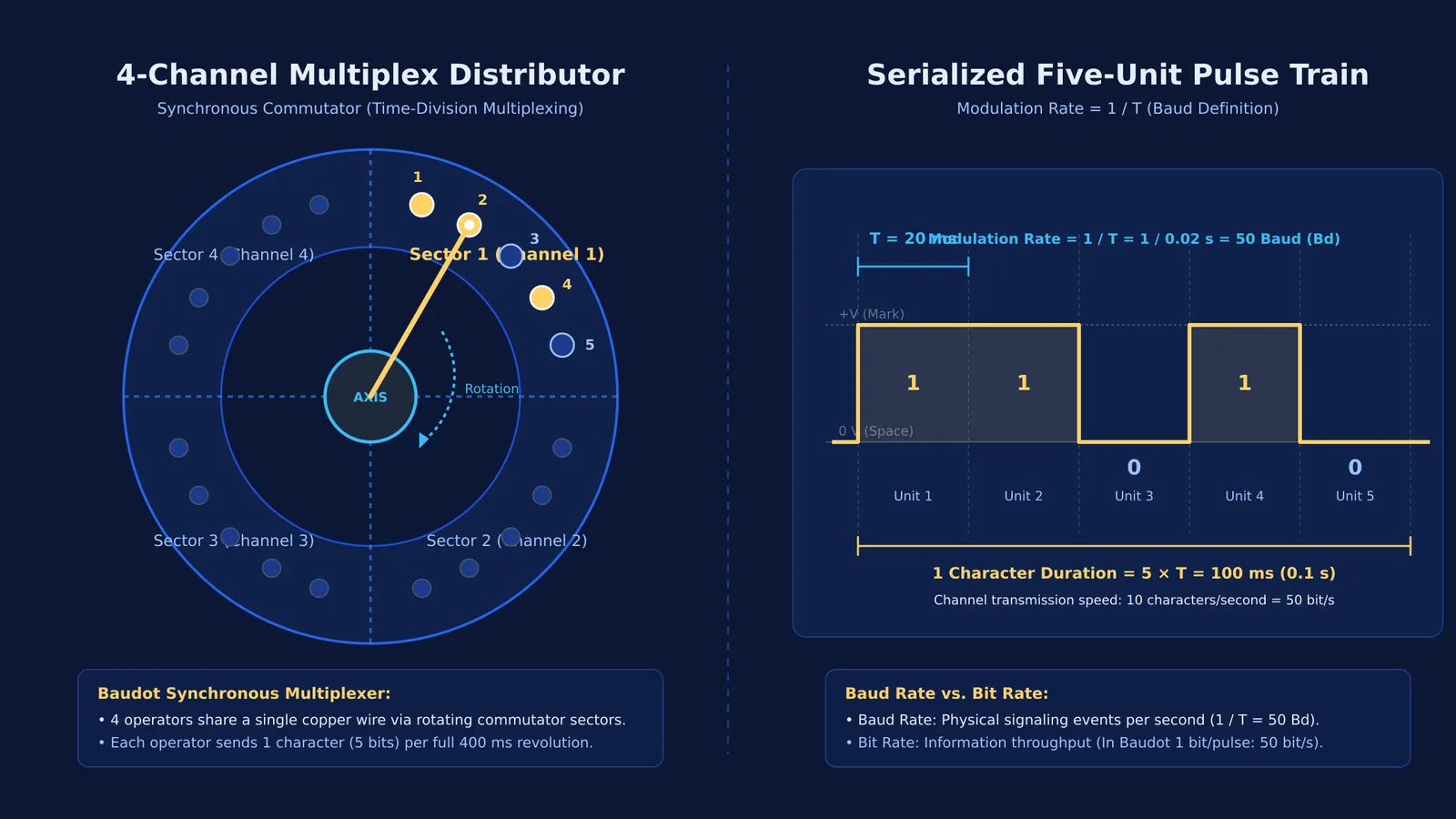
The central innovation was time-division multiplexing (TDM) using a synchronized rotating commutator wheel. A revolving brush swept across conductive rings divided into sectors, with each sector linked to one operator's keyboard.
As the brush wiped a sector, it serialized five locked key contacts into five consecutive pulses down the line. Interleaving sectors enabled four to six operators to share a single wire. At the receiver, an identical distributor turned at matching speed, routing pulses to electromechanical print wheels that stamped text onto paper tape at roughly 30 words per minute per channel.
What is the difference between baud rate and bit rate?
In November 1926, the International Telegraph Consultative Committee (CCIT) met in Berlin and named the unit of modulation rate the baud (symbol: Bd) in Baudot's honour. According to ITU-T Recommendation R.140, the baud equals the reciprocal of the duration of the shortest signaling element: Modulation Rate = 1 / T Bd, where T is the unit interval in seconds.
International standards such as NIST Special Publication 811 and ISO/IEC 80000-13 separate signaling rate from data rate:
Baud rate (symbol rate): The number of physical signaling transitions or pulse intervals per second.
Bit rate: The number of information bits transmitted per second.
When each signal element represents one binary bit (as in Baudot's direct-current pulses), baud rate equals bit rate: 50 Bd conveys 50 bits per second. In modern multi-level signaling, each symbol carries several bits. For instance, PAM-4 encodes 2 bits per symbol, so 100 Bd yields 200 bits per second. Long before Claude Shannon and how to measure information in bits defined channel capacity, Baudot showed that speed depends on shortest element duration.
How do you calculate telegraph transmission parameters?
To evaluate throughput on a 4-channel Baudot multiplex circuit using the standard unit pulse duration T = 20 ms (0.02 seconds) defined under ITU-T Recommendation R.140:
Signaling rate: Modulation rate = 1 / T = 1 / 0.02 s = 50 Bd.
Character duration: Each 5-unit character takes 5 × 20 ms = 100 ms (0.1 seconds).
Multiplex frame: Allocating 100 ms to each of the 4 operators completes a distributor rotation in 4 × 100 ms = 400 ms.
Throughput: Each operator transmits 2.5 characters per second (150 characters per minute). At standard telegraph formatting (6 characters per word), each channel delivers 25 words per minute, yielding an aggregate line rate of 100 words per minute.
Baudot's architecture solved key limitations of Morse signaling:
Code format: Morse used variable dots, dashes, and pauses, whereas Baudot used uniform 5-pulse frames.
Line sharing: Morse restricted lines to one conversation, whereas Baudot's distributor interleaved up to six channels.
Readout: Morse required human auditory transcription, whereas Baudot drove direct typographic printing.
Connecting pulse shaping, circuits, and modulation often exposes gaps for students in physics and computing. The Fermi Concept Library covers every concept in physics, chemistry, biology, mathematics and computing, each with its own lesson and its place in the map. For practice with pulse intervals, bandwidth, and information rates, the Fermi Problem Library provides worked problems with a step-by-step solver that explains the reasoning rather than printing an answer. When visualising wave pulses and harmonics, the Fermi Simulation Lab offers interactive simulations for ideas that are easier to see than to read.


